


The key points of the "one country, two systems" policy are that within the PRC, the main body (mainland) will continue with its socialist system, while Hong Kong, Macao and Taiwan will maintain the capitalist system. The aim is to achieve peaceful reunification of the motherland and maintain stability and prosperity in Hong Kong, Macao and Taiwan. One country is the premise and basis of the two systems, and recognition of the principle means recognition of the premise of "one country" that refers to the PRC, and that the main body of the nation will maintain the socialist system with Chinese characteristics. The policy is an important component of the socialism with Chinese characteristics.
Taking into account the special status of Taiwan, the Chinese Government has pursued to solve the Taiwan issue with the basic principle of "peaceful reunification and one country, two systems." That is, after the reunification of both sides across the Taiwan Strait, Taiwan's current socio-economic system, its way of life, as well as economic and cultural ties with foreign countries will remain unchanged. As a special administrative region, Taiwan will enjoy a high degree of autonomy, including administrative and legislative powers, an independent judiciary and the right of final adjudication on the island. It will run its own party, political, military, economic and financial affairs, may conclude commercial and cultural agreements with foreign countries and enjoy certain rights in foreign affairs. It may retain its armed forces and the mainland will not dispatch troops or administrative personnel to the island. On the other hand, representatives of the government of the special administrative region and those from different circles of Taiwan may be appointed to senior posts in the Central Government and participate in the running of national affairs.
The development of Hong Kong and Macao since their return to the mainland testifies to the fact that the policy of "one country, two systems" is correct and has strong vitality.
Hong Kong Special Administrative Region
On July 1, 1997, Hong Kong returned to the mainland after 150 years of British colonial rule. It entered into a new historical era of "one country, two systems" and "Hong Kong governed by the Hong Kong people with a high degree of autonomy."
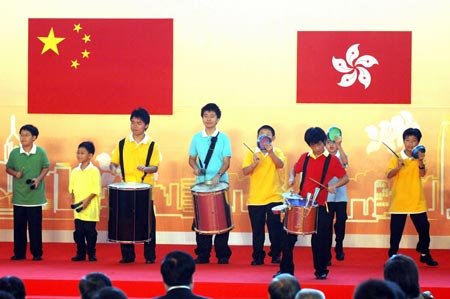 |
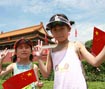
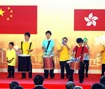
Primary school students in Hong Kong perform at a grant celebration for the ninth anniversary of Hong Kong's return to the motherland and the establishment of the Hong Kong Special Administrative Region.
In the nine years since the handover, the Central Government has supported the chief executive and the government of the Hong Kong Special Administrative Region to administer the region in accordance with the Basic Law, Hong Kong's mini-constitution, and promoted its stability and prosperity. Hong Kong continues to maintain the characteristics of a free port and its status as a center of international trade, finance and shipping.
According to statistics provided by the local government, Hong Kong's gross domestic product volume reached HK$1.4723 trillion in 2006, up 6.5 percent over the previous year. As of the end of 2006, total population of the region stood at 6.8571 million, a year-on-year increase of 0.6 percent. Its total employment hit a record high of 3.4527 million, with the unemployment rate down from 8.6 percent in 2003 to 4.4 percent at the end of 2006--the lowest in four years. Its total import and export volume (including transit trade) saw an increase of 10.5 percent year on year in 2006, amounting to HK$5.0608. At the end of 2006, Hong Hong's foreign exchanges reserves were $133.2 billion.
The sector of banking, insurance, real estate and business services led other industries in the growth rate, growing 13.4 percent year on year. The sector of wholesale, retail, import and export trades and catering and accommodation came next with an annual increase of 10 percent.
Tourism is a pillar industry in Hong Kong, which ranks seventh place on the list of the world's most visited destinations. In 2006, it received more than 25.251 million inbound tourists, an increase of 8.1 percent over the previous year.
The robust economic growth greatly boosted the strength of the local government. Due to the sound economic performance, growing corporate profits and household wage income, a bullish capital market and a stable property market, the revenue of the local government was higher than expected in the 2006-07 fiscal year. Its surplus in the operating account stood at HK$38.6 billion, while that in the consolidated account reached HK$55.1 billion. By March 31, 2006, Hong Kong's balance of fiscal reserves came to HK$310.7 billion.
The support the Central Government renders to Hong Kong is an important guarantee of economic recovery and development in the region. The development in Hong Kong since its return testifies to the correctness of the policy of "one country, two systems," shows that the Basic Law conforms to the reality of the region and is an important guarantee of its prosperity and stability, and that the people of Hong Kong are fully capable of administering Hong Kong well.
Macao Special Administrative Region
Macao, a part of the Chinese territory since ancient times, fell into the hands of Portuguese colonialists in the late 19th century. It returned to the motherland on December 20, 1999.
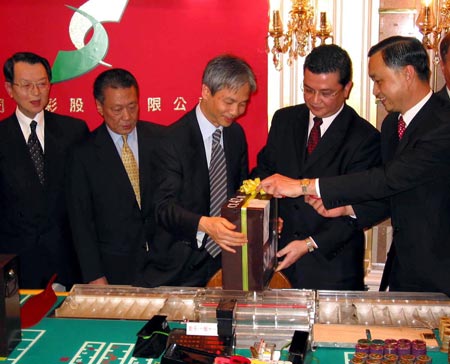 |
The gaming industry is one of Macao's economic pillars. Pictured are officials of Macao Special Administrative Region launching a lottery game.
Since its return, the Central Government has supported the chief executive and the local government to administer Macao in accordance with the region's Basic Law. Macao's total gross domestic product reached MOP92.591 billion in 2005, more than doubling the 1999 figure of MOP45 billion.
In 2006, Macao's gross domestic product grew 16.6 percent to MOP114.36 billion. The per-capita gross domestic product was MOP227,508 ($28,436).
The growth of Macao's tourism and gaming industries maintained strong momentum in 2006. Through the year, the region received a total of nearly 220 million inbound tourists, up 17.6 percent over 2005. Their total expenditures, excluding those in relation to the gaming industry, were also 17.6 percent higher than that in the previous year. The gross revenue of the gaming industry shot up 22 percent year on year.
The robust tourism and gaming industries also drove up investment and consumption in Macao. Local fixed assets investment soared 39.5 percent in 2006 over 2005, while local residents' consumption witnessed a year-on-year increase of 8.2 percent.
Thanks to the strong economic growth, the 2006 year-end assets of Macao's banking sector grew 26.5 percent on an annual basis to MOP273.8 billion.
As for external trade, Macao's exports remained steady in 2006 while its exports registered a rapid growth. Its annual export volume was MOP20.46 billion, an increase of 3.2 percent year on year, of which exports of local products rose 0.1 percent. The region's import volume hit MOP36.53 billion in 2006, up 16.6 percent over 2005. As a result, Macao had a trade deficit of nearly MOP16.07 billion. The United States and the European Union remained as Macao's top export destinations, accounting for 63.6 percent of its export volume. Asian economies were major sources of Macao's imported goods, of which the Chinese mainland and Hong Kong had a combined share of 55.3 percent in terms of import value.
Taiwan Province
Taiwan has been part of Chinese territory since ancient times. In 1945, when the Chinese won the War of Resistance Against Japanese Aggression (1937-45), compatriots across the Taiwan Strait shared the joy of Taiwan's return to the motherland. In 1949, when the People's Republic of China was founded, the world saw a China enjoying complete sovereignty and towering in the East once again. Regretfully, Taiwan could not be reunified with the mainland because of the ongoing civil war and the armed intervention of foreign countries. The Chinese people had to continue their struggle for reunification across the Taiwan Strait. At the end of the 20th century, China made great progress in its reform and opening-up drive. Hong Kong and Macao successively returned to the motherland, ending the history of Western powers occupying Chinese territory. Chinese compatriots at home and abroad have since become even more concerned about the early settlement of the Taiwan issue and the complete reunification of the motherland.
Cross-Strait Relations
The mainland's stance on developing cross-strait relations is consistent, firm and clear. This stance is to unswervingly adhere to the one-China principle; never give up efforts for peaceful reunification, nor change the principle of pinning hope on the Taiwan people; and never compromise on opposition to secessionist activities. Deliberate provocation by the Taiwan leader will not change the solemn commitment to utmost efforts to do everything that is conducive to the interests of Taiwan compatriots, cross-strait exchanges, peace across the Taiwan Strait and peaceful reunification of the motherland.
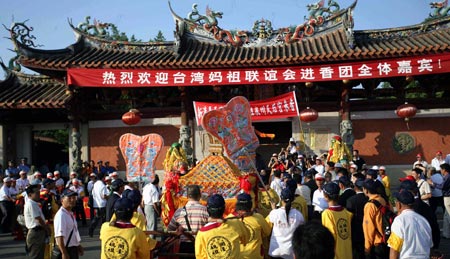 |
Compatriots on both sides of the Taiwan Strait are limbs of the same ancestry. Pictured is a pilgrimage by Taiwanese worshippers of the maritime goddess Mazu to her natal home in Fujian Province on the mainland.
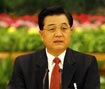
When meeting with Lien Chan, visiting Honorary Chairman of the Chinese Kuomintang, in Beijing on April 16, 2006, Hu Jintao, General Secretary of the CPC Central Committee, stressed that peace, development and cooperation are the themes of the times. Under such circumstances, he said, people across the Taiwan Strait should examine and handle relations between the two sides from a new height and try every possible means to maintain peace and stability in the Taiwan Strait, promote bilateral cooperation and struggle for the peace and interests of people on both sides of the strait.
Hu called on compatriots across the Taiwan Strait to join hands in promoting the development of bilateral relations in the direction of peace and stability, enhance fraternity and deepen cooperation, so as to create a new situation in cross-strait ties and realize the great rejuvenation of the Chinese nation.
The CPC chief also put forward four proposals on peaceful development of cross-strait relations: First, adherence to the "1992 consensus" is an important basis for peaceful development of cross-strait relations; second, maximization of interests for people across the Taiwan Strait is the ultimate goal of peaceful development of bilateral relations; third, a mutually complementary and beneficial relationship is the effective way for realizing peaceful development across the strait; and fourth, equal consultation is the only way to achieve peaceful development of cross-strait relations.
The agreement signed between the mainland and Taiwan in 2006 to expand chartered flight cooperation was welcomed by the island's residents. On June 14, 2006, aviation organizations from both sides of the Taiwan Strait reached a consensus on the framework of chartered flights for traditional festivals and special cases. According to the agreement, chartered flights will be arranged during Qingming, or the Tomb-sweeping Festival, the Dragon Boat Festival and the Mid-autumn Festival, in addition to the Chinese lunar New Year season, following the operational model of Spring Festival chartered flights in 2006. The two sides also agreed to open chartered flights for emergent medical rescue, first aid for the handicapped and chartered cargo flights for special need on a case-by-case basis. The first direct cargo chartered flight from Taiwan, a Boeing 747-400 from China Airlines, Taiwan's largest air carrier, landed in Shanghai's Pudong International Airport at 0:33 a.m. on July 20, 2006.
Spring Festival Chartered Flights
The 2007 Spring Festival chartered flights started on February 13 and ended on February 26. A total of 96 round-trip direct chartered flights to connect mainland cities of Shanghai, Beijing, Guangzhou and Xiamen with Taipei and Kaohsiung in Taiwan were made, involving mainland carriers of Air China, China Eastern Airlines, China Southern Airlines, Hainan Airlines, Shanghai Airlines and Xiamen Airlines, as well as air companies in the island including Far Eastern Air Transport Co., China Airlines, Mandarin Airlines, UNI Air, Eva Air and Trans Asia Airways. Passengers aboard the flights totaled 34,303, carrying 34,627 luggage items weighing 531,096 kg. The number of flights, number of passengers and number and weight of luggage items rose 33.3 percent, 25.8 percent, 14.6 percent and 27.7 percent compared with corresponding figures of the previous year, respectively.
Despite the remarkable increase in the number of flights, they were still short of demand. Carriers from both sides of the Taiwan Strait and a large number of Taiwan business people have therefore called for the launch of chartered flights at weekends or on a regular basis and the realization of direct cross-strait air services as soon as possible.