REPORT ON THE IMPLEMENTATION OF THE CENTRAL AND LOCAL BUDGETS FOR 2008 AND ON THE DRAFT CENTRAL AND LOCAL BUDGETS FOR 2009
Second Session of the Eleventh National People's Congress
March 5, 2009
Ministry of Finance of the People's Republic of China
Fellow Deputies,
The Ministry of Finance has been entrusted by the State Council to report on the implementation of the central and local budgets for 2008 and submit the draft central and local budgets for 2009 for your deliberation and approval, and also for comments and suggestions from the members of the National Committee of the Chinese People's Political Consultative Conference (CPPCC).
I. Implementation of the Central and Local Budgets for 2008
II. Draft Central and Local Budgets for 2009
III. Managing Public Finance in Accordance with the Law and Making Management More Scientific to Ensure Successful Implementation of the 2009 Budgets
I. Implementation of the Central and Local Budgets for 2008
In the face of the grim and complex situations at home and abroad, the people of all our ethnic groups under the correct leadership of the Communist Party of China and the guidance of Deng Xiaoping Theory and the important thought of Three Represents, thoroughly applied the Scientific Outlook on Development and comprehensively implemented the principles and policies of the central leadership and the decisions and resolutions of the First Session of the Eleventh National People's Congress (NPC) in 2008. As a result, we made major continued achievements in reform, opening up and socialist modernization. The central and local budgets were satisfactorily implemented and fresh progress was made in reform and development of the public finance system.
National revenue reached 6.13169 trillion yuan, an increase of 999.512 billion yuan or 19.5% over 2007 (both here and below), equivalent to 104.8% of the target. This consists of 3.267199 trillion yuan collected by the central government and 2.864491 trillion yuan collected by local governments. Added to the 110 billion yuan taken from the central budget stabilization fund, total revenue came to 6.24169 trillion yuan. National expenditures amounted to 6.242703 trillion yuan, an increase of 1.264568 trillion yuan or 25.4%, equivalent to 101.7% of the target. This figure consists of 1.337431 trillion yuan used by the central government and 4.905272 trillion yuan used by local governments. Added to the 19.2 billion yuan set aside for the central budget stabilization fund, total expenditures amounted to 6.261903 trillion yuan.
Revenue in the central budget totaled 3.361192 trillion yuan, an increase of 499.997 billion yuan or 17.5%, equivalent to 103.3% of the target. This consists of 3.267199 trillion yuan directly collected by the central government and 93.993 billion yuan turned over by local governments. Added to the 110 billion yuan from the central budget stabilization fund, total revenue came to 3.471192 trillion yuan. Expenditures in the central budget totaled 3.631992 trillion yuan, an increase of 673.997 billion yuan or 22.8%, equivalent to 102.5% of the target. This figure consists of 1.337431 trillion yuan used by the central government and 2.294561 trillion yuan in tax rebates and transfer payments to local governments. A total of 19.2 billion yuan was set aside for the central budget stabilization fund. Total expenditures thus added up to 3.651192 trillion yuan. Expenditures exceeded revenue, leaving a deficit of 180 billion yuan, which was within the target approved at the First Session of the Eleventh NPC. The outstanding balance of government bonds in the central budget at the end of 2008 totaled 5.327076 trillion yuan, which was under the set limit of 5.518585 trillion yuan.
The central government's tax rebates and transfer payments to local governments. The central government turned over 2.294561 trillion yuan in tax rebates and transfer payments to local governments in 2008, an increase of 480.772 billion yuan or 26.5%, representing 106.1% of the target. This total consists of 428.219 billion yuan in tax rebates, up 3.9%, 869.649 billion yuan in fiscal transfer payments including general transfer payments, a 22% increase, and 996.693 billion yuan in special transfer payments, a 44.6% increase. The large increase in this last item was mainly due to the huge increase in expenditures required to subsidize key local programs such as education and medical and health care. Tax rebates and transfer payments turned over to local governments became part of the revenue of local governments, which made arrangements for their utilization. Transfer payments from the central government accounted for an average of 38% of local government spending nationwide and 54.4% in the central and western regions.
Figure 1
Central Government Revenue and Expenditures in 2008

Revenue of local governments totaled 5.159052 trillion yuan, an increase of 988.001 billion yuan or 23.7%, equivalent to 106.4% of the target. This consists of 2.864491 trillion yuan collected by local governments and 2.294561 trillion yuan in tax rebates and transfer payments from the central government. Local government expenditures totaled 4.999265 trillion yuan, an increase of 1.079057 trillion yuan or 27.5%, equivalent to 103.1% of the target. This total consists of 4.905272 trillion yuan spent by local governments and 93.993 billion yuan turned over to the central government. Revenue exceeded expenditures, leaving a surplus of 159.787 billion yuan, which mainly came from the surplus revenue in the central and local budgets that was not spent and will be rolled over into local budgets this year.
Figure 2
Local Government Revenue and Expenditures in 2008

In addition, revenue from government-controlled funds nationwide totaled 1.563635 trillion yuan, an increase of 446.72 billion yuan or 40%. Expenditures from these funds came to 1.49847 trillion yuan, representing an increase of 530.026 billion yuan or 54.7%.
Revenue from the funds controlled by the central government reached 252.566 billion yuan, an increase of 78%. This large increase was mainly attributable to profits from the sale of lottery tickets coming under budgetary control and strong growth in revenue from the foreign exchange funds controlled by the central government. Total revenue includes 20.259 billion yuan from the fund for developing the Three Gorges Project, 55.504 billion yuan from the fund for developing railways, 9.621 billion yuan from civilian airport administration and development fees, 9.148 billion yuan from port development fees, 14.87 billion yuan from the fund for providing continuing aid to residents relocated to make way for the construction of large and medium-sized reservoirs, 34.814 billion yuan in profits from the sale of lottery tickets, and 68.491 billion yuan from operations of the foreign exchange funds controlled by the central government. Added to the 55.987 billion yuan from 2007, total revenue came to 308.553 billion yuan. Expenditures by the central government from funds under its control totaled 205.672 billion yuan, an increase of 94.5%. This includes 20.456 billion yuan from the fund for developing the Three Gorges Project, 62.1 billion yuan from the fund for developing railways, 5.313 billion yuan from civilian airport administration and development fees, 10.185 billion yuan from port development fees, 20.547 billion yuan taken from profits from the sale of lottery tickets to support social welfare programs, sports, education and other public service programs, and 68.287 billion yuan from operations of the central government foreign exchange fund. Added to the 46.489 billion yuan in subsidies for local governments from the fund for providing continuing aid to residents relocated to make way for the construction of large and medium-sized reservoirs and the 56.392 billion yuan rolled over into this year, total expenditures amounted to 308.553 billion yuan.
Revenue from funds controlled by local governments reached 1.311069 trillion yuan, up 34.5%. This huge increase was mainly the result of the incorporation of all the income from the transfer of land-use rights into local budgets. Total revenue includes 1.037528 trillion yuan from the transfer of land-use rights and compensation for the use of new land for construction and 118.488 billion yuan from road maintenance fees. Total expenditures by local governments taken from the funds they control increased by 49.9% to reach 1.292798 trillion yuan. This figure includes 1.01725 trillion yuan in land-related expenditures which consists of 377.815 billion yuan as compensation for land requisition, housing demolition and resident relocation and subsidy grants to farmers for land expropriations, a large increase of 113% primarily attributable to the widespread increase in the level of compensation paid to farmers dispossessed of their land; and 128.622 billion yuan for developing and protecting farmland; 14.165 billion yuan for building low-rent housing; 36.988 billion yuan for developing rural infrastructure and developing and protecting primary farmland; 303.532 billion yuan for promoting urban development; and 156.128 billion yuan generated from the transfer of the land-use rights of bankrupt state-owned enterprises and those converted into joint stock companies and used to provide for their laid-off employees. A total of 117.344 billion yuan was spent in financing road maintenance.
Revenue from government-controlled funds was used exclusively for its intended purposes. The discrepancy between revenue and expenditures from these funds in 2008 arose primarily as a consequence of the requirement to roll over a portion of this revenue into this year in accordance with the measures for managing these funds.
Following is an overview of budget implementation and financial work in 2008:
1. Budgetary revenue growth and use of surplus revenue
Thanks to intensified efforts in revenue collection and management by tax, customs and public finance departments in addition to economic development, overall revenue growth was fairly rapid, though growth in the second half of the year was noticeably more sluggish. Thanks to rapid economic growth and good corporate performance in the first half of the year, plus special factors such as the 2007 surge in corporate profits, increase in corporate income tax receipts and the effect of tax policy adjustments, national revenue grew by 33.3%. None of these special factors were present in the second half of the year. Due mainly to the impact of the global financial crisis, economic growth slowed and corporate profits weakened. Following a big cut in the corporate income tax rate in 2008, a series of policies to reduce or exempt taxes and fees were introduced to strengthen and improve macro-control through management of public finance and promote steady and rapid economic growth. This led to the slower growth in national revenue. National revenue grew by 5.2% in the second half of the year, while revenue collected by the central government dropped by 0.9%.
Main revenue items in the central budget. Domestic VAT reached 1.349742 trillion yuan, up 16.3% and equivalent to 100.7% of the target. Domestic sales tax reached 256.78 billion yuan, a rise of 16.4% and equivalent to 104% of the target. VAT and sales tax on imports amounted to 739.107 billion yuan, up 20.1% and equivalent to 107.8% of the target. VAT and sales tax rebates for exports totaled 586.59 billion yuan, up 4.1% and equivalent to 102% of the target, which represents a decrease in revenue by the same amount. Business tax totaled 23.21 billion yuan, an increase of 14.5% and equivalent to 103.2% of the target. Corporate income tax registered 717.34 billion yuan, a rise of 27% and equivalent to 111.6% of the target, with the high increase mainly due to the large increase in corporate income tax in 2007. Individual income tax reached 223.418 billion yuan, up 16.9% and equivalent to 110.1% of the target, with the large increase mainly due to the growth of per capita disposable income for urban residents and improved collection and management. The securities transaction stamp tax reached 94.968 billion yuan, down 51.2% and equivalent to 48.8% of the target, with the shortfall due to a large decline in revenue triggered by the sluggish stock market, the reduction of the securities transaction stamp tax rate and the scrapping of the stamp tax on stock purchases. Tariffs hit 176.995 billion yuan, an increase of 23.6% and equivalent to 110.6% of the target, mainly due to the rapid growth of general imports. Non-tax revenue hit 170.451 billion yuan, up 23.6% and equivalent to 118.4% of the target, with the high increase mainly due to the increase in fees for mineral prospecting and mining rights and resource consumption charges as well as mineral resource compensation fees following reform of the system for paid use of resources.
Figure 3
Central Government Revenue in 2008
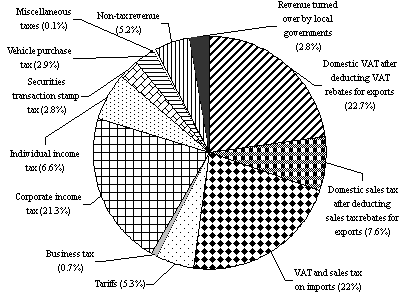
The use of surplus revenue. National revenue exceeded the budget target by 283.09 billion yuan, including a 108.02 billion yuan surplus in the central budget. The main reasons for the surplus are as follows: increases in real terms in economic indexes directly related to tax revenue, including the value-added of industry and commerce, total fixed asset investment, total volume of imports and exports and total retail sales of commodities, exceeded the projected figures. In addition, the increase in corporate income tax added to national revenue by a large margin due to the considerable increase in corporate profits in 2007. Surplus revenue in the central budget was used in the following areas in accordance with relevant laws and regulations as well as resolutions and decisions of the First Session of the Eleventh NPC. A total of 18.5 billion yuan was used to increase tax rebates and transfer payments to local governments. Two billion yuan was spent on education, the bulk of which went to students in the quake zone in need of special temporary assistance. Another 500 million yuan went to science and technology for independent research and development work on major scientific research equipment. Four billion yuan of surplus revenue from vehicle purchase tax receipts was transferred to the central government fund for post-earthquake recovery and reconstruction to rebuild damaged roads through expenditures from vehicle purchase tax receipts. Another 29.1 billion yuan was used to increase subsidies for agriculture, fisheries, forestry and other industries to offset the increases in the prices of refined petroleum products in June. An additional 4.7 billion yuan went to providing disaster relief, handling public emergencies and providing further relief for victims of massive natural disasters, the earthquake and the baby milk formula scandal. In response to the global financial crisis and in order to further boost domestic demand, the central government increased spending by 30 billion yuan mainly to build low-income housing and major infrastructure facilities. Finally, 19.2 billion yuan was added to the central budget stabilization fund to be incorporated into the budget in the years ahead. The State Council has reported the use of the surplus in 2008 to the Standing Committee of the Eleventh NPC.
2. Implementation of major expenditure items in the central budget
In compiling the budgets in early 2008, we implemented the relevant decisions and plans of the central leadership by improving the structure of expenditures to increase funding in key areas such as agriculture, rural areas, farmers, education, the social safety net, medical and health care, housing, independent innovation, energy and resource conservation, and protection of the ecosystem. All key expenditure items received guaranteed funding. In light of the objective requirements for economic and social development, surplus revenue and some reserve funds were primarily applied to increase spending on agriculture, education and disaster relief during the implementation of the budget (all expenditures on major items consist of funds actually spent by the central government and transfer payments granted to local governments).
1) Expenditures for agriculture, forestry and water conservancy totaled 182.174 billion yuan, an increase of 43.6% and equivalent to 125.6% of the target, with the large excess mainly due to the increase in agricultural subsidies during the implementation of the budget. A total of 16.34 billion yuan was spent to increase subsidies for planting superior crop varieties and purchasing agricultural machinery and tools, subsidize all rice producers in the country planting superior rice varieties, raise the level of subsidies for planting superior late rice varieties by more than 100%, increase acreages sown to superior wheat and corn seeds with government subsidies by 100% and 570% respectively, and extend subsidies for the purchase of agricultural machinery and tools to all agricultural counties across the country. Expenditures for developing agricultural infrastructure totaled 113.76 billion yuan and were mainly used to develop large and medium-sized reservoirs, harness major rivers, reinforce 2,505 dilapidated large and medium-sized and key small reservoirs, and provide safe drinking water for more than 48 million rural residents. A total of 12.7 billion yuan was spent for overall agricultural development to support the improvement of 1.67 million hectares of low and medium-yield farmland and increase overall grain production capacity by 2.866 million tons. The number of counties conducting soil testing to determine appropriate fertilizer formulas increased from 1,200 to 1,861. Trials to subsidize insurance premiums for crops were extended from 6 to 16 provincial-level administrative areas, and 75 million rural households are now covered. A total of 16.73 billion yuan was disbursed to alleviate poverty through development, focusing on developing infrastructure and industry in poor rural areas and providing job training for poor rural residents. The area of key public forests funded by the central government with the forest ecological conservation fund expanded to 46.67 million hectares.
2) Spending on education reached 159.854 billion yuan, a 48.5% gain and equivalent to 102.4% of the target. A total of 61.81 billion yuan went to making free compulsory education available in both urban and rural areas. We stopped collecting tuition and miscellaneous fees from all urban students receiving compulsory education starting last autumn, raised the level of funding for operating expenses for rural compulsory education, provided free textbooks required by the state to rural students receiving compulsory education, and raised the school heating subsidies for rural primary and secondary schools in northern China. A total of 5.31 billion yuan was used to step up development of new schools with improved sanitation facilities as part of the developing new countryside and construction of primary and secondary school buildings in the central and western regions and improve the living facilities in rural schools there. A total of 22.3 billion yuan was used to grant financial assistance to students from poor families at regular undergraduate institutions, vocational colleges and secondary vocational schools. Secondary vocational school students from poor urban families and rural areas received financial aid of 1,500 yuan per student a year, a policy benefiting 90% of the student population. We supported development of three groups of state-level demonstration vocational colleges totaling 100 schools, resulting in improvement in the quality of their teachers and operating conditions. A total of 43.243 billion yuan was spent to raise the quality of higher education and begin full-scale development of the third phase of the 211 Project for Higher Education.
3) Expenditures for medical and health care amounted to 82.68 billion yuan, a 24.5% growth and equivalent to 99.4% of the target. We established a new type of cooperative medical care system in all rural areas across the country, covering more than 800 million residents. We increased the number of pilot cities making basic medical insurance available to their non-working residents from 88 to 317, with the number of participating residents increasing from 42.91 million to over 100 million. The central government raised the level of financial aid to 40 yuan per person a year in the central and western regions, and granted a certain level of subsidies to the eastern region. These measures claimed expenditures totaling 27.868 billion yuan. Eight billion yuan was used to expand the basic medical insurance program for urban workers to include all retirees from state-owned enterprises subject to policy-mandated closure or bankruptcy in all localities of the country. We increased funding for public health in areas such as prevention and control of major diseases, as well as for oversight and supervision of food and drugs and development of traditional Chinese medicine, improved medical treatment procedures for public emergencies, stepped up public health and epidemic prevention efforts, and screened infants and pre-school children potentially exposed to melamine-tainted milk power free of charge. These measures claimed expenditures by the central government totaling 12.614 billion yuan. A total of 3.4 billion yuan went to increasing medical assistance in both urban and rural areas, and providing assistance for medical care for urban and rural residents receiving cost of living allowances and rural childless and infirm residents who receive subsidies to cover food, clothing, medical care, housing and burial expenses to enable them to obtain medical insurance and reduce the burden on them from medical expenditures. We spent 6.6 billion yuan to step up development of public health facilities in counties and townships and equip them with basic medical equipment. We expanded the area of the country covered by the policy granting allowances to rural women giving birth in hospitals so that it now covers the entire central and western regions, and the central government raised the allowances to 300 yuan per person for the central region and 400 yuan for the western region.
4. Expenditures for the social safety net and employment work reached 274.359 billion yuan, up 19.2% and equivalent to 99.3% of the target. A total of 36.31 billion yuan was used to improve all aspects of the cost of living allowance system for both urban and rural residents and raise the monthly allowances for urban dwellers by 15 yuan per person and for rural residents by 10 yuan per person on January 1 and again on July 1. The central government allocated 112.743 billion yuan in subsidies for old-age insurance to continue to increase basic old-age benefits for retirees from state-owned enterprises by 110 yuan per person a month, with the focus on the central and western regions and northeast China and other old industrial bases. Twenty billion yuan was spent to support policy-mandated closures or bankruptcies of 80 state-owned enterprises and provide for 320,000 of their laid-off employees. The central government spent 25.208 billion yuan to support the implementation of policies to secure employment for people experiencing difficulty in finding employment by granting them subsidies for subscribing to social security and working in low-paying public service positions. We improved the policies on charges and fees and on guaranteed small loans to encourage business startups in order to expand employment.
5. Expenditures to develop low-income housing totaled 18.19 billion yuan, an increase of 114.3%. More families were made eligible for low-rent housing and rent subsidies for such housing became available to more people. We made steady progress in renovating shantytowns (old and dilapidated housing). A total of 2.95 million low-income urban families across the country benefited from the low-rent housing program. This included 2.29 million families enjoying rent subsidies, 260,000 households renting government-managed housing, and 340,000 families paying discounted rent.
6. Expenditures on culture reached 25.281 billion yuan, up 20% and equivalent to 99.9% of the target. Admission to 1,007 museums and memorial halls across the country was offered free of charge to the public. We supported the project to build a national shared database for cultural information and resources; this has proceeded ahead of schedule and now covers all counties in some provinces and municipalities directly under the central government. Grant of subsidies to enable villages to show movies has been extended to all incorporated villages in the central and western regions. We supported 46,434 incorporated villages in the central and western regions in purchasing suitable books and rewarded those provinces and municipalities directly under the central government in the eastern region that did well in setting up rural reading rooms.
7. Spending on science and technology reached 116.329 billion yuan, up 16.4% and equivalent to 102.6% of the target. This included 90.391 billion yuan applied to step up basic and applied research and 6 billion yuan to launch and carry out all the 16 key state science and technology projects. Funds were used to enable key state laboratories to allow outside personnel to use their facilities and design, manufacture and upgrade their instruments and equipment, and undertake independent innovation and research. Funds were also used to develop a system of industrial technologies for modern agriculture involving 50 major farm products.
8. Spending on environmental protection totaled 104.03 billion yuan, up 33% and equivalent to 101.2% of the target. Included in this total is 42.3 billion yuan used to promote development of the ten major energy conservation projects and the circular economy, control water pollution in key river valleys, and improve urban water supply and wastewater pipe networks in the central and western regions, and 49.96 billion yuan used to support the project to protect natural forests and implement policies for returning farmland to forests and returning grazing land to natural grasslands. Funds were used to finance the trial of a compensation and credit trading system for the right to release pollutants in the Tai Lake basin and the Binhai New Area of Tianjin. Funds were also spent to promote comprehensive utilization of resources and develop new and renewable energy sources.
9. Spending on industry, commerce and banking totaled 387.135 billion yuan, an increase of 59.4% and equivalent to 114.8% of the target. This figure includes 86.7 billion yuan in direct subsidies to grain farmers and general subsidies for purchasing agricultural supplies, representing an increase of 103%, which benefited 728 million farmers. Another 46.169 billion yuan was used to raise the minimum grain purchase prices three times by a significant accumulative of more than 20%, implement a short-term policy for purchasing and storing major agricultural products, and maintain grain and edible oil reserves. A total of 36.538 billion yuan in subsidies was granted to the fishery industry and four other major industries seriously affected by adjustments in prices of refined petroleum products. Another 2 billion was used to extend to 12 provincial-level administrative areas the program to grant subsidies to enable rural residents to buy home appliances. A total of 89.5 billion yuan was used to support reform of the banking system. Finally, 36.969 billion yuan was spent to promote industrial upgrading and restructuring and accelerate industrial application of new and high technologies.
10. Spending on public security came to 87.577 billion yuan, up 9.3% and equivalent to 102.1% of the target. We intensified our efforts to ensure adequate funding for procuratorial, judicial and public security organs, with the focus on guaranteeing sufficient operating expenses to carry out their major duties and improve their infrastructure. We made funds available for reforming the method for collecting court fees for bringing suits. We supported key areas of the country in responding to emergencies.
11. Expenses for national defense totaled 409.943 billion yuan, up 17.7% and equivalent to 100% of the target.
12. Expenditures for transportation amounted to 129.077 billion yuan, an increase of 3.4% (or 22.6% if not including the one-time expenditures in 2007 for railway construction financed with the proceeds from the sale of state assets held by railway enterprises) and equivalent to 122.4% of the target. The large amount over the target was mainly due to increase in expenditures from vehicle purchase tax receipts and in expenditures for developing highways, railways, and other transport facilities during implementation of the budget. Included in this total is 49.5 billion yuan used to strengthen transportation infrastructure such as expressway networks, railways, inland channels, and airports,and 49.2 billion yuan spent to increase support for construction of rural roads, resulting in 391,000 kilometers of newly built or upgraded roads.
13. Expenditures for providing general public services totaled 252.299 billion yuan, up 8.7% and equivalent to 95% of the target. This consists of 1) 127.233 billion yuan for basic public administration and services, such as operation of government offices, down 4.3% and equivalent to 89.6% of the target (expenditures were under the budgeted amount for this item mainly because the budget compiled early last year included transfer payments to administrations of industry and commerce in compensation for the fees they used to collect from sole proprietors and fair trade markets, but during actual implementation this item was incorporated into fiscal transfer payments, and regular budgeted expenditures of state organs were reduced to make more funds available to fight the earthquake and provide disaster relief); and 2) 125.066 billion yuan was used to pay interest on national debt, an increase of 26.2% and equivalent to 101.2% of the target.
Figure 4
Expenditures in the 2008 Central Budget
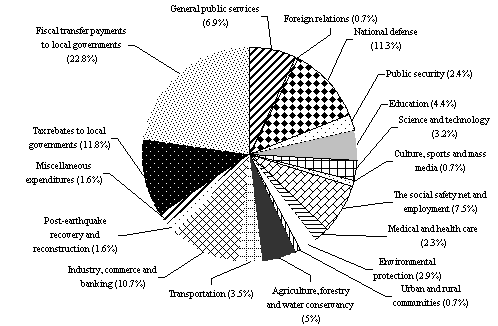
Total spending by the central government on the above items in areas such as education, medical and health care, the social safety net, employment, low-income housing and culture that directly affect the people's lives came to 560.364 billion yuan, an increase of 29.2%. Central government expenditures for agriculture, rural areas and farmers totaled 595.55 billion yuan, an increase of 163.7 billion yuan or 37.9%. This figure includes 226.01 billion yuan for agricultural production; 103.04 billion yuan, an increase of 100%, for direct subsidies to grain producers, general subsidies for purchasing agricultural supplies, subsidies for planting superior crop varieties and subsidies for purchasing agricultural machinery and tools; 207.28 billion yuan for social programs such as education, medical and health care, the social safety net, employment, low-income housing and culture in rural areas; and 57.62 billion yuan for expenses and interests related to stockpiles of major agricultural products. The central government's tax rebates and fiscal transfer payments to local governments totaled 1.255932 trillion yuan, the bulk of which went to the people's wellbeing, agriculture, rural areas, and farmers.
3. Public finance's active effect in macro-control
The central leadership made major adjustments in the orientation of macro-control on two occasions in light of developments and changes in the domestic and international economic situations. The primary task for macro-control shifted mid-year from preventing overheated economic growth and significant inflation to maintaining steady and rapid economic development and preventing prices from rising too fast. In September, the central leadership resolutely shifted the focus of macro-control to preventing economic growth from slowing down too quickly. Even more proactive fiscal and taxation policies and measures were adopted mid-year in line with the orientation of central government macro-control while the government continued to pursue a prudent fiscal policy. An even more proactive fiscal policy was implemented in and after October by reducing and exempting taxes and fees by an appropriate amount, raising export rebate rates several times and increasing the spending and key expenditures of the central government. These moves played an important role in promoting steady and rapid economic development.
We maintained an appropriate increase in central government spending. At the beginning of the year, we reduced the central government deficit and funding for bond-financed projects and increased spending on capital construction in the central budget. The scale and structure of expenditures were adjusted during implementation of the budget to provide relief for quake-hit areas. We set up a central government fund for post-earthquake recovery and reconstruction to give full support for recovery and reconstruction efforts. In the fourth quarter, we energetically raised funds and increased central government spending by 104 billion yuan to ward off the impact of the global financial crisis, accelerate recovery and reconstruction efforts in quake-hit areas, construct low-income housing and carry out other measures to improve the people's wellbeing, and strengthen agricultural infrastructure.
We promoted price stability and alleviated price irrationality. We increased general subsidies for purchasing agricultural supplies and subsidies for planting superior seed varieties by a large margin. We raised minimum grain purchase prices significantly three times, imported a greater volume of agricultural products and important raw materials in short supply on the domestic market, strictly controlled the export of grain and chemical fertilizers and improved regulation of reserves of important commodities. Subsidies were granted to the fishery industry and four others that were greatly affected by changes in the prices of refined petroleum products. We assisted producers of resource products because prices became irrational and were not likely to see correction in the near future. Subsidies for the low-income population were raised promptly as needed. Junior and regular college students in full-time programs received temporary meal allowances.
We reduced the load on enterprises and individuals. The new Law on Corporate Income Tax was implemented, reducing the tax load on enterprises. The salary threshold for the individual income tax was increased and the individual income taxes on interest earnings from savings and stock account balance were suspended. Fiscal and taxation policies were adopted to support development of low-rent housing, affordable housing and the rental housing market. Taxes on housing sales were reduced. The securities transaction stamp tax rate was reduced and the stamp tax on stock purchases was scrapped. We adjusted policies for the sales tax on vehicle purchases. Financially-strapped enterprises were temporarily allowed to suspend their payment of social security contributions, and the required contributions to medical, unemployment, worker's compensation and maternity insurance funds were decreased. According to preliminary statistics, the tax load on enterprises and individuals was reduced by about 280 billion yuan in 2008 due to policies requiring tax reductions and exemptions.
We supported development of small and medium-sized enterprises. The central government and governments at the provincial level allocated 28.64 billion yuan to assist small and medium-sized enterprises in innovating technology, upgrading products and expanding into international markets. Trials were carried out in investment of venture capital. We improved the credit guarantee system for small and medium-sized enterprises, and granted rewards and subsidies to agencies providing guarantees for them. More enterprises became eligible for guaranteed small loans, the central government raised subsidies for interest on guaranteed small loans, and a mechanism for rewarding lending institutions and a mechanism for risk sharing and compensation in the event of losses from nonperforming loans were set up. Preferential taxation policies were adopted to promote development of small and medium-sized enterprises.
We supported efforts to stabilize exports. We increased export rebate rates for textiles, garments and other labor-intensive products, as well as high value added products with high technology content four times. Export tariffs on some steel and chemical products and grain were rescinded, and export tariffs on some chemical fertilizers were lowered and collection methods adjusted.
4. A powerful effort to fight natural disasters and provide disaster relief
The government allocated relief funds totaling 47.91 billion yuan in a strong response to low temperatures and snow and ice storms that occurred in some areas of the south at the beginning of the year. The level of assistance to disaster victims rose to help them with the temporary difficulties they had in their lives and ensure their basic living conditions. We provided strong support to efforts to resume agricultural production, rebuild collapsed housing and repair infrastructure facilities such as power grids, transportation and education. After the devastating earthquake hit Wenchuan in Sichuan Province on May 12, we quickly launched a contingency fiscal plan for the earthquake and promptly took effective measures to arrange adequate relief funds. The central government allocated 38.437 billion yuan in rescue and relief funds and local governments, 24.328 billion yuan. A fund of 74 billion yuan was allocated to the central government fund for post-earthquake recovery and reconstruction, of which 69.87 billion yuan was actually spent, including 38 billion yuan for rebuilding urban and rural housing, 9.749 billion yuan for repairing infrastructure, 4.8 billion yuan for rebuilding industry and 2.436 billion yuan for preventing and reducing disasters. We cut general public spending in state organs by 5%, and all of the savings were used to provide disaster relief. Nineteen provinces and municipalities directly under the central government now set aside at least 1% of their annual regular revenue each year to aid designated quake-hit areas. Fiscal and taxation policies were implemented to support disaster relief and post-earthquake recovery and reconstruction. Donations were closely monitored and tightly managed to ensure their effective use.
5. Steady progress in fiscal and taxation reforms
The income tax systems for domestic and overseas-funded enterprises were unified. The trial VAT reform underway in the three northeastern provinces and 26 old industrial cities in the central region expanded to include eastern Inner Mongolia as well as areas seriously hit by the Wenchuan earthquake, and the plan to carry out the reform nationwide beginning January 1, 2009 was released. The new provisional regulations for tax on farmland used for nonagricultural purposes and detailed rules for their implementation were instituted. The real estate tax systems for domestic and overseas-funded enterprises and Chinese and foreign individuals were unified. We worked out a plan for the reform of taxes and fees for refined petroleum products. A preliminary plan was formulated for setting up a mechanism to ensure adequate basic funding for county-level governments in line with the requirement to set up a sound public finance system whereby the financial resources of governments are commensurate with their responsibilities. Progress was made in the initiative to place county finances directly under the management of provincial governments and township finances under the management of county governments. Reform was enacted on taxes and fees for state-owned farms. We supported trial reduction of debt incurred in rural nine-year compulsory education in 14 provincial-level administration areas. Trials to set the allowable number of employees, level of funding and limits for spending for goods within basic expenditures expanded. The number of departments required to submit their budgets to the NPC for approval increased from 40 in 2007 to 50 in 2008. We carried out the reform to set up a centralized treasury payment system in all central government departments, over 12,000 of their subsidiary agencies responsible for preparing their own budgets, and more than 280,000 local departments that prepare their own budgets. Reform of the system for collecting non-tax revenue was conducted in most central government departments and all provincial-level governments. The scope and scale of government procurement expanded. Trials of the budget system for state capital operations were carried out, and budgets were compiled on a trial basis for state capital operations by the central government.
6. Constantly strengthening management of public finance
In accordance with the decisions and resolutions of the First Session of the Eleventh NPC and guidelines of the Financial and Economic Affairs Commission of the NPC, we strengthened budgetary management and improved collection and management of revenue, adjusted the structure of expenditures and deepened reform of the fiscal and taxation systems. Local governments received advance notice of the estimated size of general and special transfer payments from the central government to become able to compile more comprehensive budgets. Budgets were made more detailed to ensure that implementation was more on track at the beginning of the year. We set up a notification and inspection system to improve budget implementation. Trials to disburse official business expenses with credit cards continued. We expanded the trial evaluation of the performance of budgetary expenditures of 2007 from 6 to 108 items and from 4 to 74 departments in 2008. We thoroughly screened fees and funds and stopped collecting administration fees from sole proprietors and fair trade markets nationwide. We worked out guidelines for improving management of non-tax revenue and a plan to bring it under budgetary management by 2011. Oversight and examination were tightened for the funds for natural disaster recovery and relief and improvement of the people's lives, as well as for the implementation of major fiscal and taxation policies. Continued progress was made in rendering fiscal operations more transparent.
In general, the budgets for 2008 were implemented satisfactorily, thereby effectively promoting steady and rapid economic development and social harmony and stability. This is attributable to the firm leadership and scientific decision making of the Party Central Committee and the State Council and to the strong support and close cooperation of all regions, departments, and particularly tax and customs administrations. However, we are clearly aware that problems persist in budget implementation and fiscal work, including the following: The impact of our economic downturn on public finance is mounting, as are factors reducing revenue and increasing expenditures, thus rendering it ever more difficult to balance revenue and expenditures. The structure of expenditures needs to be optimized and more support is required for weak links in economic and social development. The structure of taxes and fees needs to be made more rational, the taxation system needs further improvement, and the government's role in the distribution of national wealth needs further standardization. The transfer payment system and the fiscal systems at and below the provincial level need further improvement, and some county and township governments lack adequate financial resources. Budgets are not prepared precisely enough, and budget implementation needs to become more uniform. There is still serious loss, waste, and diversion of budgetary funds, and thus our budgetary oversight and supervision need improvement. We must pay close attention to these problems, continue working to find more effective measures and successfully solve them.
