| Tools: Save | Print | E-mail | Most Read |
| The Dramatic Story of Drama |
| Adjust font size: |
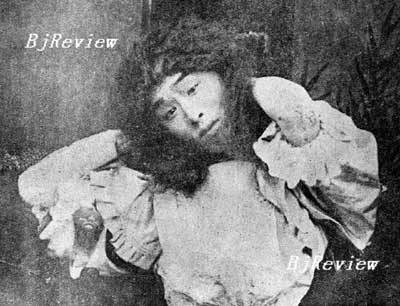
A group of students deadlocked over how to stage a play about Chinese actors a hundred years ago, pondered the ideas of three different directors, and ended up lost in the essence of drama. That is the story told in Xunzhao Chunliushe, or Finding The Spring Willow Drama Club, a play staged recently to mark the centennial birthday of Chinese modern drama, which "originated from the West, but has developed into something with vigorous Chinese characteristics," according to Wang Weiguo, a researcher on the art form. "Today we put on this play to pay tribute to the ancestors of Chinese drama and to continue reflection on its future," said the play's director Ren Ming, who gave it an ending where instead of giving up on the play, the students carried on pursuing an answer. Early stages The Spring Willow Drama Club, which was started in 1906 by Chinese students studying in Japan, is considered as the founder of Chinese modern drama. The original group acted as well as performing music and poems and its members included Li Shutong, one of the pioneers of Chinese painting, modern music and arts education. In Tokyo, in 1907, the club put on a trial performance of the third act of the classic The Lady of the Camellias, in which Li played the role of the lady. This performance is considered the first drama performed by Chinese in the Chinese language.
The club premiered a five-act play based on the novel Uncle Tom's Cabin, and established an unprecedented form of drama in China: the first drama script and the first complete drama performance. The advent of modern drama in China contrasted with traditional Chinese drama which was divorced from reality, by reflecting social reforms and issues that the public cared about, according to Professor Ding Nan from Shanghai Theater Academy.
Echoing the Spring Willow Drama Club, which was Japan-influenced and actively performed in Shanghai, a school-based drama club in north China's Nankai University in Tianjin began to gain influence. The club was led by the president of the university Zhang Boling and performed 50 plays between 1908 and 1922.
Tian's contemporary Hong Shen was the first Chinese citizen to major in drama at Harvard University in 1919. Hong established a drama director system and was known for his strict rehearsals. He established drama through dialogues as distinguished from opera and dance, and gave the name huaju to modern theater performed in China. Huaju literally translates as dialogue play.
Produced sometime between 1927 and 1935, Snow on Lushan Mountain, in which many of the original cast were high-ranking military officials, is considered China's first "red drama." It was among the many revolutionary dramas that were staged by the Chinese Communist Party at its revolutionary base in Jiangxi Province.
Set in the early 20th century in China, the play chronicles the intriguing relationship among members of a large, well-off family. Cao Yu, influenced by ancient Greek tragedies and Norwegian playwright Henrik Ibsen, told a soul-touching story about eight characters from two families over the course of one day, looking deep into human nature.
Chinese modern drama was revived after the founding of the People's Republic of China in 1949. Various theaters and drama institutes were established to explore stage art, which they were unable to do during wartime. Also, the Stanislavsky System, an approach to acting developed by Russian director Konstantin Stanislavsky, was introduced to China to guide Chinese drama.
Jiao stressed the importance of examining life. For him, "psychological experience" and realistic acting were indispensable to a good performance. In 1957, Lao She wrote the three-act masterpiece Teahouse. The drama is set in a typical old Beijing teahouse and follows the lives of the owner and his customers through three stages of modern Chinese history. The play spans 50 years and has a cast of over 60 characters drawn from all levels of society, reflecting the changes that have taken place in Chinese society. Much of the play's strength and appeal lay in Lao She's masterful recreation of the characters and language of the streets of old Beijing, but at its core is his vision, his unerring choice of significant detail, and his familiarity with the old society he was describing, with its strengths, weaknesses and ironies. It is this which carries Teahouse beyond the borders of social criticism and makes it a complex and living work of art. The play was invited to be staged in Europe in September 1980, the first time the Chinese drama traveled abroad. Afterwards it played in Japan, Canada and the United States, where on one occasion it was staged in English. Chinese drama almost disappeared from the stage during the calamitous Cultural Revolution (1966-76), with many talented actors, writers and director, including Lao She, persecuted or killed. New era Two years after the Cultural Revolution ended In the Silence was staged in Shanghai. The play reflected the true story of the Chinese people commemorating Zhou Enlai, the country's former premier who died in 1976 and condemning the Gang of Four, a group of leaders who were arrested and removed from their positions in 1976, following the death of Mao Zedong, and were primarily blamed for the events of the Cultural Revolution. The same year another play, The Song of Loyalty, starring Yu Shizhi, who also played the hero in Teahouse, provoked strong reactions. Four years after The Song of Loyalty appeared, prominent Chinese stage director Lin Zhaohua directed Signal Alarm, sending a signal to the little theater movement, which was experimental and usually avant-garde. Emancipated in the reform and opening up of the 1980s, Chinese dramatists began to grow discontented with the development of theater in China and laid their eyes on Western modern drama. In the 1990s drama in China saw two trends: either becoming more experimental or returning to realism. Modern stage techniques were used widely and brought a modern look to the stage. Rhino in Love in 1999, directed by 35-year-old Meng Jinghui, brought profits to small theaters in China and the director cultivated a cult following. However, Beibingmasi Theater, where Rhino in Love debuted, closed its doors in 2005, a sign of the difficult situation facing modern Chinese drama, which lacks money. There were 3,000 drama clubs in China at the beginning of the 21st century, but many of them rarely perform and few would pay to watch them do so. "Narcissistic" and "lack of audience" are words mostly used to describe the situation. Some researchers have warned that modern Chinese drama is dying. Art or market To be or not to be, that's the question raised in every corner of Chinese culture and society in the midst of the new market-oriented economy that has swept the country and threatened the survival of Chinese drama. In 1995 when prospects for the drama market looked dim, Shanghai People's Art Theater and the Shanghai Youth Drama Troupe were merged to form the Shanghai Dramatic Arts Center and the move proved highly successful. According to Shanghai media reports, the self-sufficiency rate of the Shanghai Dramatic Arts Center has reached 70 percent in recent years, 20 percent higher than that of its Western counterparts in Britain and 40 percent higher than its counterparts in Beijing. Yang Shaolin, General Manager of the center, is concerned about the effect market force could have on Chinese drama. "It's a dilemma that has put drama art under test," said Lu Linyin, a Shanghai reporter who has interviewed many dramatists. "If you don't care about the market you lose the chance to survive. The another way round, if you care too much about the market you undermine the art itself." The Shanghai Dramatic Arts Center was the first in China to introduce the "producer" to drama market management in China. It is the producer's role to take care of many things including choosing scripts, picking actors, organizing rehearsals and promoting shows. What bothers producers most is the lack of good original scripts. "In many cases the scripts are immature and the director and actors have to try hard to make up for that, but often they end up not so satisfying," said Ren. But Ren is optimistic about the future of drama. "The living environment for drama will get better and better," he said, explaining that people are getting richer and have more time and money to spend on culture and entertainment. "With the development of diversity of entertainment, theater will finally find its niche," added 93-year-old Ouyang Shanzun, a veteran actor and former president of the Beijing People's Art Theater. (Beijing Review by Tang Yuankai July 4, 2007) |


| Tools: Save | Print | E-mail | Most Read |
 |
| Related Stories |
|
