Organizational System
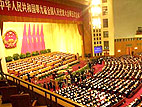
The People's Republic of China practices the system of people's congress. China's Constitution stipulates that all power in the People's Republic of China belongs to the people, and the organs through which the people exercise state power are the National People's Congress and the local people's congresses at different levels. Local people's congresses at different levels are elected in a democratic way, and are responsible to the people and subject to supervision by the people. Deputies to the people's congresses at county and township levels are elected directly by their constituents. All citizens of the People's Republic of China who have reached the age of 18 have the right to vote and stand for election, regardless of ethnic status, race, sex, occupation, family background, religious belief, education, property status or length of residence. Such citizens make up 99.97 percent of the population who are 18 years of age or over. Over the past dozen years, more than 90 percent of the electorates participated in the four direct elections of deputies to the people's congresses at county and township levels. Deputies to the people's congresses of the provinces, autonomous regions, municipalities directly under the Central Government, autonomous prefectures and cities divided into districts are elected by the people's congresses at the next lower level. Deputies to the NPC are elected by the provinces, autonomous regions and municipalities directly under the Central Government, and by the armed forces. Candidates for deputies to the people's congress at various levels are nominated on the basis of electoral districts or electoral units. The political parties and various people's organizations may either jointly or separately recommend candidates for deputies. Any voter or deputy may, with at least 10 people supporting his proposal, also recommend a candidate. The number of candidates for deputies shall be greater than the number of deputies to be elected. The elections shall be by secret ballot.
Function
The NPC is the highest organ of state power. It exercises the state power of amending the Constitution and supervising the enforcement of the Constitution; enacts basic laws of the state; elects and decides on the choices of the leading personnel of the highest state organs of China, including the President and Vice President, the choice of the Premier of the State Council and other component members of the State Council; elects the Chairman of the Central Military Commission and decide on the choice of other component members of the Central Military Commission; elects the President of the Supreme People's Court and the Procurator-General of the Supreme People's Procuratorate; examines and approves the plan for national economic and social development and the report on its implementation; examines and approves the state budget and the report on its implementation; and make decisions on other important issues in national life. The NPC is elected for a term of five years. It meets in session during the first quarter each year and is convened by the NPC Standing Committee.
Allocation of the Number of Deputies
The number of delegates to the National People's Congress shall be decided in accordance with the proportion of the population in each province, autonomous region and municipality directly under the Central Government. No less than 15 delegates shall be allocated to a province or an autonomous region with a small population. At the same time, the allocation should make sure that there is appropriate representation of all ethnic groups, people from all walks of life and all political parties within the NPC.
Rights and Duties of NPC Deputies
The National People's Congress is comprised of deputies who exercise the highest state power. According to the Constitution and the Organic Law of the National's People's Congress, NPC deputies are elected for a term of five years. The term of a deputy chosen through by-elections dates from the date of the vote until the expiration of the current NPC.
In accordance with the Constitution and the Organic Law of the National's People's Congress, the NPC deputies enjoy the following rights and duties:
1. Putting forward bills, suggestions and criticisms;
2. Putting forward proposals regarding the dismissal of government officials;
3. Having power to address and make inquiries;
4. Not being held liable for their speeches and votes at various NPC meetings;
5. Exemption from arrest or criminal trial without authorization, whether or not the NPC is in session;
6. The right to inspect the topics for discussion at the NPC session and related contents; and
7. The state and society provides NPC deputies with necessary guarantees when they are attending the NPC sessions and performing their duties as deputies.
NPC deputies should fulfill following duties:
1. To abide by the Constitution and laws in an exemplary way, exercise their powers in an earnest way, guard state secrets and help facilitate the enforcement of the Constitution and laws in the production, work and other social activities in which they take part; and
2. To keep in close touch with their constituency and the public, listening to and giving expression to the opinions and requirements of the people and work hard to serve the people.
NPC Standing Committee
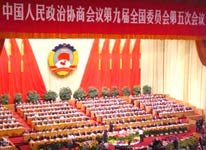
The permanent organ of the National People's Congress is its Standing Committee, which is responsible to the National People's Congress. It functions as the highest body of state power and accepts supervision by the National People's Congress when it is not in session.
The NPC Standing Committee is composed of the Chairman, Vice-Chairmen, the Secretary-General and other members who are elected from among the deputies at the first session of every National People's Congress. The members of the NPC Standing Committee generally include: (a) representatives from the Communist Party of China;
(b) representatives from various democratic parties and patriots and democrats without party affiliation; (c) representatives of people's organizations; (d) representatives of the People's Liberation Army; and (e) representatives of minority ethnic groups with a population of over 1 million each.
The NPC Standing Committee serves the same term as the National People's Congress, five years from its election at the first session of every National People's Congress to the birth of a new Standing Committee at the first session of the next National People's Congress. The chairmanship and vice-chairmanship of the NPC Standing Committee cannot go beyond two successive terms. Nobody on the NPC Standing Committee is permitted to hold any post in any of the administrative, judicial or procuratorial organs of the state. Any member who holds any post in any of the aforesaid state organs must resign from the NPC Standing Committee.
The Chairman of the NPC Standing Committee presides over the work of the Standing Committee. The Vice-Chairmen and the Secretary-General assist the Chairman. Executive meetings with the participation of the Chairman, Vice-Chairmen and Secretary-General handle the important day-to-day work of the Standing Committee. Under normal circumstances, the NPC Standing Committee meets every two months, but extraordinary meetings can be convened as required.
The Chairmen of all previous NPC Standing Committees were: Liu Xiaoqi, Zhu De, Ye Jianying, Peng Zhen, Wan Li and Qiao Shi. Li Peng is chairman of current NPC Standing Committee.
According to the Constitution and the Organic Law of the National People's Congress, the NPC Standing Committee exercises the following functions and powers:
1. Legislative right. In accordance with the provisions of the Constitution, the National People's Congress and its Standing Committee jointly exercise the legislative right, including enacting and amending statutes, with the exception of those which should be enacted by the National People's Congress; enacting supplements and amendments to statutes enacted by the National People's Congress when it is not in session, as long as these do not go against the basic principles of the statutes. Consequently, except for the Constitution and basic laws, The NPC Standing Committee undertakes a large amount of legislative work.
2. Right to interpret the Constitution and laws. Interpretation of the Constitution means to provide a legislative explanation of the articles and provisions that require further definition, and supplements, so as to correctly deal with any problems arising during the execution of the Constitution and laws to guarantee their correct implementation.
3. Right to supervise the enforcement of the Constitution. The Constitution now in force gives the supervisory right also to the NPC Standing Committee in addition to the National People's Congress. As a permanent body of NPC, this ensures it can carry out regular supervision of the enforcement of the Constitution.
4. Right to supervise the work of other state organs. The NPC Standing Committee supervises the work of the State Council, Central Military Commission, Supreme People's Court and Supreme People's Procuratorate; annulling those administrative rules and regulations, decisions or orders of the State Council that contravene the Constitution or the statutes of the state; and annulling those local regulations or decisions of the organs of state power of provinces, autonomous regions and municipalities directly under the central government that contravene the Constitution, statutes, or administrative rules and regulations of the state.
5. Power of appointment and removal. When the National People's Congress is not in session, the NPC Standing Committee decides on the choice of ministers in charge of ministries or commissions or the auditor-general and the secretary-general of the State Council according to the nomination by the premier of the State Council; selects the vice-chairmen of the Central Military Commission and members of the commission according to the nomination of the chairmen of the Central Military Commission; appoints and removes vice-presidents and judges of the Supreme People's Court (SPC), members of SPC's Judicial Committee and the president of the Military Court according to the motion from the president of SPC; appoints and removes deputy procurators-general and procurators of the Supreme People's Procuratorate (SPP), members of SPP's Procuratorial Committee and the chief procurator of the Military Procuratorate according to the motion from the president of SPP, and approves the appointment and removal of chief procurators of the people's procuratorates of provinces, autonomous regions and municipalities directly under the central government; and decides on the appointment and recall of plenipotentiary representatives abroad.
6. Right of decision concerning major issues in state affairs. This includes: deciding on the ratification and abrogation of treaties and important agreements concluded with foreign countries; instituting systems of titles and ranks for military and diplomatic personnel and of other specific titles and ranks; instituting state medals and titles of honor and deciding on their conferment; deciding on the granting of special pardons; deciding on the proclamation of a state of war when the state faces armed encroachment or must fulfill an international treaty against aggression whilst the NPC is not in session; deciding on general mobilization or partial mobilization; deciding on the enforcement of martial law throughout the country or in particular provinces, autonomous regions, or municipalities directly under the central government; and examining and approving partial adjustments to the plan for national economic and social development and to the state budget that prove necessary in the course of their implementation when the NPC is not in session.
Other functions and powers as the National People's Congress may assign to it. In addition to all these, the NPC Standing Committee is empowered by the NPC to chair the election of NPC deputies, convene NPC sessions, keep in touch with NPC deputies and organize them to make inspection, and lead the work of NPC special committees when the National People's Congress is not in session.
Special Committees
The National People's Congress establishes the Ethnic Affairs Committee, Law Committee, Committee for Internal and Judicial Affairs, Financial and Economic Committee, Education, Science, Culture and Health Committee, Foreign Affairs Committee, Overseas Chinese Affairs Committee, Environment and Resources Protection Committee and Agriculture and Rural Affairs Committee. These special committees, under the direction of the National People's Congress and its Standing Committee, examine, discuss and draw up relevant bills and undertake the routine legislative and supervisory tasks.
1). Proposal of bills. According to Chinese law, the NPC Presidium, Standing Committee and various special committees as well the State Council, the Central Military Commission, the Supreme People's Court and the Supreme People's Procuratorate may submit bills to the National People's Congress. Such bills are put on the agenda of the NPC session by the Presidium. A group or delegates, with at least 30 of them in a joint letter, may also present bills to the National People's Congress. The Presidium will decide whether to put such presented bills on the agenda or hand them over to relevant special committees for discussion and conclusion before making the decision. If the bills are presented to the NPC Standing Committee by the Chairmen's meeting, various NPC special committees, the State Council, the Central Military Commission, the Supreme People's Court and the Supreme People's Procuratorate, the Chairmen's meeting will submit them to the Standing Committee's meeting for deliberation. Or the Chairmen's meeting will first hand them over to relevant special committees for discussion and issuing a report before deciding to submit them to the Standing Committee's meeting for deliberation. The members of the Standing Committee, if at least 10 of them sign a joint letter, may also present bills to the NPC Standing Committee. The Chairmen's meeting will decide whether to submit such presented bills to the Standing Committee's meeting for deliberation or hand them over to related special committees for discussion and issuing a report before making the decision. If the Chairmen's meeting decides not to submit them to the Standing Committee for deliberation, it should report to the Standing Committee's meeting or furnish an explanation to the bill's presenters.
2) Deliberation of bills. Where a bill is put on the NPC session's agenda for deliberation, the proposer should first make a presentation about the bill at the plenary session. Then the bill is discussed and deliberated at the plenary and group meetings of each delegation, and meanwhile it is discussed and deliberated by the Law Committee and other related special committees. The Law Committee will have a final discussion of the bill in the light of the considerations and proposals from various delegations and related special committees and submit a report on the results of the discussions and the revised version of the draft law to the Presidium. The Presidium will print it, distribute it among the delegates and submit the revised bill to the NPC session for voting. A bill, which has been put on the agenda of the NPC Standing Committee's meeting, is subject to at least two rounds of deliberation. The first Standing Committee meeting hears the presentation about the bill and, after preliminary discussion, hands it over to the Law Committee and the relevant special committee for deliberation. The Law Committee presents to the next or future Standing Committee's meeting the report on the results of the deliberation, which will finally put it to the vote at the plenary session of the Standing Committee after discussions by the Standing Committee group and joint meetings.
3) Vote upon bills. At the NPC sessions and the Standing Committee's meetings, voting is electronic. A bill is passed if more than half of the delegates attending the NPC session or more than half members of the Standing Committee agree.
4) Promulgation of law. The laws adopted by the NPC and its Standing Committee are promulgated in the form of the decree of the President of the People's Republic of China.
The Legislative Power in China
Before the end of 1982, only the National People's Congress (NPC), the highest body of state power established under the Constitution, had the power to make laws. In December 1982, however, the fifth session of the Fifth NPC adopted the fourth Constitution of the People's Republic of China, which confers partial legislative power to the NPC Standing Committee. In addition, the Constitution gives the right to the State Council, people's congresses at the provincial level and their standing committees, and the people's congresses of autonomous regions of ethnic minorities to issue administrative regulations, local rules and regulations and rules covered by the principles of self-government. Later, the revised Organic Law of the Local People's Congresses and Local People's Governments extends legislative power to the people's congresses of cities where provincial and autonomous regional governments are based and large cities approved by the State Council, as well as their standing committees.
In 1981, the NPC Standing Committee empowered the people's congresses of Guangdong and Fujian provinces, and their standing committees, to make various special economic laws and regulations for the special economic zones established under their jurisdiction.
In 1988, Hainan Province was established and began to enjoy local legislative power immediately.
In 1990, the third session of the Seventh NPC adopted the Basic Law of the Hong Kong Special Administrative Region, giving it administrative, legislative power and independent judicial power and the right of adjudication.
In 1992, the Shenzhen Special Economic Zone was empowered by the NPC to pass local legislation.
In 1993, the first session of the Eighth NPC adopted the Basic Law of the Macao Special Administrative Region, giving it administrative, legislative and independent judicial power, and right of adjudication.
In 1994, the Xiamen Special Economic Zone was empowered by the NPC to pass local legislation, and this was extended to the Zhuhai and Shantou special economic zones in March 1996.
Legislation by NPC and Its Standing Committee Since 1979
By the 11th session of the 9th NPC Standing Committee, which concluded on August 30, 1999, the NPC and its Standing Committee had adopted 253 laws and 106 decisions on relevant law issues in addition to amendments to the Constitution.
Leadership of the Ninth NPC Standing Committee
Chairman: Li Peng
Li Peng, who is a Standing Committee member of the Political Bureau of the Communist Party of China (CPC) Central Committee, served as the Chinese premier after 1987.
Son of a revolutionary martyr, Li acquired his higher education in the former Soviet Union. Renowned as an electricity specialist, he is one of those ranking officials with a technical background in New China.
Li was born in October 1928 in the city of Chengdu in southwest China's Sichuan Province. He joined the CPC in November 1945.
Li studied at the Yan'an Institute of Natural Sciences, Yan'an Middle School and Zhangjiakou Vocational School of Industry between 1941 and 1946.
Then he served as a technician in the Shanxi-Chahar-Hebei Power Company and an assistant manager and a party branch secretary at the Harbin Grease Company.
In 1948, one year before the founding of New China, he was sent to study at the Moscow Power Institute, majoring in hydroelectric engineering. During the period he was chairman of the Chinese Students Association in the Soviet Union.
Upon his return home in 1955, Li served as deputy director and chief engineer of the Fengman Hydroelectric Power Plant in northeast China. Later he served as deputy chief engineer of the Northeast China Power Administration and director of its Electricity Dispatch Department, director of the Fuxin Power Plant and deputy secretary of the plant's Party committee.
Between 1966 and 1976, he held the posts as an acting secretary of the Party Committee of the Beijing Power Supply Bureau, chairman of the Revolutionary Committee of the Bureau, deputy secretary of the Party Committee of Beijing Power Administration, chairman of the Revolutionary Committee and director of the Administration and secretary of the leading Party group of the Administration.
Between 1979 and 1983, he served as vice-minister and minister of Power Industry and secretary of the leading Party Group of the Ministry of Power Industry, and vice-minister and deputy secretary of the Party group of the Ministry of Water Resources and Power.
Li Peng was elected member of the CPC Central Committee at the 12th CPC National Congress in 1982 and was co-opted member of the Political Bureau and member of the Secretariat of the CPC Central Committee at the Fifth Plenary Session of the 12th CPC Central Committee in 1985.
Li Peng started to serve as vice-premier of the State Council in 1983, and took charge of energy, communications and raw materials departments. Beginning 1985, he served concurrently as minister in charge of the State Education Commission.
Li was elected member of the Standing Committee of the Political Bureau of the CPC Central Committee at the First Plenary Session of the 13th CPC Central Committee in November 1987 and in the same month he was appointed acting Premier of the State Council. Five months later, that is, at the First Session of the Seventh NPC, Li was appointed Premier of the State Council, the fourth premier in the history of the People's Republic of China.
Li was re-elected member of the Standing Committee of the Political Bureau of the CPC Central Committee at the First Plenary Session of the 14th CPC Central Committee in October 1992, and re-appointed premier at the First Session of the Eighth NPC in the following year. Between 1988 and 1990, he served concurrently as minister of the State Commission for Economic Restructuring.
Over the past 11 years since Li Peng became the premier, China has scored tremendous achievements in its socialist modernization drive that have drawn worldwide attention. The country's economic restructuring has taken decisive strides forward, opening-up reached a new level, and social productive forces, comprehensive national strength and people's living standards ascended a new stage.
Meanwhile, China's exchanges and cooperation with other countries have greatly been enhanced. Li has made quite a number of visits to foreign countries, contributing to the consolidation and development of China's friendship and cooperation with other countries.
As the premier of the People's Republic, Li Peng has always kept a packed schedule. Li often went down to grassroots units across the country to do investigations and study. Over the past 11 years as premier, he made inspection on study tours almost all over the country.
As the premier, he has paid equal attention to economic growth and socialist cultural and ethical progress. He construed the socialist cultural and ethical progress as ideological and ethical progress and development of education, science and culture. Li showed particular care and attention for the work and life of the intellectuals.
According to sources close to him, Li is an unassuming and easy to approach, and good at making friends. Among his acquaintances are common folks as well as political personalities, experts and scholars. Li is well-versed in Russian and has learned English all by himself. He also loves reading.
At home, Li is a good helper and often does some house work. Newspapers once published a photo showing Li Peng mending his overcoat. He said he learned sewing in Yan'an in the 1940s when he lived together with children of many other revolutionary martyrs. "Li Peng has not the slightest traces of male chauvinism," said Zhu Lin, his wife. "Whenever he is free, he would lend a helping hand in household chores either when he was an ordinary official or later a minister or even after he became the Premier."
Li Peng's father, Li Shuoxun, was one of the earliest CPC members. He was killed in Hainan Island by the Kuomintang when Li Peng was only three years old.
Li Peng's mother, Zhao Juntao, used to be an educator and also one of the early CPC members. She passed away in 1985.
Li Peng has a family of 11. His wife graduated from the Harbin Foreign Languages Institute and worked in the power departments for many years. The couple has two sons and one daughter.