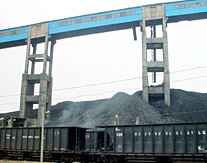
The confirmed death toll at the Daping Coal Mine explosion in Zhengzhou, Henan Province, hit 141 by October 30, with the seven miners still missing believed to be dead. The blast occurred on October 20.
On the same day, another explosion in a mine near Chongqing Municipality in southwest China left 12 dead and one missing. Also on the 20th, 29 miners were trapped underground by a flood at a mine in the northern province of Hebei, and chances of their survival were considered slim.
Two days later, 15 more men died in a mine gas explosion in the southwestern province of Guizhou.
And the list goes on: at press time, breaking news indicates that a gas explosion in a Shanxi Province mine has left 10 miners dead and six missing.
The State Administration of Work Safety reports that in the first nine months of 2004, 4,153 people died in mining accidents, a figure that the administration admits may be low because of cover-ups or inaccurate reporting. Reports of coal mine accidents are so frequent they seem commonplace, but the quick succession of serious accidents in late October put mine safety into the public as well as the official spotlight.
On October 23, People's Daily interviewed Professor Wang Deming of the China University of Mining and Technology to gain a clearer picture of why these disasters take place with such alarming frequency.
People's Daily (PD): What sort of gap is there between China and developed countries in terms of mine safety?
Wang Deming: The main work-safety indexes are accident and fatality rates per million tons. China has a poor safety record among coal-producing countries: in fact, we can say it has the poorest safety record. Last year, China produced 1.7 billion tons of coal. With 6,434 miners dead in accidents, the fatality rate per million tons was nearly 4. Look at the US, a big coal producer. Its output is 1 billion tons per year, but its death toll is only 50 miners, putting the rate per million tons at 0.04. The death rates per million tons in Russia and South Africa were 0.34 and 0.13. The fatality rate in developed countries averages 0.4. Although mine safety has improved since 2002, we have still a long way to go.
Still, some mining operations in China are relatively sound. Shenmu-Dongsheng Coal Mine, the country's largest, has a fatality rate of 0.026; and at Yanzhou Coal Mine in Shandong it is 0.02.
PD: Why do coal mine accidents occur so frequently in China?
Wang: China is short of gas and oil but has plenty of coal, so coal accounts for a big part of its energy supply structure. In 2003, coal supplied 74 percent of total energy consumption. Over the next 20 years, coal will still account for about 70 percent. The greater the production volume, the higher the risk of accident. Some enterprises seek profits while ignoring safety.
In addition, there is a large amount of gas in China's coal mines, which raises accident risk. Complicated geological conditions are another factor, with the coal lying in thin layers deep underground.
PD: With these known conditions in place, isn't there a human factor at work here?
Wang: You are right. The main reason is that our country places too little emphasis on safety, which leads to poor training for the miners, outdated safety equipment and an obsolete management system. In a word, the applications of science and technology in this area lag too far behind.
PD: Can you demonstrate the effect of this, and compare China with more developed countries?
Wang: Let's take Shandong Province as an example. Shandong is the best in terms of coal mine safety in our country. From January through September, the fatality rate per million tons in Shandong's coal mines was 0.42, close to secondary developed countries, yet the gap is still obvious.
First, mechanized excavation accounts for only 75.4 percent overall, but in county-level coal mines the figure is zero. Mechanized excavation in developed countries is at 100 percent, or very close to it. When there is more mechanization, fewer miners are needed and so accident and casualty rates drop.
Second, science and technology contribute 40 percent to coal production in Shandong, compared with 60 percent or above in developed countries.
Third, there is little input into scientific research. Funding earmarked for this in Shandong is less than 1.5 percent of coal sales. In the United States it is 3 percent.
Fourth, the miners are poorly educated and trained and transient farmers account for a large portion of the total workforce. Many operators of small mines have poor safety awareness. In the US, most miners are senior middle school graduates and management personnel are college graduates.
Fifth, safety-related technology, equipment and facilities need to be updated. Safety equipment is short in service life, poor in applicability, low in precision and unreliable in function. There is a dearth of special equipment to deal with accidents. The US has advanced monitoring systems and its death toll is nearly zero in accidents involving fire or flooding. Gas and coal dust explosions seldom occur.
PD: China has a total of 28,000 coal mines, 24,000 of them small ones that produce a combined 600 million tons per year, or one-third of the nation's total. What special risks do small mines pose?
Wang: Their danger is obvious. First, there are the obvious limitations brought by the absence of mechanized excavation. They cannot achieve economies of scale and the result is a severe waste of resources. From the angle of safety, low investment, poor personnel quality and ineffective management mark the operations of small mines. Of the 6,343 people killed in coal mine accidents last year, only 1,773 worked in state-owned mines. Accidents can be avoided if management is improved. Hopefully, the "Shandong experience" will become more widespread.
PD: The death rate in Shandong Province's coal mines is only one-tenth the national average. What are the reasons for this? What can mine operators learn from the Shandong experience?
Wang: As a matter of fact, conditions in Shandong coal mines are not as good as they might seem. But at the core of its improved situations is the slogan, "invigorating safety by applying science and technology." It is putting this slogan into practice to improve production safety and to establish effective systems in all areas.
Investment in science and technology in Shandong coal mines reached 1.2 billion yuan (US$139.9 million) in the past three years, with an average annual growth rate of 40 percent. Digitized remote monitoring is now applied in 40 percent of mines. The province leads the country in terms of mechanization. Following the reform of the system and the closing of small township operations, there are 369 producing coal mines in the province, most of which are state-owned and with high production efficiency standards.
The State Coal Industry Association named 37 high-production, high-efficiency coal mines last year, seven of which were in Shandong. Coal production at these seven mines accounts for a third of the province's total, and their fatality rate for every million tons of coal is only 0.001. Other important economic and technological indicators also meet the standards of developed countries.
PD: One of the reasons for mining accidents is the lack of safety equipment, isn't it?
Wang: This is a longstanding problem resulting from operators' mistaken thinking. Safety equipment requires a very large lump-sum investment. Many operators of small mines trust to luck and are loathe to spend money on safety equipment. In a highly dangerous industry like coal mining, the ratio of safety equipment investment to benefit should be 1:7. When an accident happens, the cost of dealing with the resultant problems is usually 1.5 times that of investment in safety, and that calculation does not include losses caused by the halt in production.
Also, studies have shown that before an accident causing serious casualties occurs, there are usually many small accidents, events with no apparent losses but creating potential hazards. The ratio of large to small accidents, to zero-loss accidents and to the creation of new hazards is 1:29:300:1200. If coal mines improve their management and prevent these hidden dangers from manifesting themselves, accidents can be avoided.
PD: Coal output is increasing every year. When will the safety situation improve?
Wang: According to the state's plan, by 2007 coal mine safety will be improving steadily. By 2010 the improvement will be obvious, with the national fatality rate per million tons of coal falling below 1.6. By 2020 the situation will be fundamentally improved, with the death rate down to about 0.4, a figure in line with that of developed countries, and with no major accidents.
The plan is good, but it needs a great deal of investment in manpower and materials. The task is a tough one, but developed countries had the same experience. In the US, the death toll in coal mine accidents decreased from 2,000 in the 1960s to 1,000 in the 1970s. By closing most small coal mines, expanding average scale of production and using intensive methods, it has finally attained its goals.
PD: In addition to lowering the fatality rate, what problems need to be addressed?
Wang: Other problems involve pollution caused by damage to the earth's substrata. To solve the problems, we must reduce environmental pollution by controlling earth subsidence in a timely way. We must also solve the problem of damage to underground water resources during the process of coal exploitation. In some areas, the underground water level has dropped to only 600 or 700 meters. Moreover, we should recycle gas as developed countries do. Some coal mines have already started doing these things. Basically, we must exploit resources in a way that is advantageous to the environment.
(People's Daily, translated by Guo Xiaohong and Li Jingrong for China.org.cn, November 5, 2004)