Full Text: Report on China's Economic and Social Development Plan
 0
0 


REPORT ON THE IMPLEMENTATION OF THE 2009 PLAN FOR
NATIONAL ECONOMIC AND SOCIAL DEVELOPMENT
AND ON THE 2010 DRAFT PLAN FOR NATIONAL
ECONOMIC AND SOCIAL DEVELOPMENT
National Development and Reform Commission
I. Implementation of the 2009 Plan forNational Economic and Social Development
II. Overall Requirements and Major Objectives for Economic and Social Development in 2010
III. Major Tasks and Measures forEconomic and Social Development in 2010
Fellow Deputies,
The National Development and Reform Commission has been entrusted by the State Council to report on the implementation of the 2009 plan for national economic and social development and on the 2010 draft plan for national economic and social development for your deliberation and approval at the Third Session of the Eleventh National People's Congress (NPC), and also for comments and suggestions from the members of the National Committee of the Chinese People's Political Consultative Conference (CPPCC).
I. Implementation of the 2009 Plan for National Economic and Social Development
Last year was the most difficult year for our country's economic development since the beginning of the new century. Faced with grim and complex economic situations at home and abroad, the people of all our ethnic groups, under the leadership of the Communist Party of China (CPC), thoroughly implemented the Scientific Outlook on Development. Based on the national economic and social development plan adopted at the Second Session of the Eleventh NPC, we took maintaining steady and rapid economic development as the primary task in our economic work, followed a proactive fiscal policy and a moderately easy monetary policy, fully implemented and made constant additions and improvements to the package plan for responding to the global financial crisis, and stopped the significant decline in economic growth rate. As a result, our country was one of the first in the world to achieve overall economic turnaround. We also achieved significant results in our work to sustain economic growth, adjust the economic structure, promote reforms, and improve people's wellbeing. Overall, the plan for 2009 was well-implemented.
1. The expansion of domestic demand effectively stimulated economic growth.
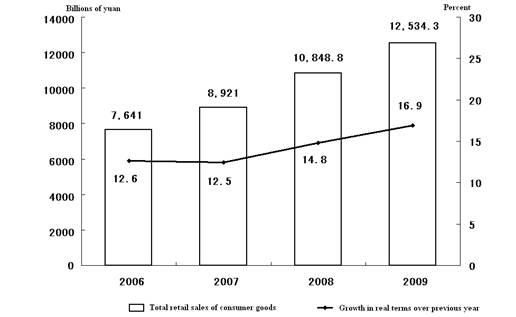
Consumer spending kept rising. We implemented strong and wide-reaching measures to encourage consumption of home appliances, motor vehicles, energy-efficient products and housing, optimized the market consumption environment, and effectively unleashed people's consumption potential, especially in rural areas. Retail sales of consumer goods totaled 12.5343 trillion yuan, up 15.5% from the previous year, 1.5 percentage points higher than planned, and an increase of 16.9% in real terms after adjusting for price changes. A total of 13.645 million motor vehicles were sold, up 46.2%; nearly 90 million home appliances were delivered by manufacturers listed in the national program to subsidize rural residents' purchase of home appliances, with total sales for the year exceeding 150 billion yuan; the total floor area of commodity housing sold throughout the country was 937.13 million square meters, an increase of 42.1%, which in turn stimulated the consumption of building materials, decorative materials, furniture and other commodities. Market prices were basically stable, with the consumer price index (CPI) falling 0.7% for the year, 4.7 percentage points lower than planned.
Figure 1
Retail Sales of Consumer Goods
Investment grew rapidly. Total investment in fixed assets across the country reached 22.4846 trillion yuan, up 30.1% from the previous year, and 10.1 percentage points higher than planned. Fixed-asset investment in urban areas was 19.4139 trillion yuan, up 30.5%. Specifically, investment in primary, secondary and tertiary industries increased by 49.9%, 26.8% and 33% respectively. To implement the plan of investing an additional 4 trillion yuan over two years, we made a total of 924.3 billion yuan of central government investment in 2009, 503.8 billion yuan more than the budgeted figure for the previous year. This investment was divided as follows: the construction of low-income housing, projects to improve the lives of rural residents, rural infrastructure and social programs accounted for 44%; independent innovation, restructuring, energy conservation, emissions reduction and ecological improvement accounted for 16%; major infrastructure projects accounted for 23%; post-disaster recovery and reconstruction work accounted for 14%; and other public spending accounted for 3%. Expanded government investment directly boosted immediate demand, guided and stimulated investment from non-government sources, and played a crucial role in promoting the stability and recovery of the economy. At the same time, it shored up weak links in economic and social development and strengthened the foundations for long-term development.
Figure 2
Quarterly Growth of GDP Since 2008
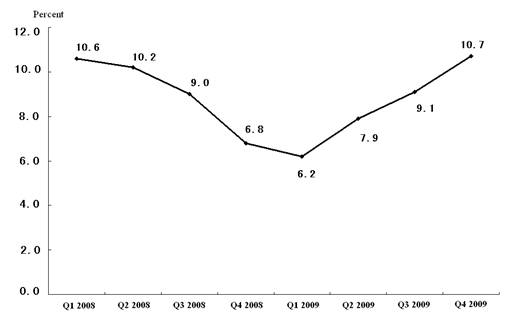
The economic growth rate increased each quarter. It rose by 6.2%, 7.9%, 9.1% and 10.7% respectively compared with the previous year's quarters. GDP for the year was 33.5353 trillion yuan, an increase of 8.7% over the previous year and 0.7 percentage points higher than planned. Of this total, the value-added of primary, secondary and tertiary industries increased by 4.2%, 9.5% and 8.9% respectively, and 1.2, 0.9 and 0.3 percentage points higher than planned. The contributions of consumption and investment to economic growth were 4.6 and 8 percentage points respectively, which offset a 3.9-percentage point shortfall arising from a decline in net exports. Government finances also played an important role in economic development. National revenue for the entire year hit 6.85 trillion yuan, up 11.7%, 3.7 percentage points higher than the budgeted figure, and the government deficit was kept below the budgeted amount; the broad money supply (M2) was increased by 27.7%, 10.7 percentage points higher than planned, and RMB loans totaling 9.594 trillion yuan were granted in 2009. Economic performance improved gradually. The profits of large industrial enterprises stopped declining, began increasing again and reached 2.59 trillion yuan for the period from January to November. Compared to the previous year, profits grew in 30 of 39 large industries, and enterprises operating at a loss reduced their losses by 33.5%.
2. The agricultural foundation was further consolidated.
Agriculture maintained steady development. Despite the impact of serious natural disasters, grain output rose for the sixth consecutive year and totaled 530.82 million tons in 2009, up 0.4% from the previous year, and 30.82 million tons more than planned. Cotton production was 6.4 million tons and did not meet the target; oilseed and sugar crop output was 31 million tons and 122 million tons respectively, 1 million tons and 2 million tons more than planned. The animal husbandry and fishery industries developed in the midst of structural adjustments. The downward trend of dairy cow farming was reversed. Meat production totaled 76.42 million tons, up 5%, and 2.42 million tons more than planned, and the output of aquatic products reached 51.2 million tons, up 4.6%, and 2.2 million tons more than planned.
Figure 3
Grain Output

We continued to improve policies that strengthen agriculture and benefit farmers. We issued the Guidelines on Promoting Steady Agricultural Development and Raising Rural Incomes in the Current Situation. We significantly raised minimum grain purchase prices, and the average floor prices for wheat and rice increased by 0.22 yuan and 0.26 yuan per kilogram respectively. We implemented a national policy for temporarily purchasing and stockpiling corn, soybeans and canola seeds, and increased our reserves of cotton and sugar. The amounts of corn, soybeans, canola seeds, cotton and sugar we stockpiled in 2009 reached 35.891 million tons, 6.863 million tons, 5.569 million tons, 2.72 million tons, and 360,000 tons respectively. We formulated and promptly launched a contingency plan for preventing a precipitous drop in the price of hogs, and successfully implemented the outline for rectifying and reinvigorating the dairy industry. We applied various methods to strengthen regulation of the markets for important agricultural products, and thus solved farmers' difficulty in selling their products and kept prices stable for major agricultural products and agricultural supplies.
Figure 4
Central Government Investment in Agriculture, Rural Areas and Farmers

Investment in agriculture, rural areas and farmers increased dramatically. Central government spending on agriculture, rural areas and farmers was 725.31 billion yuan for the whole year, a year-on-year increase of 21.8%. This included 189 billion yuan of investment in capital construction, an increase of 150%, and 127.45 billion yuan for the four kinds of subsidies to farmers, an increase of 24.41 billion yuan. The outstanding balance of bank loans to agriculture, rural areas and farmers exceeded 9 trillion yuan at the end of 2009, up 34.8%. We began implementation of the Plan for Increasing National Grain Production Capacity by 50 Billion Kilograms (2009-2020). We intensified work to upgrade water-saving devices in large irrigated areas, renovate large pumping stations, reinforce dilapidated reservoirs, and develop production bases and storage and distribution facilities for important agricultural products, including grain, cotton, edible oil and sugar. We increased our support for the project to cultivate superior varieties and breeds; the large-scale, standardized hog and dairy cow farming; the crop protection project; the animal epidemic prevention system; the system for quality inspection and testing of agricultural products; and the project to improve grain yield through science and technology.
Working and living conditions continued to improve in rural areas. An additional 60.69 million rural residents benefited from the project to provide safe drinking water in the countryside, and the portion of the rural population with access to tap water increased by 3.2 percentage points over the previous year to reach 68.7%, and the target was met. We built 1,579 large and medium-sized methane facilities and smoothly achieved the objective set early last year of providing methane gas to an additional 5 million households. We newly built or renovated 380,000 kilometers of rural roads, and extended rural power grids by an additional 266,000 kilometers of power lines. A total of 800,000 dilapidated rural houses were renovated, and 92,000 nomadic families were moved into permanent homes. We made further progress in expanding IT application in rural areas. The telephone network was extended to 99.8% of the country's villages, and 99.5% of towns and townships now have access to the Internet. We also obtained new successes in the project to get retailers to open stores in more townships and villages, the system of scientific and technological services in rural areas, and the project to support 100 large wholesale markets for farm products and 100 large rural retail distributors.
3. We made new progress in restructuring.We made headway in structural optimization and upgrading of key industries. We implemented in an orderly way the plan and related rules for restructuring and revitalizing ten major industries: the steel, motor vehicle, shipbuilding, petrochemicals, textile, nonferrous metals, equipment manufacturing, electronic information, logistics and light industries. To encourage quicker technological upgrading in enterprises, the central government allocated 20 billion yuan to support 4,441 technological upgrading projects. Substantial progress was made in mergers and reorganizations in the machinery, steel, nonferrous metals and papermaking industries. Three integrated refinery and petrochemical complexes, each with ten-million-ton oil refining capacity and one-million-ton ethylene production capacity, were completed and put into production, one each by Dushanzi Petrochemical Corporation, Xinjiang, Fujian Refinery and Petrochemical Company and Tianjin Petrochemical Corporation. We reversed the decline in high-tech manufacturing and achieved a year-on-year increase of 7.7%. We issued and implemented industrial policies for digital television and biological industries. We launched major projects to promote the industrial application and development of technologies in the areas of satellite applications, biotechnology, integrated circuits, flat-panel displays and helicopters. The first Airbus A320 aircraft produced by Airbus Final Assembly Line China in Tianjin made a successful maiden flight. We intensified efforts to build 3G networks with TD-SCDMA as the national standard and promote 3G businesses. Our work to domestically produce key equipment proceeded smoothly. We made a significant breakthrough in independently developing and manufacturing large forgings, a key component of nuclear power generators, and our capacity to domestically produce high-speed EMU trains and urban rail transit facilities improved significantly.
We steadily pressed ahead with the adjustment of industries with excess production capacity. We formulated and implemented the Guidelines on Curbing Excess Production Capacity and Redundant Development in Some Industries and Guiding Them toward Healthy Development, and put forward the main principles, policies and measures on promoting the healthy development of the steel, cement, plate glass and coal chemicals industries. A system for the joint release of information by government departments was set up, and guidance of industrial information was strengthened. We continued to improve the mechanism for eliminating backward production facilities. We put small-capacity thermal power generating units with a total capacity of 26.17 million kilowatts out of business last year, and reached the goal of eliminating small-capacity thermal power generating units with a total capacity of 50 million kilowatts within the Eleventh Five-Year Plan period (2006-2010) one and a half years ahead of schedule. In addition, we shut down backward production facilities in a number of industries, including steel mills with a total capacity of 16.91 million tons, iron foundries with a total capacity of 21.13 million tons, coalmines with a total capacity of 50 million tons, cement plants with a total capacity of 74.16 million tons, calcium carbide plants with a total capacity of 460,000 tons, ferrous alloy foundries with a total capacity of 1.62 million tons, coking works with a total capacity of 18.09 million tons, paper mills with a total capacity of 500,000 tons and chemical fiber mills with a total capacity of 1.37 million tons.
The pace of independent innovation was accelerated. We smoothly implemented the Outline of the National Program for Long- and Medium-Term Scientific and Technological Development (2006-2020). The central government spent 151.2 billion yuan on science and technology, an increase of 30%. Sixteen key science and technology programs, including the development of fabrication equipment and complete process technology for ultra-large scale integrated circuits, high-grade digitally controlled machine tools and basic manufacturing equipment, were fully implemented. Major science projects, such as those to develop the "large sky area multi-object fiber spectroscopic telescope" and upgrade the Beijing electron-positron collider, were successfully completed. Faster progress was made in the third phase of the Knowledge Innovation Program. Significant progress was made in the Technology Innovation Program, the March 1986 High-Tech Program, the March 1997 Program for Basic Research and other state science and technology programs. Twenty-five national engineering laboratories and 63 key national laboratories were built. Support was given to 58 national engineering or technology research centers to improve their capacity for sustained innovation. Eighty-five national projects to develop major industrial technologies were implemented. We assisted enterprises in improving their R&D and laboratory conditions.
Infrastructure and basic industries were constantly strengthened. We increased investment in the South-to-North water diversion project and other large and medium-sized water conservancy projects. Major railway projects, including Beijing-Shanghai, Harbin-Dalian, Shijiazhuang-Wuhan and Lanzhou-Urumqi railways, progressed smoothly. Construction of the national expressway network proceeded in an orderly manner. Construction began on the Hong Kong-Zhuhai-Macao Bridge. An additional 5,557 kilometers of railways and 98,000 kilometers of highways were opened to traffic, including 4,719 kilometers of expressways. A total of 35 civilian airports were built, upgraded or expanded. Work on building large, specialized, deepwater ports and on improving the main navigation channel on the Yangtze River was sped up. Construction began on the eastern section of the second West-to-East Natural Gas Pipeline Project, the Hulun Buir coal-fired power generation base and an energy and chemicals production base in Ningxia. The western section of the second West-to-East Natural Gas Pipeline Project was put into operation. Installed power-generating capacity was increased by 89.7 million kilowatts. We approved the construction of six one-gigawatt nuclear power generating units. Work on large hydropower projects, such as the Jishixia power station on the Yellow River in Qinghai Province and the pumped-storage power plant in Qingyuan, Guangdong Province, progressed smoothly. Construction of a ten-gigawatt wind power generation base, the first of its kind in China, was started in Jiuquan, Gansu Province. Upgrading of urban power grids progressed in an orderly manner. The second phase of the state petroleum reserves project was implemented. Annual coal output reached 3.05 billion tons, up 8.8% from the previous year, and 150 million tons more than planned; oil production hit 189 million tons, 3 million tons less than planned; and 3.7 trillion kilowatt-hours of electricity were generated, a rise of 6.3%, and 73.8 billion kilowatt-hours more than planned.
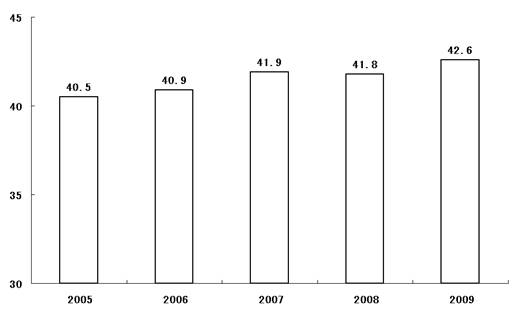
The service sector experienced steady growth. We further implemented policies and measures for encouraging service sector development. We gave greater support to modern services in terms of fiscal and tax, land supply, pricing and financial policies. We successfully launched a number of major interregional, cross-sector projects that will play a stimulating and supporting role for service industries. Banking, insurance, information services, logistics and community services grew rapidly, and a variety of new business emerged in the service sector. The value-added of tertiary industry accounted for 42.6% of GDP, 0.8 percentage points higher than the year before.
Figure 5
Value-added of Tertiary Industry in Percent of GDP
4. We worked harder to conserve energy, protect the environment and tackle climate change.
New progress was made in energy conservation and emissions reduction. Central government investment and incentive funds were used to support a total of 1,318 major energy conservation projects, capable of generating energy savings equivalent to 75 million tons of standard coal per year. Energy-efficient buildings with total floor area of 960 million square meters were built in 2009, capable of generating energy savings equivalent to 9 million tons of standard coal. We used government subsidies to get people to install over 5 million high-efficiency, fixed-frequency room air-conditioners and 150 million efficient light bulbs. Progress was made in demonstration projects for energy-efficient vehicles and new energy vehicles in 13 cities including Beijing, Shanghai and Chongqing. Central government investment was used to support 132 key projects related to the circular economy and resource conservation. We intensified publicity activities, such as the campaign to get everyone to save energy and reduce emissions. Energy consumption per unit of GDP dropped by 2.2%. Sulfur dioxide emissions and chemical oxygen demand were lowered by 4.6% and 3.3% respectively. Water consumption per 10,000 yuan of value-added of industry decreased by 8.2%, 2.6 percentage points higher than planned. The percentage of industrial solid waste that was comprehensively utilized reached 66.6%, a year-on-year increase of 2.3 percentage points, and 0.7 percentage points higher than planned.
We intensified our ecological improvement and environmental protection efforts. Progress was made in major ecological projects, including those to protect virgin forests, build shelterbelts, return farmland to forests, control the sources of dust storms that affect Beijing and Tianjin, and return grazing land to grasslands. An additional 5.885 million hectares of land were planted with trees, raising the percentage of China's land area covered by forests to 20.36%. We constantly intensified our efforts to control soil erosion in key areas. A comprehensive project to prevent karst regions from becoming stony deserts was launched. Smooth progress was made in treating industrial wastewater and waste gases and in preventing and controlling water pollution in key water basins, including the Huai, Hai and Liao rivers and the Tai, Chao and Dianchi lakes. The daily urban sewage treatment capacity rose by 13.3 million cubic meters, and the daily capacity of urban garbage disposal rose by 50,000 tons. The percentage of urban sewage treated reached 72.3% and the percentage of safely handled urban household waste reached 69%, up 2.1 and 2.2 percentage points over the previous year respectively, and 3.3 and 2 percentage points higher than planned. The system of indices for assessing compliance with clean production standards in 11 industries was released. Desulphurization devices were installed in thermal power generating units with a total capacity of 102 million kilowatts, raising the percentage of the total capacity of thermal power generating units so equipped to 72%.
We made new progress in addressing climate change. We conscientiously implemented China's National Climate Change Program. We energetically carried out Clean Development Mechanism projects. We actively promoted R&D on and application of climate-friendly technologies. We set action targets for limits on China's greenhouse gas emissions by 2020. We played a constructive role in international talks and making international rules for dealing with climate change, actively engaged in international exchanges and joint programs, strengthened cooperation and dialogue with relevant countries, and upheld China's legitimate rights and interests in development.
5. We took new steps to balance development among different regions.
We thoroughly implemented the master strategy for regional development. We made substantial progress in the main tasks for promoting large-scale development of the western region. Construction began on 18 major infrastructure projects, with a total investment of 468.9 billion yuan. Industries that can take advantage of local strengths enjoyed faster development. We further strengthened the development of infrastructure, social programs and projects for people's wellbeing in the region.
The revitalization of northeast China and other old industrial bases accelerated. We promulgated and implemented the Guidelines on Further Implementing the Strategy for Revitalizing Northeast China and Other Old Industrial Bases. The policy framework for sustainable development of resource-dependent cities took shape. We expanded the work to clear up non-performing loans in the equipment manufacturing industry. Modern agriculture and modern services developed quickly.
We made new progress in energizing the development of the central region. We promulgated and implemented the plan for promoting the development of the central region. We pressed ahead with efforts to build three different types of production bases and a system of integrated transportation hubs. Powerful momentum was maintained in developing clusters of cities. Industries relocated to the region at a faster pace. The overall economic strength of the region further improved.
In the eastern region, efforts were intensified to ease the impacts of external demand contraction, accelerate restructuring and independent innovation, and foster emerging industries of strategic importance. The region witnessed stronger vitality in economic development and greater overall competitiveness. The development and opening up of special economic zones, the Shanghai Pudong New Area and the Tianjin Binhai New Area, deepened.
We continued to make regional development more balanced. We formulated and implemented a number of plans, policies and measures to support the development of key areas. We implemented the guidelines for the development of the Yangtze River Delta and the plan for the development of the Pearl River Delta. We formulated the guidelines for building Shanghai into an international financial and shipping center, developing the economic zone in Fujian Province on the west coast of the Taiwan Straits, and turning Hainan into an international tourist island. We drew up plans for the development of the coastal area of Jiangsu Province, the coastal economic belt in Liaoning Province, the ecological economic zone of the Yellow River Delta, the Guanzhong-Tianshui economic zone in Shaanxi and Gansu provinces, the Poyang Lake ecological economic zone in Jiangxi Province, Hengqin Island and the region on the Chinese bank of the Tumen River. We increased support for the development of the old revolutionary areas, ethnic minority areas, border areas and poor areas. Measures aimed at promoting the development of Xinjiang, Ningxia, Guangxi, Tibet and Tibetan areas in Qinghai and other provinces were gradually implemented. The flow of factors of production across regions continued well, and the industrial division of labor among regions was readjusted at a faster pace, giving different regions greater comparative advantages.
6. Reform and opening up continued to deepen.
We made new progress in reforming key areas and crucial links. We promoted the expansion of rural reforms. The reform of tenure in collective forests was extended nationwide, and the rights on 100 million hectares of collective forests (60% of the country's total) were devolved to rural residents. New steps were taken in the reform of enterprises. The 142 central state-owned enterprises (SOEs) at the beginning of 2009 were restructured into 129, and we extended the pilot project for standardizing boards of directors to 24 central SOEs. We basically completed asset and business restructuring in relevant enterprises of the basic telecommunications industry, and the competition pattern in the 3G telecommunications market took shape. We formulated and implemented the guidelines for further promoting the development of small and medium-sized enterprises and formulated policies and measures to encourage and guide investment from non-government sources, thereby expanding market access, lowering the market entry threshold, broadening the channels of financing and improving the investment environment. We achieved positive results in fiscal, tax and financial reforms. We comprehensively rolled out VAT reform. We made smooth progress in reforming prices of refined petroleum products and related taxes and fees and rescinded six kinds of fees, including the road maintenance fee. We continued to deepen the reform of financial institutions and capital markets, launched the ChiNext stock market, made steady progress in transforming the China Development Bank into a commercial institution and the Agricultural Bank of China into a shareholding company, and began trials of RMB settlements in cross-border trade. We continued to deepen reform of the investment system, continue to review the items subject to examination and approval for investment projects, and improved the way in which the government arranges and manages its investment plans. The reform of prices for resource products and environmental protection charges moved forward steadily. We conducted the trial of direct trade between electricity users and power plants. We began comprehensively expanding the reform of the pharmaceutical and health care system, promulgated the plan for implementing the reform and 15 relevant documents, and made orderly progress in key areas, such as developing the system of basic medical insurance, implementing the national system for basic drugs, improving the community-level medical and health care system, and promoting equal access to basic public health services. We implemented the reform to introduce a performance-based salary system in schools providing compulsory education, and in public health institutions and community-based medical and health care institutions, and steadily pressed ahead with institutional reforms in culture, the press and publishing. Work on experimental zones for integrated, complete reform progressed in an orderly manner.
We achieved positive results in opening up. We raised export rebate rates four times for labor-intensive products and technology-intensive, high value-added products under 6,955 HS codes; cancelled or lowered 102 export tariffs on grain, fertilizers and selected industrial products; adjusted and reduced 1,804 items on the list of commodities whose processing is classified as prohibited or subject to some restrictions in the processing trade; took active steps to address trade frictions; and effectively eased the adverse impact of drastic changes in the external environment. Drops in imports and exports gradually slowed and both returned to growth at the end of the year. Total import and export volume reached US$2.20722 trillion in 2009, including exports of $1.20166 trillion and imports of $1.00556 trillion. This figure dropped 13.9% compared to the previous year, and failed to meet the targeted growth rate of 8% -- a failure resulting from the sharp decline in international demand, the drop in global market prices, as well as the comparatively low grades of our export products. We continued to adjust the structure of foreign investment utilization. We promulgated and implemented the Suggested List of Industries that Can Take Advantage of Local Strengths in the Central and Western Regions for Foreign Investment in order to lead foreign investment toward high-tech industries, high-end manufacturing and R&D as well as resource-conserving and environmentally friendly industries. Last year, foreign direct investment (excluding that in the banking, securities and insurance sectors) totaled $90 billion, $2.4 billion less than planned. China's foreign exchange reserves stood at $2.3992 trillion at the end of 2009, an increase of $453.1 billion year on year. Outbound investment cooperation soared despite the financial crisis, with new progress made in joint exploitation of energy and resources, overseas mergers and acquisitions, contracted projects and labor services. Chinese direct investment (excluding financial sector investment) in other countries reached $43.3 billion in 2009, an increase of 6.5%, and the volume of business in overseas contracted projects amounted to $77.7 billion, an increase of 37.3%.
7. We made notable progress in improving people's wellbeing and promoting harmony.
We further strengthened work concerning employment and social security. The central government allocated 42.6 billion yuan to promote employment, an increase of 59%. An additional 11.02 million urban jobs were created, 2.02 million more than planned. The urban registered unemployment rate stood at 4.3%, thus meeting the target of keeping it under 4.6%. Employment rate for college and university graduates this year was 87.4%. The number of rural migrant workers totaled 145 million, an increase of 4.92 million. Central government spending on social security was 290.575 billion yuan, an increase of 16.6%. Overall planning for basic old-age insurance for workers of urban enterprises at the provincial level was basically accomplished. The methods for transferring old-age pension accounts for workers who move from one region to another were promulgated and implemented. The number of urban residents covered by basic old-age insurance reached 235 million, 7 million more than planned. The pilot program for a new old-age insurance system for rural residents was launched. The basic medical insurance system for non-working urban residents was fully implemented. The problem of medical insurance for retirees from closed or bankrupt SOEs was properly resolved. The number of participants in the basic medical insurance for urban workers and non-working urban residents increased by 82.39 million to exceed 400 million; and the number of rural residents who signed up for the new type of rural cooperative medical care system increased by 16.3 million to reach 833 million. Standards for enterprise retirees' pensions, urban and rural subsistence allowances and subsidies to entitled groups continued to increase. Channels were further expanded for the funding of social security.
People's living standards continued to improve. We further developed the infrastructure in urban and rural areas and continually improved our ability to provide services. Supplies of goods and materials were abundant and the market was prosperous and stable. Annual urban per capita disposable income and rural per capita net income reached 17,175 yuan and 5,153 yuan respectively, up 9.8% and 8.5% from the previous year, both in real terms after adjusting for price changes, and 3.8 and 2.5 percentage points higher than planned. Great success was achieved in the current stage of our plan for low-income housing construction. The central government allocated 55.056 billion yuan for this purpose, an increase of 200%. As a result, 2 million units of low-income housing of various types were basically built, and 1.3 million houses were renovated in run-down areas in some cities, in state-owned forest regions and land reclamation zones, and around coalmines, thus improving living conditions for nearly 10 million urban residents experiencing difficulties. We allocated 5.6 billion yuan to work-relief schemes and 1.8 billion yuan to the pilot program for relocating impoverished people from inhospitable areas. These funds supported poor areas in strengthening their ability to develop and poor people in alleviating poverty. Policies for providing ongoing aid to rural residents relocated to make way for the construction of large and medium-sized reservoirs were conscientiously implemented, benefiting 23.56 million relocated people.
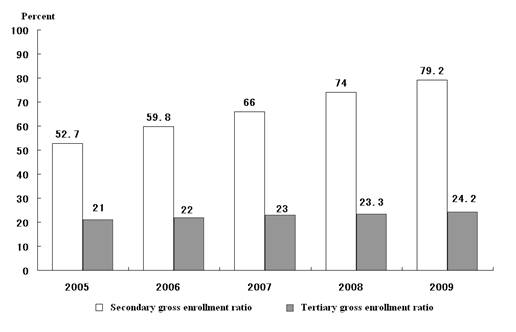
Social programs progressed in an all-round way. Infrastructure development for social programs was strengthened. Since the fourth quarter of 2008, central government funding for the development of social program infrastructure exceeded 55 billion yuan, more than the total for the whole Tenth Five-Year Plan period (2001-2005). Policies for free compulsory urban and rural education were fully implemented, and projects to renovate rural junior secondary school buildings in the central and western regions and to ensure the safety of primary and secondary school buildings across China were energetically carried forward. A total of 6.7 million square meters of rural junior secondary school buildings were renovated, and 3.14 million square meters of secondary vocational school buildings and special education school buildings were built. The junior secondary school retention rate rose by 0.3 percentage points to reach 94%; secondary gross enrollment ratio reached 79.2%, up 5.2 percentage points, and 2.2 percentage points higher than planned; regular undergraduate enrollment reached 6.395 million, an increase of 318,000, and 105,000 more than planned; and graduate enrollment totaled 511,000, an increase of 65,000, and 36,000 more than planned. Development of community-level medical and health care services and family planning facilities was further strengthened. A total of 17,171 community-based medical and health care clinics were set up; 4,522 community-level family planning service programs were established; and work relating to prevention and control of influenza A (H1N1) proceeded in a lawful, scientific and orderly way. The natural population growth rate was 5.05‰, meeting the goal of keeping it under 7‰. Construction of major cultural projects such as the National Museum of China and the second phase of the National Library of China proceeded smoothly. A total of 5,062 multipurpose cultural centers in towns and townships were built, and 1,444 public cultural facilities including museums, art galleries, and libraries were opened to the public for free. Radio coverage was extended to 96.3% of the population, and television coverage was extended to 97.2%. The tasks in the Eleventh Five-Year Plan to extend radio and TV coverage to every village were completed one year ahead of schedule. The targets in the plan for developing key tourist sites concerning the early history of the CPC were fully achieved. Philosophy, the social sciences, the press, publishing, literature, art and sports all flourished. The Eleventh National Games were successfully held. Construction of the Shanghai World Expo Park was basically completed.
Figure 6
Gross Enrollment Ratios for Secondary and Tertiary Education
Great progress was achieved in the current stage of implementing the plan for recovery and reconstruction following the Wenchuan earthquake. Investment of 654.5 billion yuan has been made in the most seriously affected areas, accounting for 65.5% of the total investment allocated in the plan. The rebuilding of rural houses was basically completed; rebuilding and reinforcing of urban houses were fully carried out; building of schools, hospitals and infrastructure proceeded smoothly; and reconstruction of Beichuan, Wenchuan and Qingchuan county seats and severely hit towns such as Yingxiu and Hanwang was sped up. The protection of cultural heritage in quake-hit areas was strengthened. Remarkable progress was achieved in one-to-one assistance.
Figure 7
Progress in Major Post-Wenchuan Earthquake Recovery and Reconstruction Tasks

In the context of the international financial turbulence, global economic recession, and grim and complex situations at home and abroad, we completed the main tasks specified in the 2009 plan for national economic and social development well. This achievement did not come easily. It was the result of the scientific response and strong leadership of the Party Central Committee and the State Council and the enormous concerted efforts of the whole nation from top to bottom in thoroughly applying the Scientific Outlook on Development and fully implementing the package plan for responding to the global financial crisis and relevant policies and measures. It was also attributable to the political advantages of the socialist system, which enables the country to mobilize the public, make efficient decisions, and concentrate resources on accomplishing major tasks.
While fully affirming our achievements and strengthening confidence in success, we are keenly aware that our country's economic and social development still faces severe challenges that will confront us for some time to come.
Internationally, although the world economy is beginning to recover, there are still many uncertainties and instabilities in economic development. The foundation for economic recovery is still weak; risks in the financial sector have not been completely eliminated; unemployment rates in major developed economies remain high; trade protectionism is rising; and prices for major international commodities and exchange rates of major currencies might fluctuate more wildly.
Domestically, there are outstanding conflicts and problems as well.
First, the internal driving force of economic growth is still too weak. Consumer spending is unlikely to grow significantly; non-government investment is still not fulfilling its potential; and the effect of policies for stimulating consumption and investment might wear off. All of this makes it hard to further expand domestic demand. At the same time, external demand is unlikely to return to the level before the crisis any time soon due to sluggish international market demands and increasing trade frictions.
Second, we are under mounting pressure to transform the pattern of development and adjust the economic structure. Our enterprises are weak in independent innovation; our economic growth still relies heavily on high consumption of material resources; land, resources and the environment impose increasingly tight constraints on development; investment and consumption are disproportionate; and the problem of excess production capacity and haphazard and redundant development in some industries is serious.
Third, it is very difficult to promote energy conservation and emissions reduction. As the economic situation has turned for the better, energy-intensive and highly polluting industries have expanded their production significantly, some enterprises with operating difficulties have reduced their spending on upgrading energy-saving, emissions-reducing technologies and controlling pollution, and some localities have slackened their efforts to conserve energy and reduce emissions.
Fourth, the foundation for promoting the steady development of agriculture and continual increases in rural incomes is not solid. The weak infrastructure for agricultural water conservancy and the vulnerability to natural disasters and comparatively low profits of agriculture make it difficult to keep rural incomes growing.
Fifth, the employment situation is still grim. There are a large number of college graduates and other young people entering the job market; some disadvantaged groups experience increasing difficulties in finding employment; and the task of helping rural workers find non-agricultural jobs remains arduous.
Sixth, there is excessive growth in money and credit supplies and an irrational credit structure, both exerting a great pressure on liquidity management.
In addition, housing prices in some cities are rising too fast, and there are many conspicuous problems related to production safety, income distribution, social stability, and unbalanced development between urban and rural areas and among different regions.
We need to take all the above problems very seriously and adopt effective measures to solve them.


