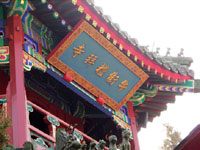
 Every place on earth has its own local specialties. There is a saying that, "Beijing has the best snacks in China, the best snacks in Beijing are the Muslim snacks and the best Muslim snacks are on Niujie (Beef Street)."
Niujie is located at Guang'anmen in the southern part of Beijing. The district is home to the largest concentration of Muslim people in Beijing. Here the rich Muslim culture has cultivated a distinguished cuisine. Truly this is a street of Muslim food.
A street made famous by food
Tradition has it that Niujie was originally known as Liujie (Pomegranate Street). When Muslim people first settled down here they liked to grow pomegranate trees, hence the name. Over the years a brisk trade in beef and mutton developed and the name Niujie came to be adopted.
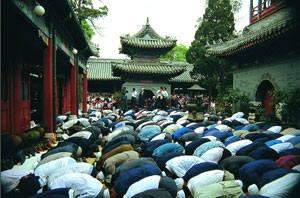
The food to be found in Niujie is closely associated with the local history. The records show that Arabs first introduced Islam to China around the 7th century. With them came cardamom, pepper, fennel, cinnamon and other spices. By the 11th century Muslims were already living in the Niujie district. The political changes of the following two centuries resulted in two large-scale migrations of Muslims and Niujie became one of the places they chose to settle down in.
For hundreds of years, Muslim cuisine has blended with local Beijing styles creating a unique culinary art. So closely are they associated with this one street, the very name Niujie has become synonymous with the Muslim snacks to be found here.
The residents here are skilled in their use of spices in cooking various meats. They are particularly fond of barbecued food so reminiscent of the traditions found in the Arab world.
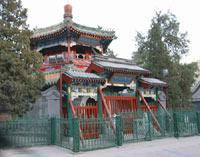 Muslim snacks had their hay days in the 17th century (Qing Dynasty). In those days there were policies in place that discriminated against the Hui people in favor of the Han majority. Denied education and facing poverty, many Muslim people of the Niujie area turned to making and selling snacks in order to eke out a living.
They became known for a life style founded on the "two knives and eight ropes". The two knives were those used for cutting mutton and qiegao. The latter is a kind of cake made of sticky (glutinous) rice with a layer of sweetened bean paste and eaten sliced. The eight ropes were those of the peddler's baskets on their carrying pole. As they worked to make ends meet they honed the skills of their culinary craftsmanship. Many of their snacks became famous, finding favor with customers from all walks of life.
Niujie delicacies
Today some 200 different snacks are produced at Niujie. They follow the pattern of the changing seasons.
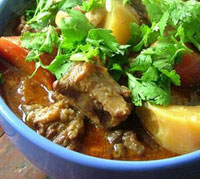 Each spring there are spiced peas, fresh, sweet and soft; salted beans in the pod, crisp while tender and green; various stuffed rice dumplings and cakes and then of course there are the fried spring rolls.
When summer comes it brings such delicacies as tender white cheese; cool, green rice and lotus leaf gruel; bean jelly; sweet and sour plum juice; the list just goes on and on, full of good things.
In autumn, wonderful cooking smells of roast meats permeate through the lanes and streets of the area. Fresh corn on the cob becomes available. Then there is soup made of the chopped innards of sheep and oxen; quick-fried tripe (Baodu); haw jelly and so on with something to suit every taste.
Winter brings the smell of roasting sweet potatoes to the street. You can also choose such hot delicacies as fried sweet flour gruel; red bean and barley gruel; fried bean dishes and quick boiled mutton to warm yourself against the winter cold.
Some snacks are now available all the year round and some have spread their influence and are to be found all over Beijing.
Sticky rice with sweet fillings (Ai Wo Wo, 艾窩窩)
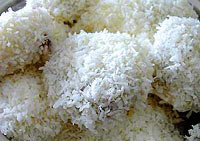 As white as snow, this delicacy is made of sticky rice. The rice is first steamed then pounded and shaped into a ball. It is then given a filling, which might be sesame and white sugar, pea-flour, jujube paste or some other treat. Flexible in consistency and with a distinctive smooth texture, this dainty snack became a favorite of imperial and noble families during the Ming Dynasty (1368-1644). It is said that it came to be called Ai Wo Wo (emperor's special) because one particular emperor loved it so much.
Stir-fried Tofu (Chao Ma Doufu, 炒麻豆腐)
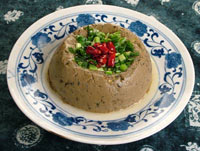 The base for this snack is Douzhi (Mung Bean Milk) itself another Beijing delicacy in its own right. Both are firm favorites with native Beijingers. Chao Ma Doufu is a colorful dish with its alternating colors of grey, white, red and green. Its tastes are hot and sour. It is fragrant with a fluffy texture. The most original version is stir-fried in mutton fat but today it also comes stir-fried in rapeseed oil. What is most important during stir-frying is to reduce the water content and produce a sticky constituency.
Pancakes with sweetened bean paste filling (Douxian Shaobing, 豆餡燒餅)
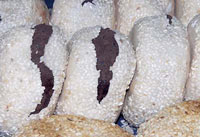 This is a very popular Beijing snack. Crisp outside, they are soft and sweet inside.
Sticky rice cake with a layer of sweetened bean paste (Qiegao, 切糕)
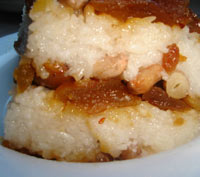 Available in Beijing markets all the year round, this delicacy is particularly associated with the month of March. The snack has a long history dating back to the 13th century and it is made and sold today much as it was in those days of long ago.
The most common form of Qiegao is made from glutinous rice with date or bean paste. Glutinous rice flour is first well mixed with water and then steamed. When cooked the rice flour is then kneaded evenly into thin layers. Each cake has four such layers with bean or date paste spread between them. It is served in slices on a plate with a dusting of white sugar.
Dried fruit dish (Guozi Gan, 果子干)
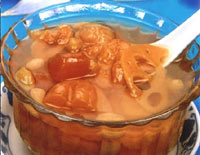 The Dictionary of the Beijing Dialect has this recipe for Guozi Gan: Take dried persimmon as the main ingredient, add dried apricot, and then soak them in warm boiled water. Add slices of fresh lotus root and mix well.
The dried persimmon brings amber and the dried apricot an orange-red, and then there is the white of the lotus root all set with sweetened osmanthus flower juice.
Served over ice, it tastes cool, crisp with a touch of sweet and sour. Very refreshing, it is a taste of summer
Cheese
Cheese making in Beijing has a long history. Made from cow or sheep milk in a complicated process it melts in the mouth. Moist and creamy, tasty and refreshing, it is a popular summer snack. Regular customers speak highly of Beijing cheeses saying they are “food for the hungry, drink for the thirsty and beneficial to the health”.
Boiled sheep innards (Baitang Zasui, 白湯雜碎)
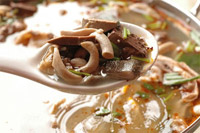 Its unique taste has made it a favorite of most native Beijingers. Traditionally it used to be put on the market to mark the beginning of autumn (August 7 or 8), but now it is available all the year round.
It is made from the internal organs of the sheep. Sheep tripe, heart, meat from the sheep's head, lung and intestines are shredded then thoroughly cooked in a mutton stock with such seasonings as salt, seeds of the Chinese prickly ash, green onion, ginger and garlic.
It is ready when the soup turns milky white after the surface is skimmed off. It is served with flavorings of coriander, sesame paste and pungent sauce.
Braised mutton
The Ode to the Top 100 Foods in the Ancient Capital says, "Braised mutton is the best food produced by the Muslim people of the ancient capital. It is characterized not only by the use of good quality mutton but also by the exquisite culinary art employed. Braised mutton is available in other places but that produced in Beijing cannot be matched for taste."
How true this is. When the braised mutton is ready for sale, its enticing smell can reach far into the distance. Well done and crisp outside but tender inside it is not at all greasy. It goes well with wine or with a pancake (Shaobing). It is a traditional Muslim food. Water-cooled noodles take up a distinctive flavor when seasoned with its soup.
Stewed mutton strip
This is a famous Muslim dish based on streaky mutton. The meat is first washed in cold water before being cooked in boiling water. Then cut into stripes and arranged in a bowl of the original stock, it is steamed together with such seasonings as green onion, ginger, Shaoxing rice wine and soy sauce. Once well done, it is pan braised. The finished dish, golden in color, is soft and fragrant.
Long-established Niujie Businesses
The Niujie area is presently undergoing the most extensive phase of demolition and re-construction in its history. Some snacks will disappear after the traditional Feast of Fast-breaking that marks the end of Ramadan. Fortunately there are some long-established businesses that will continue to offer quality delicacies and they will do so all year round.
Baodu Feng (爆肚馮)
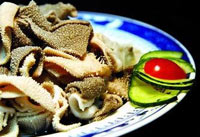 One could be excused for thinking that Baodu (quick-fried tripe) was just a snack for ordinary people. But Baodu Feng was once a supplier of oxen and sheep tripe to the imperial kitchens.
Today this branch of the culinary arts is in the safe hands of Mr. Feng Guangqu, a descendant of the proprietors the original Baodu Feng. His store is located at Langfang Ertiao.
According to Feng, he began to learn Baodu cookery from his father at the age of 10.
The dish is of either ox tripe or sheep tripe and can be cooked in oil, salt or water. Baodu Feng adopts the third of these options. The fresh oxen or sheep stomach is washed clean and cut in the traditional way before going into the boiling water. Served dipped in seasoning, it is crisp and tasty.
Requiring 13 ingredients including coriander, sesame paste, vinegar, fermented bean curd and mushroom juice, Baodu Feng seasoning is highly thought of. Two of these ingredients are kept secret; all that is known is that they must be processed at high temperatures.
Address: 39 Langfang Ertiao, Qianmeng Wai
Yuesheng Zhai (月盛齋)
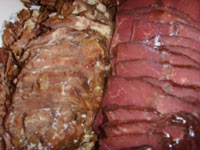 Mr. Ma's ancestor founded the Yuesheng Zhai shop during the Qing Dynasty (1644-1911). In its early years it specialized in producing braised mutton seasoned with soy sauce and stewed mutton. Later on the advice of an imperial doctor the seasoning was improved. And so clove and fructus amoni became the prime ingredients. Fermented soy paste and salt were used in the dressing. Mutton cooked this way not only tastes good but is claimed to be nutritious and capable of sharpening the appetite and regulating the vital energy.
When deep-fried in oil, the braised mutton becomes transformed into yet another delicacy. Eaten hot in this style it is crisp outside and tender inside.
Eaten with noodle in soup, it becomes is a traditional summer delicacy in Beijing.
Empress Dowager Cixi (1835-1908) was fond of the mutton produced here and arranged for Yuesheng Zhai to be issued with four passes for use when delivering the food. These passes were worn at the waist and showed that one was permitted to enter the imperial court. They are now part of the collection in the National Archives.
During the years of Chinese resistance against Japanese aggression it became difficult to buy mutton in the capital. It was then that Yuesheng Zhai increased the production of braised beef which went on to become as famous as the braised mutton.
In addition to these two delicacies, stir-fried doufu, noodle made from mung bean flour, fruit roll and other snacks are also available in this small shop.
Address: Langfang Ertiao, Qianmen Wai.
Cheese Wei
Unlike cheese produced abroad, the white and delicate cheese produced by Cheese Wei is more like a yogurt. It is smooth and sweet to the taste.
Then there is the Laogan also made from fresh milk. Its soft brown lumps have little smell and the taste is not at all greasy.
There is also naijuan. This crunchy roll is made from a skin drawn from the surface of milk. Filled with haw jam or sesame paste it is fragrant and sweet tasting.
According to Mr. Wei, the owner of the shop, their cheese making methods are not their own recent invention. They have been handed down from his ancestor who obtained them from a friend who served with the imperial court of the Qing Dynasty. The two generations of the family that followed were not only to continue the tradition but went on to further develop this particular culinary skill.
In addition to its diary products, this shop also sells another 20 snacks including sweetened fried flour gruel, sweet and sour plum juice, dried fruits, fried haw and rosy dates. More than enough to remind senior Beijingers of their childhood days.
Address: Guoqiaoju Snack Street, 1st floor underground, Xin Dong'an Market, Wangfujin
Sheep Head Ma (羊頭馬)
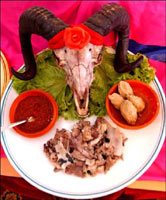 Sheep Head Ma can claim to be a very distinctive Beijing snack. Long ago a Beijinger might think himself fortunate to have a pancake filled with sheep's head mutton or be able to eat the mutton while drinking wine.
Sheep Head Ma was first seen during the period 1821-1850. A carefully selected sheep's head is thoroughly cleaned and boiled in water without any seasoning.
It is seasoned to taste while eating with a special salt-based seasoning. This is made from fried salt, clove and Chinese prickly ash. The seasoning comes in a traditional ox horn container that protects it from the ill effects of humidity.
Today’s sixth generation purveyor of Sheep Head Ma demonstrates all the craftsmanship handed down from his ancestors. Not only does he cook mutton that his ancestors would be proud of but he has also developed outstanding skills with a knife. In his deft hands a 60cm knife seems to have eyes of its own as he quickly cuts wafer thin slices of mutton to meet the requirements of his customers.
Other delicacies also available in this shop include noodles with quick-fried beef sauce and spiced sheep's feet.
Address: 98 Nanheng Xijie
Deshun Zhai (德順齋)
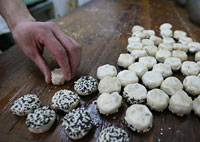 A Deshun Zhai ancestor first made pancakes (shaobing) and crisply fried dough rings (jiaoquan) during the period 1856-1874. The pancakes and dough rings produced by the Juwang Family became famous in Beijing. Although they were a most ordinary popular snack they were well received by people from all walks of life. Here the pancake is baked brown. Just a light touch on its sesame seed encrusted exterior and it cracks open. Your first bite will be greeted by a welcome fragrance. Look carefully inside a pancake and you’ll find a dozen layers, separate and not sticking to each other.
The dough ring might look very simple but it's actually not at all easy to make. Due care and attention are required at each stage of the process from selection of the ingredients through making the dough to cooking. Eating a crisply fried dough ring with mung bean milk is a number one delicacy for many old Beijingers.
Niangao Qian (年糕錢)
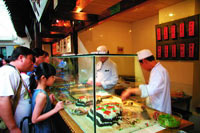 When the capital of the Ming Dynasty was moved from Nanjing to Beijing, rice followed it northwards. In was in this way that sticky and fragrant niangao (New Year cake) made of glutinous rice flour and other sticky snacks first began to appear in Beijing.
Sticky snacks are one of the main varieties of Muslim snacks. When Niangao Qian started his business in the latter years of the Qing Dynasty, three or four of the 10 Niujie residents were already engaged in selling New Year cake.
At that time they had to hawk their cakes around the streets or set up a stall in the street. Life then was difficult. Today Niangao Qian is a famous food chain in the Niujie area. In addition to Ai Wo Wo and Qiegao, the shop also sells a dozen more snacks. These include rolling donkey. Yes Ludagun, a kind of cake made of soya bean-flour, really is called rolling donkey! Apparently when it's rolled in bean flour it looks just like a donkey rolling on the ground and kicking up the dust. Then there's cake made from kidney bean flour, Chinese yam roll, cake made from chestnut flour and deep-fried cake made from glutinous millet flour.
According to Mr. Qian, owner of the shop, traditional Beijing snacks followed the seasons. Take sticky snacks for example, pea-flour cake (Wan Dou Huang) and Ai Wo Wo were available only in the first lunar month, while rolling donkey was on sale through the winter until March of the following year.
Cold delicacies like sweet cake made of glutinous rice, buckwheat pudding served with sweet sauce and bean jelly are sold in summer, while Qiegao is available throughout the year.
Address: Niujie Muslim Supermarket
(China.org.cn April 21, 2008)