?China's dream and the human dream
- By John Ross
 0 Comment(s)
 Print
Print E-mail China.org.cn, December 15, 2017


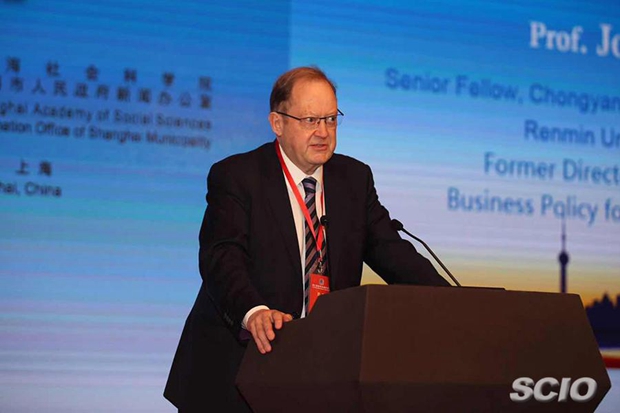
John Ross, senior fellow with the Chongyang Institute for Financial Studies at Renmin University of China, speaks at the Seventh World Forum on China Studies in Shanghai on Dec. 10, 2017. [Photo by Wu Xiaoshan/China SCIO]
Editor's note: China.org.cn has been authorized to publish this article based on John Ross' presentation at the Seventh World Forum on China Studies held in Shanghai on Dec.10-11, 2017.
First, thank you very much for the invitation to speak for which I am greatly honoured.
The theme of this session is "China towards 2050: New Era, New Thought, New Journey." I would like to take as the starting point to examine the profound speech on the development of human civilization delivered at the headquarters of UNESCO by President Xi Jinping in which he reminded us of the Chinese saying, "The ocean is vast because it refuses no rivers."
Not all rivers are the same size of course. Of those that have flowed into the ocean of human civilization China's is certainly one of the largest. But, as China itself states, its river has not flowed at all times with the same strength.
As everyone here knows, from the fifth decade of the 19th century the river of China encountered many blockages and problems. At that time, therefore, the flow of China's river into the ocean of human civilization was also weakened. Today, thanks to immense sacrifices by the Chinese people and the leadership of the Communist Party of China, that river is again running very strongly through China's own territory. Therefore, as will be discussed here, it is flowing increasingly powerfully into the general ocean of human civilization.
This reality means China's national rejuvenation and its contribution to humanity are not counter-posed, but inextricably linked. As President Xi Jinping put it in his first press conference as General Secretary of the CPC regarding China's people: "Throughout 5,000 years of development, the Chinese nation has made significant contributions to the progress of human civilization… Our responsibility is… to pursue the goal of the rejuvenation of the Chinese nation, so that China can stand firmer and stronger among the world's nations, and make new and greater contributions to mankind."
Because I know I am speaking in front of many distinguished Chinese and international experts on China I would like to divide my speech assessing some aspects of this into two parts.
The first part is my specific area of professional competence – economics. This is not only the great impact of China on the global economy but a simple considered statement – that China's economic thinking is already the most advanced in the world. The second, as someone who came to be interested in Chinese culture 52 years ago not through economics but through Chinese poetry, I hope to make a few brief non-professional, but I hope intelligent, comments on the reasons why the global impact of Chinese culture and philosophy will also greatly increase. I hope by doing so, it will also justify another considered statement – that China's geopolitics and foreign policy thinking is the most advanced in the world. Finally, I hope to show why these aspects are interrelated.
China's economic thinking is the most advanced in the world
First, to deal with the obvious impact of China, and its "New Era, New Thought, New Journey," let us note the significance of the regrettable fact that I have to deliver this speech in English – for which, as there are many foreigners at this conference who speak fluent Chinese, I have to deeply apologize! But this reality also shows the enormously growing impact of China.
For many years the Chinese economy was an object of study outside China only for specialists – whose first skill was precisely their knowledge of the Chinese language. These specialists were naturally varied in their output. Some produced extremely valuable books. Some regrettably are still active today "bad mouthing" China and predicting disaster in the Chinese economy despite the fact that China has produced the greatest economic growth over a sustained period in the whole of human history. But they shared a common feature that the study of China's economy outside China was not part of the mainstream of economics.
If I may recall a personal experience, I vividly remember in 1992 publishing an article in English and Russian "Why the Economic Reform Succeeded in China and Will Fail in Russia and Eastern Europe." This was based on careful study of Deng Xiaoping, Chen Yun and available material outside China on China's economic reform. The reaction of most people was "why are you so interested in China? It is a poor country; it is not a very big economy." And in 1992 those latter remarks were true.
My answer was simple: "Because study shows China's economic theory is correct and more advanced than anything in the West. And because China's economic theory is correct the actions based on this will produce economic success, whereas because the West's economic theories on these issues are wrong they will produce a disaster in Russia and the former USSR." As I summarized this later in an article with the deliberately self-explanatory title "Deng Xiaoping, the world's greatest economist:" "Deng Xiaoping was above all a great leader of the Chinese people. Through pursuit of his country's national revival… he also made an unparalleled contribution to humanity's overall well-being. But if that were not enough, Deng Xiaoping had another achievement. By far the greatest economist of the 20th century was not Keynes, Hayek or Friedman but Deng Xiaoping."
Facts proved which of these analyses was correct. China, developing the theory of a "socialist market economy," underwent the greatest sustained economic growth in a major country in human history. Russia, under the influence of Western economic theories which were counter-posed to China's, underwent the greatest economic collapse in a major economy in peacetime since the Industrial Revolution – with a decline of GDP of 39 percent in seven years.
The theory of economics does not recognize national boundaries nor is it the monopoly of any one language. To accurately predict what will happen it was possible to make up for very poor knowledge of the Chinese language with good economics!
Twenty-five years later of course no economist considers it strange to study China's economy. Hundreds of articles appear every day in the media outside China about China's economy. Numerous major economists write about China. A subject which 25 years ago was considered a "niche" one outside China is now totally mainstream.
Indeed, I will put it in clear form. China's achievements are too great to need exaggeration. I have no romantic concept, and neither should any serious scholar, that "China is the best in the world at everything." If you are a physicist, for example, the top prize is still held by a German, Einstein, and a Britain, Newton. But in the field of economics it should be stated bluntly that China's unparalleled economic development, China's ability to avoid the disaster produced in the former Soviet Union by Western economic ideas in "shock therapy," and China's ability to come through the international financial crisis without any setback comparable to that in the major Western economies confirms that China's economic thinking is already the most advanced in the world. I will also outline later why the same applies to foreign policy and geopolitics.
But before going on to other issues, the reasons for this advanced character of China's economic thinking was well stated not in my words but in those of one of China's most important economists, Justin Yifu Lin.
"Adam Smith's‘Wealth of Nations' marked the birth of modern economics. From Adam Smith up to the year 1930, most master-economists were British or foreigners working in the U.K. This trend changed during the 1930s, when the United States started to become home to great economists. This phenomenon has something to do with the nature of economics. Only when an economist lives in an important economy can he or she have a good command of real social and economic variables key to better illustrate cause/result relationship... It is inevitable, then, that the research center of economics will move eastward to China."
In short, it is the tremendous success of China's economy that has taken study of China's economy from being a niche speciality to being one of the most important and mainstream issues in economics. The same process is going to progressively take place in other subjects – I am just able to follow it most closely in economics.
This process, I believe, also explains what a foreigner can contribute to one of China's most important new think tanks, Chongyang Institute for Financial Studies, Renmin University of China – where I work. Obviously, as I have been writing on the issue for 25 years, I have by Western standards a good knowledge of China's domestic economy, but I would immediately state that many Chinese economists have a more detailed knowledge of its domestic economy than any foreigner. The areas where a foreigner can contribute are on the relations of China, the international economy and on issues of economic theory.
Foreign policy and geopolitics
For the second part of my speech, I hope I may be permitted to make a few non-professional, but I hope intelligent, observations on other issues and why I believe they relate to more professional issues of foreign policy and geopolitics.
As I stated my own intellectual engagement with China did not begin with economics, it began 52 years ago with poetry. At university I read the translated works of Li Bai and Du Fu and was fascinated by their reflection of Chinese culture and by certain key ideas which were different to our own European ones. Only 40 years later, aided by the impact of living in China, could I work out clearly why.
China is unique in that it is the only one of the powerful civilizations that is not founded on a religion. All the others – Christianity, Islam, Hinduism, Buddhism, Judaism – are religions. Confucianism is not. It is a system of social values.
This interacts deeply with China's current reality and aids China's role in another field in which China has the most advanced ideas – foreign policy and geopolitics. No one here with specific religious values should be insulted, but it is clear a truly global system of organization cannot be based on a religion – because there is a disagreement as to which religion is correct and there are a large number of people who are not religious. Therefore, a global order must itself be based on social values not on a religion. This fact that China is uniquely the one great civilization based on social values and not a religion gives it an advantage in thinking about a global order.
Xi Jinping has put forward as the central concept for developing foreign policy and geopolitics a "community with a shared future." In developing this, his book The Governance of China is full of references to classical Chinese authors. For example fundamental to his vision of global order, quoting The Mencius, is: "As early as over 2, 000 years ago, the Chinese people came to recognize that‘it is natural for things to be different.' Civilizations are equal, and such equality has made exchanges and mutual learning among civilizations possible….all have their respective strengths and weaknesses. No civilization is perfect on the planet. Nor is it devoid of merit."
In short, China's fundamental concept of foreign policy and geopolitics is simultaneously of equality and diversity. This is fundamentally different to the hierarchical concept of "one nation superior to others" of, for example, the U.S. neo-cons – who, because of this concept of a hierarchy, also aim at uniformity in which all nations should aspire to a single model, namely their own. It could be demonstrated that this formula of "equality and diversity" is also present in European philosophy – for example in Spinoza, Leibniz and Hegel. But Xi Jinping shows the deep roots of this concept in classical Chinese thought.
But this ancient thought of China is also deeply related to economic theory. The opening sentence of the first chapter of the founding work of modern economics, Adam Smith's The Wealth of Nations, from which the whole of the rest of it flows is clear:
"The greatest improvement in the productive powers of labour, and the greater part of the skill, dexterity, and judgment with which it is directed, or applied, seem to have been the effects of the division of labour."
But the advantage of the division of labour is precisely that of the difference of the different parts of the economic system – not of their similarity. The advantage of division of labour is not of similarity but of difference. If every part of the economic system were the same there would be no advantage from division of labour. It is this which also explains why it is a "community with a shared future." No single part, and therefore no single country, of the modern global economic order could achieve the advanced levels of productivity, and therefore of human well-being, which differentiated division of labour makes possible. The wellbeing of each part of the world depends on the wellbeing of others.
The concepts of China's traditional philosophy and morality therefore integrate with economics in a way no other country does. This is why, from a fundamental point of view, the attempt to integrate Confucianism and modern reality is not artificial.
It is therefore in these areas – of economics, foreign policy and geopolitics – that China's thinking is already the most advanced in the world. For reasons outlined China's classic thinking is not an obstacle to this but an aid. It reflects what I believe is a profound reality – that China is simultaneously the oldest country in the world and the most modern.
Finally, what does this mean for the place of China's river flowing into the ocean of human civilization? It means precisely what Xi Jinping said: "Throughout 5,000 years of development, the Chinese nation has made significant contributions to the progress of human civilization… Our responsibility is… to pursue the goal of the rejuvenation of the Chinese nation, so that China can stand firmer and stronger among the world's nations, and make new and greater contributions to mankind."
But these words can also be seen from another angle – inevitably so by someone who is a member of humanity but not Chinese.
The great German Philosopher Hegel noted that at a particular moment in history the general progress of humanity becomes determined by a specific country. This meant that the pursuit of the progress of a particular country is decisive for the progress of the whole of humanity.
To take an historical process, in Europe, at the end of the 16th century, Holland carried out the first successful anti-feudal revolution in history. Holland was a tiny country, but so progressive and so great was the impact of this event that it inspired writers and other struggles for centuries. In 1776 the launching of the U.S. struggle for independence was the first break with the British Empire and created what became the world's most powerful state. At the end of 18th century the French Revolution created a struggle for liberty which shook Europe to its foundations. In 1917 a revolution took place in Russia that was not only one of the greatest events in world history but hastened the fall of all colonial Empires – and had a decisive effect on China itself.
Today, in equal measure, the greatest step that can be taken not only for China but for all humanity can only be taken by Chinese people, on Chinese soil, and in pursuing a Chinese Dream.
Thank you.
John Ross, Senior Fellow, Chongyang Institute for Financial Studies, Renmin University of China, is a columnist with China.org.cn. For more information please visit:
http://www.ccgp-fushun.com/opinion/johnross.htm
Opinion articles reflect the views of their authors, not necessarily those of China.org.cn.


