Development in all respects
- By Kou Liyan
 0 Comment(s)
 Print
Print E-mail China Today, October 14, 2017


Every five years, foreign expats in the Chinese capital – from executives of multinational companies, to journalists, to teachers – take time out from their daily business to see what's going on in China's politics, a topic also kindled by local taxi drivers. This cycle is worldwide – the reason? The National Congress of the Communist Party of China (CPC), which is held every five years.
This October 18, the 19th National Congress of the CPC is to be convened in Beijing. Many of my foreign friends are looking forward to this event as a way of getting a handle on the Party's proposals and actions over the past five years, and catching a glimpse of the course the country will take in the five years to come and how it will affect them. As a warm-up, I've recommended that they read Seven Years as an Educated Youth, which is about the seven years that President Xi Jinping spent in a poor village, four decades ago, and Xi's Up and Out of Poverty. Both books, through the telling of anecdotes, can give some insight into the logic behind all the domestic and foreign policies that China has introduced since the last CPC National Congress.
Shaking off Poverty, the Basic Logic
The CPC holds that all national policies must be based on the reality that China is still in the primary stage of socialism, which entails low to average living and production standards and immature systems and institutions. Poverty, therefore, is a basic logic of these policies. Here, however, poverty is not confined to the economic sphere. As Xi Jinping wrote in Up and Out of Poverty, to shake off poverty we must first of all shake off poverty of mind. This notion is a nod to Karl Marx's 1847 book, The Poverty of Philosophy. In other words, poverty means deficiency, which could be in both the material and intellectual sense.
|
|
|
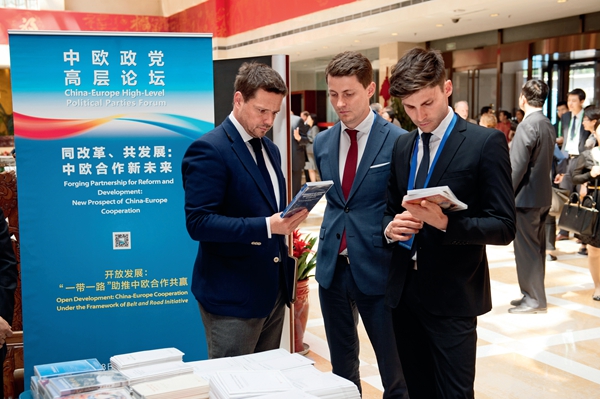
The 5th China-Europe High-Level Political Parties Forum opens in Beijing on May 17, 2017. |
I think the president knows more about poverty than most of us. He was sent to an impoverished village in arid northwestern China in 1969, at the age of 15, and remained there for seven years. According to Seven Years as an Educated Youth, "poor" is actually an understatement when describing life in Liangjiahe Village at that time, by Western standards. The adjective "primitive" might be more apt.
Under dire food shortages, local farmers and Xi subsisted on ground chaff for most of the year. Meat was absent from the local diet, and even vegetables were scarce. There was no electricity, and other fuels were hard to come by. To collect wood for heating and cooking, villagers risked their lives fishing logs from torrential flood waters. And as there was no means of transportation, they had to walk for miles carrying 200 or more pounds of grains on their backs.
To compensate for this material poverty, Xi read voraciously in his spare time. The seven years in Liang-jiahe exposed this young man to the cruel fact that many of his countrymen had to struggle to feed and clothe themselves, and were, what's more, benighted. After being elected as village head, Xi explored the use of methane for fuel, set up a blacksmiths shop and a sales agency, and established adult literacy classes. By the time he left the village to attend university in Beijing, local life had significantly improved.
After reading about Xi's seven years in the countryside, one can easily understand why China adopted the policy of opening-up and reform – there was no other way to address the pervasive poverty in the country at the time. When Xi was elected as top leader of the nation and of the CPC in 2012, most Chinese were well able to feed and clothe themselves, but poverty was yet to be eradicated. This problem can be perceived in two ways. First, economically, more than 100 million Chinese still struggle to exist below the poverty line; second, those who have risen out of poverty now expect more out of life, and hence feel deficiencies in a broader sense. They yearn for a life of abundance in all respects, which is what the CPC has been working towards and will continue to pursue over next five years and beyond.
Four-Pronged Comprehensive Strategy
As poverty in the broader sense is apparent in various fields, any solution calls for extensive and coordinated efforts. This is why China put forward the Four-Pronged Comprehensive Strategy, which includes building a moderately prosperous society in all respects, pursuing an expanded in-depth reform agenda, implementing a comprehensive framework for promoting the rule of law, and launching an all-out effort to enforce strict Party discipline.
Building a moderately prosperous society in all respects means leaving no citizen behind and equally advancing economic, political, cultural, social and ecological progress. This boils down to the goal of common prosperity and all-round development for the people.
Over the past five years, China's average per capita disposable income has risen by 7.4 percent annually, and the number of impoverished people has plummeted 55.64 million. Today, 99.7 percent of rural residents have access to paved roads and electricity. The "primitive life" Xi experienced four decades ago in Liangjiahe has thus receded into history. The CPC has promised to eradicate poverty in China by 2020.
Meanwhile Chinese people also enjoy a richer cultural life. Internet users now stand at 1.1 billion, and last year cinema visits reached 1.37 billion. Online social networking, shared bike services, and mobile payments, among other innovations, are profoundly changing our lifestyle. China is now indeed on the path towards prosperity in all respects.
Deepening reforms provide the sustained drive towards all-round development. When Xi Jinping and other Beijing youth went to the countryside of Shaanxi Province, they found that the region was stifled not only by poverty but also an absence of gumption. As village head, Xi reinstated a young cadre who had been removed from his position for reclaiming wasteland without obtaining official permission. Xi also founded a sales agency, a tailor's shop, a blacksmiths shop, and a mill in the village. Such establishments all ran counter to planned economy policies of the time, but Xi and other Chinese officials of his generation were aware that reforms and breaking away from old practices were the only ways of bringing a better life to the people.
This is why the current generation of Chinese leaders resolutely keeps to the policy of reform and opening-up. In the past five years, the central government has introduced 330-plus reform measures in 15 realms, delegated power, or cancelled the requirement for government reviews on 618 items, and abolished the practice of non-administrative review. Through these reforms, the sphere of government control is shrinking, government review and approval procedures have been simplified, and the government's function as provider of public services has been reinforced. In the process the Chinese economy has become more integrated with the world economy, more open, and more market-based.
The rule of law provides institutional support for national development. At the age of 15, Xi Jinping was forced to work in the fields in a remote area amid the throes of a political movement that shattered all laws and rules, and plunged the Chinese economy and society into chaos. While in Liangjiahe, he observed that the local handling of minor aggressions, such as stealing and disputes, was brutal. After being elected village head, Xi spearheaded the making of a village charter which served as the micro-law for the community.
By the time the 18th National Congress of the CPC convened in 2012, China's legal system had been much improved, but not yet to the point where it was commensurate with the level of national development, and marred by many flaws. China, therefore, has continued to advance the rule of law over the past five years, making or revising 48 laws, 42 administrative rules, 2,926 local decrees, and 3,162 regulations on individual bases; it has also amended 57 laws and 130 administrative rules as a "package," as revision of one clause in a law usually necessitates revision of other related laws and administrative rules. In addition, nearly 80 Party regulations have been formulated or revised.
Meanwhile a number of cases of wrongful conviction have been reheard. Since July 2016, all Supreme Court sessions open to the public have been broadcast live on the Internet, and lower courts have followed suit on 600,000 occasions.
Strengthening Party discipline is the political precondition for national development. Having stayed in power for nearly 70 years, the CPC faces the question and mission of how best to govern itself, both of which are also part of the discussion on the Chinese path and Chinese democracy. Xi Jinping has felt a strong bond with the Party since his youth. When in Liangjiahe, he wrote 10 applications to join. After being admitted, he devoted himself to Party work, both as a student and later as a local magistrate.
Since its 18th National Congress, the CPC has placed greater emphasis on self-purification, self-perfection, self-renewal, and self-progression, which not only decide the vitality of the Party itself, but also the success of its mission to lead the Chinese nation's great rejuvenation.
Over the past five years the CPC has strengthened discipline among its members by improving ideological and ethical education and Party organizations and institutions, and by combating corruption. More than 50 Party regulations have been formulated to institutionalize and standardize the political life of Party members. A number of venal senior officials (locally nicknamed "tigers") have been snared, and 240 centrally administered officials have been investigated, 223 of whom received punishments. Meanwhile, 1.14 million Party members in the position of section chief (or the equivalent) and below (often referred to as "flies") have been punished. A new inspection system has been instituted at all levels of government. And reforms to the Party's disciplinary inspection system is under way, addressing such questions from the public as, "the disciplinary inspection commission is authorized to supervise all Party members, but who is authorized to supervise the commission itself?"
An Alternative for the World
Another new development over the past five years is the closer alignment of domestic and foreign policies. The expression, "consider the overall domestic and international situations" has been recurrent in the Party's policy papers. The Four-Pronged Comprehensive Strategy itself reflects the CPC's global thinking.
Party work and the socio-economic development of China should both be placed in the context of the nation's opening-up, which exposes them to extensive exchanges with the rest of the world that benefit both sides. The development of China and its thoughts on state governance can inspire the international community to look at more options when trying to resolve the problems humankind faces. For instance, certain regions mired in economic imbalance and social disorder can borrow from China's experience in overall planning; regions where economic growth has lost steam, and where society is static and divided may follow China's example of deepening reforms; and for the nations faltering under political instability and feeble government, whose elected leaders fail to represent the people or turn around difficult situations, China offers relevant references for the ruling party's institutional design and capacity building.
China's experience and practices, of course, are not the sole answer to these problems; they instead represent alternatives for the world. Even when handling domestic issues, the CPC never regards any of its policies or measures as a panacea. One catchphrase frequently heard in recent years is, "always on the road," meaning pressing on continuously with both reforms and Party discipline. It is in this spirit that the CPC is advancing development of the nation in all aspects, and seeking solutions to problems that crop up in the process. Overcoming these problems will lead China to greater development, thus creating a benign spiral.
KOU LIYAN is a deputy research fellow with China Center for Contemporary World Studies.


