The economic roots of China's crimes
 0
0 


Thirty years of reform and opening up have resulted in rapid economic growth. But they have raised the crime rate, too. The number of crimes committed in 2008 was 4.88 million, almost 9 times of that in 1978. Why? Chen Yili, an associate professor of economics in Chongqing-based Southwest University of Political Science and Law, uses empirical research to answer the question.
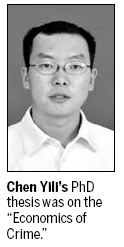
Chen is an associate professor alright, but he is only 29 years old. He has a master's degree in law and is a doctorate in economics. His PhD thesis was on "Economics of Crime", a subject new to many Chinese but decades-old in the West. The subject views crime from the angle of economics and analyze it using "econometric" methods. The greatest proponent of economics of crime - in fact, the person who gave it shape - is Gary S. Becker. He won the Nobel Prize for Economics in 1992 for extending economic analyses to the wide field of human behavior, including crime.
Economics of crime see criminals and potential criminals as "rational economic beings" and crime as a rational choice, considering the costs and benefits. Chen says this viewpoint can help people analyze criminals and crimes in a more rational way. People tend to presuppose that criminals are basically bad elements and thus ignore that important social factors contribute to crimes. The fact is that a person commits a crime for some reason.
Chen's empirical research on the relationship between macroeconomic factors and China's crime rate (1978-2004) shows there is a high positive correlation between income differential and crime rates. This is easy to understand: An increase in wealth raises the benefit people may gain from crime. But cost-benefit analysis shows a huge gap between rich and poor, too, could reduce the cost of committing a crime. Chen says people are more likely to make desperate moves when they have few things to lose.
Inequitable distribution of wealth and resources and an inadequate social security system, which widen the income gap, have a greater influence on crime rate. Today, everyone wants to make more money. But the cost the poor have to pay to do that legally is comparatively high. And since the social security system is yet to cover a majority of the people, the poor, especially farmers, remain extremely vulnerable to economic risks. The combination of the pressure to make more money, lack of enough legal channels to do so and the suffering people go through forces them into a life of crime.The public doubts the legitimacy of the wealth accumulated by the rich because of the improper income gap in society. More than 60 percent of the respondents in a recent survey said many people had become rich through improper or illegal means. This point of view reduces the moral cost of committing a crime, Chen says. It even makes some illegal practices appear justified.
The associate professor's research suggests economic growth is negatively correlated to the crime rate in China. Economic growth broadens the channels of making money legally - creating more jobs and raising wages - and thus helps reduce the crime rate. But, Chen says, the impact of economic growth is far less than that of income differential. In other words, a decline in the crime rate brought about by an increase of 1 percentage point of GDP can hardly offset the increase in crime because of a 1-percentage-point rise in Gini coefficient (a measure of income inequality). That makes it all the more important for the government to focus on narrowing the income gap between rich and poor in order to realize social harmony, he says. Reliance on economic growth alone will not solve the problem.
Wealth is more likely to be centralized in urban areas rather than the countryside. Compared with rural areas, a modern city is a milieu of strangers and hence less influenced by social norms and traditions. In such a place, the moral cost of committing a crime is comparatively low. Social interactions in cities are almost always a one-time affair, significantly reducing the possibility of a person being punished for an illegal act. Thus an increasing crime rate could be one of the unavoidable costs we have to pay for modernization and social transition, he says.
Since the process of social transition and modernization is irreversible, researchers in economics of crime try to explore the role of optimization of resource distribution in crime control. People believe severe punishment deters crime. But from an economic point of view, the cost of punishment is rather high, for the government has to spend huge amounts on police, judicial adjudication and prison, he says. Punishment complies with the law of "diminishing marginal utility", too - that is, punishment cannot reduce the crime rate further after it is severe enough. Punishment may help control the crime rate in the short run, but it cannot keep it down permanently.
Chen says that his fascination for sociology prompted him to find the social problems behind economic data. To prevent and control crime, he suggests, the government has to pay more attention to public policy. If it does that, it could kill two birds with one stone: improve people's lives as well as control crime.
From the cost-benefit point of view, raising the cost of crime can check it from spreading. If the authorities lower the barriers for people, especially the disadvantaged, to make money through legal means - for example, raise their salaries to narrow the income gap - they would be increasing the cost of committing a crime. Besides, narrowing the income gap would make people less resentful of the rich. This, Chen says, could raise the social and moral costs of committing a crime, which is conducive to reducing crime.
The government has to improve the credibility of the judiciary, too, Chen says. In some cases, the cost of protecting lawful rights and interests are too high for the poor to afford, compelling them to resort to illegal means.Chen says economics of crime is a more appropriate tool to explain property-related crime, because violent crime is more likely to be caused by irrational factors. He believes cost-benefit analysis is very important for the study of crime, because property-related crime accounts for more than 80 percent of the total crime in China.
Actually, the causes of crime cannot be explained and the crime problem cannot be solved through a single approach. But economics of crime gives us a new perspective to review crime and prompts us to look for more economic ways of controlling crime. It reminds us to re-evaluate and improve our public policies, too.


