On Wednesday at the Beijing Bookworm four prominent Western journalists presented a panel discussion on journalism in modern China. Melinda Liu, the Newsweek Beijing Bureau chief and president of the Foreign Correspondents' Club, headed the panel. James Kynge, formerly of the Financial Times and author of the prize winning novel China Shakes the World (2006), Jonathan Watts of the East Asia Bureau for the British paper the Guardian and Rob Gifford, NPR London branch China correspondent and author of the best selling book China Road, sat on the panel with Ms. Liu.
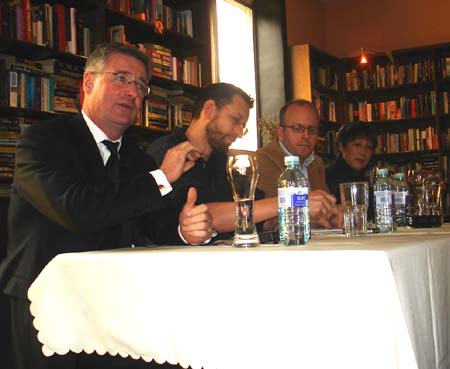
From left to right: James Kynge, Jon Watts, Rob Gifford and Melinda Liu
First the group discussed how they chose their stories. Mr. Gifford mentioned that a journalist inevitably feels tension between writing a story using a "good" or a "bad" slant when reporting the Chinese news; all journalists, he said, strive for balance. Western journalists who are too positive are called "panda-huggers" – they are accused of not reflecting the true reality, while those with stories too negative are perceived as not presenting a holistic picture of the country but rather an image of what the Western mindset wants to believe. He explained that editors also might intervene and pressure writers for certain types of stories, with some editors being completely ignorant about China and Chinese culture.
The journalists immediately brought up the concept of news as a consumption product rather than straight information. "Delivery systems have changed enormously," Mr. Kynge said, "We can draw a continuum through history." He described the early Greek runners who delivered the news on foot, dying of exhaustion and then went on to talk about the Pony Express using men on galloping horses to deliver information. He mentioned Baron Von Reuters made his name in the news business by having the fastest steamships delivering news, citing the assassination of Lincoln as a prize scoop. "But now we have telephone, Internet and TV," Mr. Kynge said. "This shows me that the news will continue to evolve; I'm wondering just how long newspapers per-say will last."
Mr. Watts expounded on this, pointing out that the Internet had radically changed the way that not only the news is delivered but also the way that journalists work and are paid. He cited ABOUT.COM, owned by the NY Times, and said, "Well known authors and journalists write for the site - that person is paid by the Google adverts that are next to his or her column rather than by the website or publisher." He further explained that journalists can now do most of their work online; "They never even have to get out in the field, there's no face-to-face, you just cut and paste and add your spin, then retail it, you're basically offering the news plus your opinion."
The panel jointly discussed the specific and unique challenges that China posed to them as journalists. "The image of China is affected by the conditions under which we work," Mr. Watts said. He referred to, among others, the problems he had experienced trying to cover sensitive subjects such as industrial accidents and land disputes. "But it's getting better," he admitted. The other journalists concurred, adding that travel restrictions have been relaxed and with the advent of the Olympics they have found their jobs to be a bit less restrictive. "The Olympics will nudge things along," Mr. Watts said, "In 2002 there were only 353 foreign journalists; in 2007 there were 760 and during the Olympics China is expecting 21,500 journalists and between 5000-10,000 unaccredited reporters."
Another topic the journalists touched on was the need to be exact when conveying information, combined with the intense financial pressures to put out the news at a faster and faster rate. "With the increase in the types of information delivery systems, much more is asked of the journalist with much less resources," said Mr. Kynge. "This is impacting the Chinese media as well." Mr. Gifford added that Western people see the Chinese media as state run; i.e., communist and censored, but they fail to realize that Chinese media too is under market pressures to perform. Digitalized information news services, whether Western or Chinese, both want to reap profits."
"Journalists are being asked to feed the digital services so much more and we have less time to get on the ground and actually do some reporting. Everything is on the Internet before it's in a newspaper," said Mr. Watts, "Eleven years ago the Guardian was a rather localized London newspaper with 400,000 circulations. Now its website has the same traffic and type of international readership as the NY Times. That means the audience I'm writing for is changing, this causes an identity crisis for the media. And you've got to consider the other forms of media now as well: video, podcasts, slideshows, galleries and two-ways: these are also changing the way we deliver and make news stories."
Mr. Kynge bemoaned the fact that original reporting is on the decline. "If you read the New Yorker those stories are works of art, with excellent editors backing them," he said, "These big name writers take months to live and research their subject; they are paid enormous sums – up to 50,000 USD per story; how can a newspaper afford that time or money-wise?"
Mr. Watts and Mr. Gifford agreed, calling modern journalism the "smash and grab" technique. "The media has been digitalized," said Mr. Watts, "We take part A from one place, B from another, and C we add our spin: this is the atomization of the media. If it's not ethical to merge people we interview into a composite is it really ethical to report the news in this way?" He went on to comment that modern advances in technology are driving the reorganization of the media. "Everything must be vivid, powerful and compelling," Mr. Gifford added.
The panel went on to discuss the impact of the Internet on Chinese news. "China is very conscious of international opinion," said Mr. Kynge. All agreed that more freedom to the Chinese press has appeared than at any other time in the past. But the Chinese press still thinks that the Western press is too negative Mr. Gifford remarked.
Despite difficulties they all agreed that China's still the most exciting place to live and work. Time will only tell how many more changes will evolve in the press and throughout society. Melinda Liu said that she was happy to be covering China. "The intense pace of change, unprecedented, it makes China an extremely dynamic story even though you're in a place where there's no conflict or war – it's car accidents that actually scare me." Ms. Liu started coming to China in 1980 when she opened the Newsweek Beijing bureau and stayed 2?and a half years. She returned in 1998 but travels globally for her job. "This is a country where you wake up every day and never can imagine what really is going to happen," she said with a huge smile. "When I go somewhere else it becomes clear just how much and how fast China has changed."
(China.org.cn by Valerie Sartor March 13, 2008)