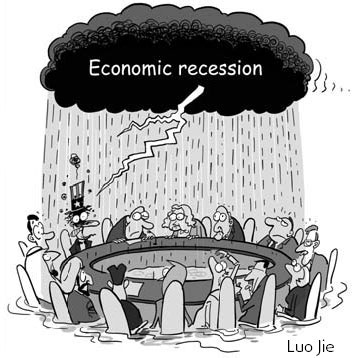
Saturday morning in Davos is the time when the chief executives
who attend the World Economic Forum like to head for the ski
slopes. The skies are blue, the snow is pristine and the best runs
are empty of holiday makers.
Only the hard core remains in the ugly conference centre listening
to the session on the global economy chaired each year with brio by
Martin Wolf of the
Financial Times. This year, though, the
hall was packed: what Wolf rightly called the "high tide of
complacency" in 2007 has been replaced by a deep pessimism about
the possibility of a
United States –
perhaps even a global – recession.
The gravity of the situation was best demonstrated by Dominique
Strauss-Kahn, the managing director of the International Monetary
Fund, who called for cuts in interest rates to be supported by a
relaxation in fiscal policy by those countries with strong enough
public finances to allow cuts in taxes or increases in
spending.
As Larry Summers, the former US treasury secretary, noted
waspishly, this was a mildly historic moment – the first time in a
quarter of a century that the fund had deviated from its iron
belief in balanced budgets and fiscal consolidation to call for a
classic Keynesian approach to economic slowdown.
Strauss-Kahn, though, is clearly worried. He wheeled out the
cliche of the moment - a perfect storm – to describe how the world
had got itself into its fine old mess: a period of low interest
rates leading to too much cheap money sloshing around the globe; a
breakdown in credit and risk management due to the failures of
self-regulation in the private sector; and short-comings in
financial regulation and supervision, particularly in the US.
John Thain, the man parachuted in to sort out the problems at
Merrill Lynch, said last week's emergency rate cuts by the Federal
Reserve – likely to be followed by a further easing of monetary
policy this week – would not be enough to spare the US from further
falls in house prices, a sharp increase in personal bankruptcies
and rising unemployment. Summers was equally gloomy, saying that
cheaper borrowing had to be accompanied by repair of the financial
system, a rescue package to prevent foreclosures in the US real
estate market.
Wolf made the point that one reason for optimism was that the
Davos consensus was usually wrong, and there is one school of
thought that says that the doom and gloom has been overdone. The
argument goes, the US has not had a single quarter of falling
output, the Fed has taken decisive and timely action to get ahead
of the curve, a $150 billion fiscal boost is being rushed through
Congress and the US tends to display extraordinary resilience.
There is something in this. The possibility that lower interest
rates and tax cuts will prove a shot in the arm for consumers in
the US should not be ruled out. Gerard Lyons, the chief economist
at Standard Chartered, believes that the Fed will cut its main
policy rate to 1 percent by the third quarter of 2008 – a level
that ought to lessen the pain for the holders of subprime mortgages
who face the prospect this year of their initially cheap home loans
being reset to higher rates.
Easier monetary policy from the Fed and the fund's welcome
rediscovery of Keynes's General Theory are certainly appropriate.
The lesson of Japan in the 1990s is that once economies get sucked
into a vicious circle of collapsing asset prices, banking crises
and deflation it takes a lot of time and a lot of pain to escape
from them. But let us not kid ourselves. Cutting interest rates,
providing the banking system with unlimited liquidity and cutting
taxes are not long-term solutions to the crisis. They may not even
be short-term solutions if they lead to rising US inflation, a
collapsing dollar and higher long-term interest rates.
A long-term solution requires recognition that the crisis of the
past six months is not the equivalent of a fit athlete suffering a
muscle strain that will wear off given a bit of time and some
intensive physiotherapy but rather the not quite fatal heart attack
for the 60-a-day smoker. Briefly cutting down to 50-a-day is not
the panacea.
In this sense, the people at Davos - despite all the somber
faces this year - are still living in a dream world. There are at
least five big fantasies. The first is that policymakers are in
control, when all the evidence of the past decade is that they have
allowed the global imbalances to develop unchecked, turned a blind
eye to the excesses in asset markets and blown up a series of
bubbles.
The second is that the global economy has decoupled so that
problems in the US will not affect the rest of the world. This, of
course, is precisely the opposite of the message of recent years,
when the argument has been that globalization has increased the
linkages between national economies. The idea that economies couple
in good times and decouple in bad times is nonsense.
The third fantasy is to believe that the financial system is
basically sound. There is still a tendency to believe that the
scandal that cost Societe Generale 4.9 billion Euro was the result
of the activities of a rogue trader rather than simply the most
egregious example of a form of the wild gambling that has been
going on unchecked. Those running the big institutions have been
happy to allow derivatives traders a free hand while the profits
have been rolling in.
The fourth fantasy is the assumption that the problems of the
past six months are a crisis of liquidity, when they are in reality
a crisis of solvency. Provision of cheap money - even in unlimited
quantities – is not nearly so effective if businesses and consumers
are unable to pay off their debts.
Belatedly, it has been accepted that subprime mortgages are not
a little local difficulty; what has yet to be taken on board is
that they have proved to be similar to an uncontrollable virus
spreading through the financial system. We know about the problems
of banks and we have had an inkling about the problems potentially
facing monoline insurers - the companies that insure bonds - but
the really big threat would be if the virus has spread to the $45
trillion market for credit default swaps, as it may well have
done.
Finally, there is the fantasy that not much has to change.
Today's problems are the culmination of a 20-year process that has
seen curbs lifted on banks and investment houses, finance becomes a
bigger and bigger part of developed economies, and a distribution
of rewards in favor of those allegedly in charge of the runaway
train.
It is no time for tinkering. Rather it is time to heed the
warning, because it may be the last one we get.
(China Daily via The Guardian January 29,
2008)