By Jeff Weintraub
Like the other two Group of 20 (G20) summits held since the global banking meltdown a year ago, the very picture of cooperation among heads of government will be the main message at the G20 gathering in Pittsburgh on Sept 24-25 - a message these leaders hope will further calm fears enough to bring the international economic crisis to a soft landing, sooner rather than later.
Unfortunately, we might hear a strikingly dissonant note in the otherwise harmonious chorus of cooperation in Pittsburgh. When the G20 meets, Washington and Beijing may be on the brink of a trade war over Chinese tire exports to the United States and the subsequent complaints from China about protectionist practices. That's obviously of great concern, not only for the U.S.-China trade itself. Because of its size and reach, that bilateral relationship also has disproportionate implications for the overall well-being of the global economy, which is now showing flickers of recovery.
 |
|
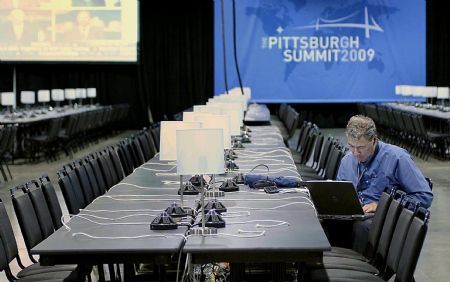
A journalist works in the press center of the David L. Lawrence Convention Center in Pittsburgh, the United States, Sept. 22, 2009. The G20 summit of world economic leaders is scheduled to be held in Pittsburgh on Sept. 24. [Zhang Yan/Xinhua] |
While not entirely unexpected, the decision to impose the tire tariffs is a departure for the Obama Administration, which has thus far mostly restrained itself from protectionist measures. Likewise, the Chinese government had been, until now, careful not to upset the trade relationship with similar actions of its own against U.S. products. "Both countries have been generally cooperative up to this point," says Mickey Kantor, former U.S. Secretary of Commerce and U.S. Trade Representative and a member of my firm's International Advisory Board. "They have followed through on past commitments not to let the current economic recession force them to do things that are protectionist."
Still, the initial exchange over the tire decision is not encouraging. There is little doubt that domestic politics played a role in Obama's decision to impose the tariffs. Frankly, that decision was more about healthcare than tires. By some accounts, the success or failure of Obama's presidency hangs in the balance over the fate of his healthcare reform proposal. One opposition party member predicted that failure of healthcare reform would "break" him. Consequently, he cannot risk alienating any labor unions, including the Steelworkers Union, which pressed for the tariffs and which supports healthcare reform.
This is a situation where actions speak louder than words. China's vigorous protest over this decision was predictable. The big question is whether China complains, but grudgingly accepts the tariffs as a politically driven exception to Obama's declared commitment to free trade. Or whether they see it as a more fundamental reversal and take retaliatory action, which could lead to a significant breach on trade. Time will tell how much of an impact the trade row will have on the bilateral economic relationship. But at the G20 and beyond, observers should also watch closely the two countries' body language on other profound and difficult challenges.
The thorniest revolves around how the United States will reduce its federal budget deficit. In short, it will be a chore, especially considering the $787 billion economic stimulus program Congress passed earlier this year, the hundreds of billions the government appropriated to rescue financial institutions at the fall of 2008 and the estimated billions more it will cost if meaningful health care reform legislation passes this year. All this is, of course, above and beyond the enormous deficits President Barack Obama inherited from his predecessor.?
Even though China enacted its own stimulus package worth 4 trillion yuan (or $586 billion) and surely understands the Obama Administration's rationale for pumping more money into its stalled economy, China has serious concerns about the U.S. deficit. The Chinese worry (as do many Americans) that, coupled with unusually low interest rates, the deficit could trigger inflation. Inflation could devalue China's significant holdings of U.S. debt, a stake that comprises a large part of China's overall reserves.
China's anxieties about such a scenario have long been well known. They surfaced noticeably during the U.S.-China Strategic and Economic Dialogue in July when - as U.S. media reported prominently - China's Assistant Finance Minister Zhu Guangyao said: "China has a huge amount of investment in the United States" and "we are concerned about the security of our financial assets."
The good news, so far, is that inflation in the United States has been negligible, a non-factor. Still, mindful of the Chinese government's fears, U.S. officials gave some comfort to their counterparts at the dialogue meetings in July, saying they would commit to polices that "reinforce and sustain recent gains in private savings rates and will bring the fiscal deficit down to a sustainable level by 2013" - both of which could keep inflation from surging.
Indeed, the personal savings rate in the United States shot up to 5 percent in the second quarter of this year, about twice as high as it was a year before and higher than we've seen it this decade. That development is likely a reaction to the shock of the recession over last year and to losses of 40 and 50 percent of the value of many Americans' personal retirement portfolios. But the Obama Administration must, as it signaled at the dialogue, do everything possible to keep the savings rate up after the economy recovers.
That will be difficult. The impulse to buy stuff, and not to save, is deeply ingrained in the American social DNA. Also, speaking only anecdotally, I'm not getting the sense that the experience of the current recession will do for this generation of Americans what it did for those who lived through Great Depression and, based on that searing experience, held fast to the values of frugality ever since. But I hope I'm wrong about that.
China must be careful what it asks for, of course. China's economy is export-driven, and the United States is its biggest consumer market. Less spending might help keep inflation in check, but it could also mean less demand over the long term for Chinese-made products.
The real trick, then, for the Obama Administration will be to stimulate growth without triggering more inflation - one of the toughest economic balancing acts any government can face. This result would of course be good for the American economy itself. But it's also a necessary ingredient of a well-functioning U.S.-China trade relationship, which is, in turn, critical to the health of the global economy. Let's see what kind of a posture both the United States and Chinese leaders signal in Pittsburgh.
Jeff Weintraub is the co-leader of the Washington, D.C., public affairs practice of Fleishman-Hillard, a communications consultancy.
(China Daily September 24, 2009)
