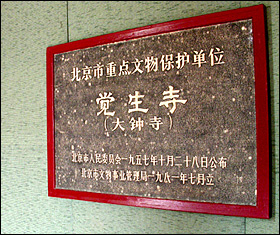
The Juesheng Si (Temple of Awakening) was built in the
northwestern suburbs of Beijing in the 11th year of the reign of
Emperor Yongzheng of the Qing Dynasty (1733). It was located in
Zengjiazhuang Village outside Xizhimen (Straight West Gate), one of
the gates of the walls surrounding the city of Beijing. The area
was dotted with pines and cypresses, plots of farmland and
cottages. Smoke ascended slowly from kitchen chimneys. Green hills
rose and fell in the distance. It was a superbly quiet place for
followers of Buddhism.
???
Since the Temple of Awakening was built under Yongzheng's
imperial edict, you can still find the horizontal stone board above
the main gate, edged with the pattern of dragons flying through
water and clouds. The board bears the characters "The Juesheng
Temple Built by Imperial Order" inscribed by Emperor Yongzheng.
???
Facing south, the magnificent Temple of Awakening was neatly laid
out as an imperial temple. Standing from south to north were the
principal buildings like the Screen Wall, the Main Gate, the Bell
and Drum Towers, the Deva-Kings Hall, the Hall of Mahavira, the
Hall of Avalokitesvara (Goddess of Mercy) and the 'lower of
Scriptures. They were flanked with side halls, houses and east and
west courtyards. With a total area of 30,000 square meters, it was
a major temple in the northwest of the capital.?
???
Shortly after the completion of the Temple of Awakening,
Imperial Prince Zhuang and others suggested to Emperor Yongzheng
that the Yongle Bell in the Wanshou Si (Temple of Longevity) be
moved to the Temple of Awakening. The archives of the Imperial
Household Department in the 4th month of the 11th year of the
Yongzheng period (1733) bear the following record: "Imperial Prince
Zhuang and other ministers presented a memorial to the Emperor on
the 16th day of the month: Concerning the move of the bell at the
Temple of Longevity, Vice Bureau Director Guan Zhining and Bureau
Secretary Hong Wenlan found out that since the Temple of Awakening
is located in the north of the capital and southeast of the
Yuanmingyuan (Garden of Perfection and Brightness) and the body of
the ball is made of metal, it will be most appropriate to move the
bell to the Temple of Awakening. If it is moved to a place
southeast of the capital, it will be located in the direction of
the Tanlang Muxing (literally meaning the star of the wood) and the
metal and the wood will subdue each other. So it will be
inappropriate to move the bell there. The Temple of Awakening
consists of five halls, and the rear hall is connected with the
element of earth. If another building is constructed behind that
hall, it will signify the mutual generation of metal and earth. The
new building will be most appropriate for housing the bell. If Your
Majesty permit, we will, in conjunction with Su Hena, present to
you a blueprint of the bell building to be built behind the rear
hall. The Emperor approved the memorial." Emperor Yongzheng
approved Prince Zhuang' s suggestion, initiating the colossal
project of building a bell tower at the Temple of Awakening and
moving the bell from the Temple of Longevity. The project was
completed ten years later in the 8th year of the reign of Emperor
Qianlong (1743).
???
The newly built big bell tower became the key architecture in
the Temple of Awakening. It stood on a huge bluestone base. The
main body of the building consisted of the square lower part and
the round upper part, suggesting that Heaven was round and the
Earth square. The carved dragons and painted pillars afforded a
magnificent view.
???
After it was moved to the Temple of Awakening, the Yongle Bell
became an important musical instrument for Buddhist services at the
temple. From then on, the big bell reverberated, Buddhist music was
played and Buddhist monks held religious services on important
occasions. As one of the major common practices in the capital
city, people listened respectfully to the sound of the bell from
the Temple of Awakening. The Yongle Bell was so well known that the
Temple of Awakening was popularly called the Big Bell Temple. With
the elapse of time, the original name of the temple was rarely
known by the public.
???
The Yongle Bell weighs 46 tons. Such a huge bronze bell has been
suspended steadily from wooden beams for hundreds of years. This
convincingly attests the consummate skills and scientific design of
Chinese craftsmen in ancient times. In order to support the heavy
bell, three tiers of beams were overlapped so that the weight
carried by the main beam was shared by ten cross sections and the
load born by eight pillars could keep constant value by and large
even in an earthquake. Careful visitors will find that the eight
gigantic pillars decorated with gilded dragon patterns slant
towards the inner side of the beams of the bell. Termed "side
angle" in traditional Chinese architecture, this design plays an
important role in resisting any wobble of the beams of the bell and
preventing the separation of the mortise and the tenon. In 1976
when the grave earthquake in Tangshan spread to Beijing, staff
members of the temple found that a tiny gap between the mortise and
the tenon at the northeastern corner of the beams of the bell had
been filled abruptly with the quake of the earth.
???
A poem written in Beijing during the Qing Dynasty noted that "A
beam was threaded through the handle of the ball and a shallow pit
was dug under the bell to spread the peal of the bell." The
resonant stone pit is in good shape. Built on a bluestone base, the
octagonal pit is 0.7 meter in depth and 4 meters in diameter. The
surface of the pit is one meter apart from the rim of the bell.
When the bell was struck in the old days, the peal could be heard
within a circumference of about 50 kilometers.
???
In ease of a prolonged drought in the early period of the Qing
Dynasty, the emperor would personally go to the Yuanqiu (Circular
Mound), the Heilongtan (Black Dragon Pool) and the Dagaodian (Great
and High Hall) to pray for rain. In the 52nd year of the reign of
Emperor Qianlong (1787), the Big Bell Temple was designated as
another site to pray for rain.
???
A terrace with a flight of steps on each of the four sides was
laid before rain was prayed for at the Big Bell Temple. It was
about 5.23 meters wide, 4.57 meters long and one-third of a meter
high. Put up on the terrace was a flat-topped mat shed, 6 meters
square and 3.3 meters high. The mat shed had a gate on each of the
four sides and was encircled by a mat wall, 26.67 meters square and
2.33 meters high. A mat screen wall was erected in front of each of
the four gates.
???
Emperor Qianlong and most of the succeeding emperors personally
went to the Big Bell Temple to offer incense and pray for rain. The
activity usually lasted several days or even dozens of days, so the
emperor could hardly stay there all the time. Princes or relatives
of the emperor took the place by turns. On such a grand occasion,
the monks chanted Buddhist scriptures while drums and bells
resounded. The emperor, princes, commandery princes, Beile and
Beile princes also offered incense there, praying for an early fall
of sweet dew. A lot of data on such activities at the Big Bell
Temple can be found from the archives of the Qing Dynasty. The
imperial praying-for-rain services at the Big Bell Temple lasted
until the end of the Qing Dynasty.
???
As an important Buddhist temple, the Big Bell Temple usually
attracted a good many worshippers. More Buddhist pilgrims came to
the temple fairs from far and near. In particular, a great many
people, men and women, old and young, enjoyed the game of throwing
coins. They mounted a height in the big bell tower to throw coins
at the hole of the bell, praying for a life of peace and good luck
from year to year.
???
There is a hole, as big as a bowl, at the top of the Yongle Bell.
In the old days, many people believed that if they managed to throw
coins into that hole, everything would go smoothly for them in the
coming year. The more coins they threw into the hole, the greater
luck they would have. So they were never bored with this game.
Historical records say that in half a month from the 1st to the
15th day of the first month of the lunar year, one half of the pit
under the bell was filled with copper coins. They had to be stored
in several sacks. This income alone provided enough food for the
monks at the temple for the year. A poem written during the reign
of Emperor Jiaqing had the following description:
???
?????? "Suspended at the
Temple of Awakening is a big bell.
??????? Puzzlingly
copper coins go through its hole.
?????? ?It seems
everything on earth has to be bought.
?????? Cash is needed to
foretell one's good luck."
???
Monks at the Big Bell Temple struck the Yongle Bell on the
eve of a new year. Buddhists strictly followed the way of striking
108 strokes of the bell. It was said that a year consisted of 12
months, 24 solar periods and 72 pentads (5 days for one pentad),
totaling 108, so the bell must be struck 108 times. Another
argument was that man had 108 kinds of worries.
The Bell
Hymn says, "Worries are alleviated when the peal of the bell
is heard." One had to strike the bell in a particular way, that is,
strike "seven quick strokes, eight slow strokes and 20 gentle
strokes," repeat these strokes three times, and then strike three
powerful strokes. That added up to 108 strokes. Apparently it was
not easy to go on striking the bell as long as one was a monk. If
he did a good job in striking the bell, he fulfilled his duty.
???
The forceful strokes of the Yongle Bell followed the heavy steps
of history over the centuries. The temple fell into disrepair
during the years of the Republic of China. The ancient buildings
were out of repair and many cultural relics were lost.
???
After the founding of the People's Republic of China, the
premises of the Big Bell Temple were occupied by Beijing No. 2 Food
Factory from the 1950s to the end of the 1970s. Most of the ancient
buildings became workshops producing candied fruit, soft drinks and
foodstuffs. The former imperial temple was changed beyond
recognition. Fortunately the big bell tower remained all alone. In
the early days of the 1980s, the Yongle Bell attracted much
attention from the departments concerned. With the approval of the
Beijing Municipal Government, the Big Bell Temple Cultural Relics
Preservation Office was established in February 1980. The
slumbering ancient temple regained its vigor.
With the great support of the governments at various levels and
the departments concerned, the factory was relocated and the
ancient buildings were repaired. In October 1985, staff members of
the Cultural Relics Preservation Office, with generous help from
people of various circles, restored the layout of the original
ancient buildings along the central route. They collected several
hundred ancient bells of different types and categories dating back
to various dynasties in Chinese history and established an ancient
bell museum with its unique features.