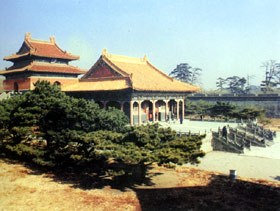
When speaking of the early Qing Dynasty tombs people are
naturally reminded of the Yongling, Fuling and Zhaoling in Shenyang
and Dongjingling mausoleums in Liaoyang in the province of
Liaoning. Different from East and West Imperial Tombs built in
Zunhua County, Hebei Province, after the Qing Dynasty set up its
capital inside the Great Wall, the aforesaid four imperial tombs
are known for their mausoleum construction in an antique
architectural style and layout of feudal castles, and their
important and unique locations and quiet secluded environs.
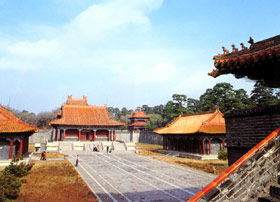
Square Castle at the Qing East Tombs in
Shenyang
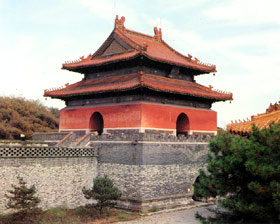
Gate Tower at the Qing East Tombs in Shenyang
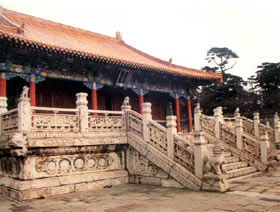
The Hall of Grand Favor in the Qing East tombs in Shenyang
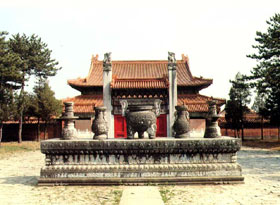
Stone sacrificial vessels in front of the Hall of Grand Favor
Front yard of the Qing north tombs
Stone archway at the Qing north tombs
Soul Tower at the Qing north tombs
Five stone sacrificial vessels in front of the Soul Tower
The Hall of Grand Favor at the Qing north tombs
???
Yongling Mausoleum?Originally known as Xingjingling
built in 1598, the mausoleum south of Qiyun Mountain northwest of
Yongling Town, Xinbin County, Liaoning Province and near the Suzi
River. It was restored many times during the Kang Xi and Qian Long
reigns after it was renamed Yongling in 1059. It covers an area of
about twelve thousand square kilometers surrounded by mountains and
rivers, creating an impression of luxuriant surroundings. Ancestors
of the first Qing emperor, Nurhachi (1559-1626), are buried in this
tomb. They are Gaitemu, one of his ancestors; Fuman, and his
great-grandfather; Juechangan his grandfather, and his father,
Takeshi.
???
The mausoleum is composed of the Front Courtyard, the Fangcheng
(the square castle) and Baocheng (tombs surrounded by additional
high walls like a castle), all surrounded by a vermilion wall. At
the centre of the south frontyard stands the Red Gate inside of
which are four pavilions with four stone tablets in each pavilion
praising the four ancestors. On the east and west sides are tea
house, washing rooms and houses for prayers to change their
clothes. In line with the system of "office hall in front and
bedroom in the rear" a Hall of Offering Sacrifice was built inside
the Square Castle. Left and right walls are inlayed with color
glazed dragons which added luster to the vermilion walls and yellow
tiles. The main building at the center of the Square Castle was
called Qiyun Hall. Inside Qiyun Hall are warm pavilion and treasure
bed for offering sacrifices. Two side halls are on the east and
west sides of Qiyun Hall. In front of the side halls is a silk
burning furnace. Behind Qiyun Hall were tombs, most of whose
occupants have been removed to other places. In some of the tombs
are buried only the hat and clothing of the dead.
??
Originally there was an old elm called the "fairy tree." When
Emperor Qian Long, in the 43rd year of his reign, traveled to the
east, he wrote a poem about the tree: "The Song of the Fairy Tree."
The poem was inscribed on a stone tablet which stood beside the
tree. The stone tablet has been moved and is now in the western
side hall.
??
Yongling Mausoleum is not large. Inside the Square Castle are
castle-like embrasured watch towers, turrets, passages and a
mausoleum with an underground palace, The mausoleum, nestled among
the hills with Qiyun Mountain towering behind it, is opposite
Yancong Mountain with Suzi River running between them. From a
distance the mausoleum appears as a red dot in the green carpet of
the forest.
Fuling Mausoleum?Fuling Mausoleum lies east of Shenyang
City. Qing Emperor Nurhachi and Empress Yehenala were buried here
in setting in which the Huihe River flows in front and Tianzhu
Mountain stands behind; an emperor's mausoleum with a unique
style.
Fuling Mausoleum, built in 1629 and expanded during the Kang Xi
and Qian Long reigns, covers an area of 194,800 square meters. The
rectangular mausoleum is surrounded by a wall, with the red
entrance gate located in the center of the south wall. The walls on
both east and west sides of the gate are decorated with glazed
dragons. In each side of the gate are tablets ordering riders to
dismount, ornamental columns, stone lions and memorial archways.
These make the door dignified and magnificent. Inside the entrance,
on both sides of the spirit path and among green pines are pairs of
stone sculptures of lions, horses, camels and tigers.
????
From south to north the rising terrain is traversed up 108 brick
steps to a stone bridge and a tombstone tower. Inside the tower is
a stone tablet inscribed in Emperor Kang Xi's calligraphy: "The
Tablet of Devine Merit and Sage Virtue." On the left and right
sides of the tower are houses used for the offering of sacrifices
such as a fruit house, a washing room and a vegetarian diet house.
Further north is the Square Castle, the principal part of the
Mausoleum. In the south center is the Gate of Grand Favor covered
by a triple-eaved arch, and in the north center is a Soul Tower
with a stone tablet proclaiming the "Mausoleum of Emperor Gao"
standing inside. Turrets stand at each corner with Long'en (Grand
Favour) Hall in the center. The three main columns and the five
columns of the east and west side halls are places for the offering
of sacrifices. Behind the main hall are the stone column gate and
five-stone arch and in front there is a silk burning pavilion.
Beyond the Square Castle is the Treasure Castle built in a crescent
shape, hence the name Crescent-Moon Castle. The upper part is the
castle and the lower part is the underground palace where the
imperial remains were buried.
??
The Mausoleum is in a mountain valley among tall pine trees,
peaceful and secluded. With a background of blue sky and white
clouds the red wall and yellow tiles can be seen dimly in the
luxuriant pine forest. The architecture of the Nüzhen combines with
traditional imperial mausoleum forms to provide a pleasing
compound.
??
Zhaoling Mausoleum?Zhaoling lies in the north part
of Shenyang City, Liaoning Province. It is the grave of Huangtaiji
(1592-1643) and Empress Boerjijite. Born in 1592, Huangtaiji was
the eighth son of Qing Emperor, Nurhachi, and an outstanding
politician and strategist. In 1026, he succeeded his father and
ascended to his reign title of "Han' and the following year he
established as his reign title "Yuan Tian Cong." In 1636 he set
himself up as an emperor and adopted the reign title Later Kin.
Then, he titled his rule as Great Qing and accomplished in unifying
northeast China. He died in 1643.
??
Zhaoling Mausoleum is the largest and the most complete among
the imperial tombs in northeast China. Recently, following a
decision of the State Council Zhaoling was listed as an important
cultural and historical monument placed under state protection.
With an area of 4.5 million square meters, it was first built in
the 8th year of the Chong De reign (1643) and completed in the 8th
year of the Shun Zhi reign in 1651. The tomb was extended during
the years of the Kang Xi and Jia Qing reigns.
??
The overall arrangement of this cemetery is the same as Fuling.
The graves are surrounded by rectangular walls, and the red
entrance gate is located in south center. Outside the gate are
tablets ordering dismount from horses, ornamental columns, stone
lions and a stone bridge, as well as a memorial archway built in
the 6th year of the Jia Qing reign. The memorial archway lies in
the center outside the door. It is exquisitely carved with high art
value.
??
The left and right walls are inlaid with vividly shaped colored
glazed dragons. Inside the door, on the two sides of the Spirit
Path, are six pairs of stone sculptures of lions, Chinese unicorns,
camels, horses and elephants. Among them, a pair of stone horses,
called "elder white" and "younger white," were the favorites of
Huangtaiji. This sort of horse displays the Mongolia horse
characteristic of short legs. In the centre of the north area is a
tower for the tombstone. Inside the tower is a stone tablet
sculptured with Emperor Kang Xi's calligraphy: "The Tablet of
Devine Merit and Sage Virtue" of the Qing Dynasty. The tablet is
over five meters high and weighs 50 thousand kilograms. The tower
has an ornamental column, attracting more attention. East and west
are a tea house and a washing room. Behind the tower is the main
part of the cemetery -- the Square Castle. The Long'en Palace built
on a carved granite foundation, is in the center. It has three
rooms, a glazed tile roof and sculptured beams. On its east and
west sides are side halls and towers stand at each corner. The main
entrance, Long'en Door, is in front, and behind the palace a vivid
tower contains a stone tablet inscribed with "The Tomb of Emperor
Tai Zong" in the center. North of the Square Castle lies Baocheng
(Treasure Castle) shaped like a crescent moon. Inside Baocheng can
be seen the roof of the castle over the underground palace where
the Emperor Huangtaiji and his concubine were buried.
??
Though the mausoleum lies fairly low on flat ground, its towers
and halls are landmarks among green pines and cypresses. It was a
forbidden palace during the Qing Dynasty.
??
Dongjing Mausoleum?This mausoleum lies on Yanglu
Mountain 3.5 kilometers east of the Taizi River, Liaoyang City,
Liaoning Province. It is only one kilometers southwest of Dongjing
Town (now Xincheng) built during the Qing Dynasty. After Nurhachi,
the Qing Emperor, moved his capital to Liaoyang, he moved the tombs
of Jing Zu, and others of his relatives to Dongjing in the 9th year
of Tian Ming (Later Kin) (1624) hence the name Dongjingling
Mausoleum. In the 11th year of the Shun Zhi reign (1654) in the
Qing Dynasty, the tombs of his grandfather Juechangan and his
father Takeshi were moved back to Hetuala, only those tombs of
Shuerhachi, Muerhachi, Hurehachi and some others remained. All
these people, once led by Nurhachi, fought in the wars,
contributing to the setting up of the Qing Court. After they routed
over a hundred thousand fighters of the Ming Dynasty in Saerhu, the
east mountain area of Fushun, Nurhachi turned south to capture
Liaoyang in 1621 and set up his capital at Dongjing Town. After
that, warring stopped for awhile and he started construction of the
Dongjing Mausoleum.
??
Dongjing Mausoleum occupies the whole Yanglu Mountain but is the
smallest among the early four imperial tombs of the Qing Dynasty in
northeast China. It has high walls, a gate and tablet pavilions.
There are four tomb yards with Prince Shuerhach's Tomb as the
dominant element. Shuerhachi had died in battle in 1611. He
proclaimed a Later Kin Dynasty and his reign title was
Daerhanbatulu. His tablet pavilion is well preserved under a
four-roof pavilion with a single eave. Inside the pavilion are
colored paintings and sunken panels. On the marble tablet are
engraved Manchurian and Chinese words: "The Tablet of Prince Zhuang
Daerhanbatult."
??
The other tombs also have their own tablets, except for Zhuying,
the eldest son of Nurhachi. It was said that Zhuying, following his
father, fought valiantly and rendered many meritorious services.
However, during the battle for Liaoyang some military action was
delayed and the soldiers of the Qing Dynasty suffered because
Zhuying was drunk. As a result, no tablet was erected for him.
??
The four early imperial mausoleums of the Qing Dynasty north of
the Great Wall demonstrated their own styles and unique
construction designs. All had high surrounding walls, like the
imperial Forbidden City, with watchtowers at each of four corners;
the steps and railings of Fuling and Zhaoling mausoleums in
Shenyang are exquisitely sculptured. The detailed carvings and
sculptured relief works are seldom seen in tombs inside the great
wall. Their sizes and scope are not as large as the Ming Tombs and
the East and West Imperial Tombs of the Qing Dynasty but the
examples are invaluable.