Through the 7th to 9th centuries in Tibet, southwest China,
there existed a famous regime -- the Tibetan Regime. Its first
ruler, King Songtsen Gambo (617-650), was an accomplished leader.
Unifying all the tribes in Tibet, he made Lhasa the capital. He
then developed production, created a Tibetan language, made laws,
set up official and military systems, and established a Tibetan
slavery system.
??
In order to absorb central China's advanced culture, Songtsen
Gambo married Tang Dynasty's Princess Wen Cheng in 641, sent
Tibetan aristocratic children to Chang'an for study, invited Han
people to take charge of his official documents and letters,
dispatched his people to learn central China's production
techniques and technology, and otherwise promoted economic and
cultural exchange between the Han and Tibetan areas.
?? ?
In 649 the Tang regime granted him title "Commandant-escort."
Songtsen Gambo made great contributions to the social, economic and
cultural development of the Tibetan region, to good relations
between Han and Tibetan people, and to formation and development of
a multi-national China.
??
According to such Tibetan history books as Grand Ceremonies
of the Wise, Chronicle of Tibetan Kings and Officials and
Chronicles of Tibetan Kings and Clansmen, there were
altogether 35 tombs of Tibetan Kings and concubines, divided into
groups, with each group centered in a separate area.
???
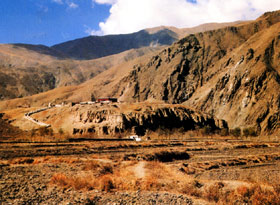
The largest group of known tombs was located on Mure Mountain at
the southern bank of the Yarlung Zangbo River, southwest of the
Zongsam Mountain and beside the Yarlung River (today under the
jurisdiction of Qongyai County in the Tibetan Autonomous Region).
Surrounded by open ground and benefiting from moderate weather,
rich soil, and beautiful landscape, this area with its favorable
natural conditions was the birthplace of the ancient Tibetan
nationality and the old home of the founding King, Songtsen
Gambo.
??
After the King chose Lhasa as a capital, this area became his
base to strengthen his regime and solidify his rule, and was
accorded special attention. It may have been nostalgia, as well as
the favorable and rich natural conditions, that decided Songtsen
Gambo on this area as his burial place. Later quite a few other
Tibetan kings were buried here.
???
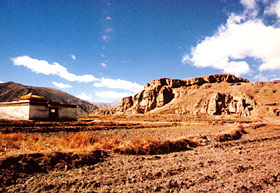
Scattered all over Mure Mountain, nine recognizable
mausoleums cover an area of 3 square kilometers. Similarly shaped,
they were all high, square earth heaps with flat tops of piled
stone and pecked earth, imitating the early tomb styles of central
China. But now, after over a thousand years of wind and weather,
their characteristics have changed; some have become rounded and
flat on top.
Tomb of Tibetan king
???
According to historical documents and inscriptions on the
memorial tablets, only three of the nine tomb occupants have been
identified:
??
The Tomb of Songtsen Gambo?A surviving inscription
at the tomb reads that the tomb of Songtsen Gambo was situated at
the mouth of the Qingpu Ravine (after several centuries the tomb
now is a huge square grave at the center of a plain facing a
distant Qongyai County seat). The tomb appears to have been square.
The interior had nine chambers, the main one a Buddhist hall, at
the center of which stood a 7-or 8-chi-long (3
chi = approx 1 meter) coral lamp that burned day and
night. The four corner chambers stored treasure. The inner tomb
wall was made of square stone slabs covered by a thick layer of
earth, which in turn was covered with broken stones, forming
an earth hillock.
Tomb of Songtsen Gambo
??
The tomb door opened to the west and each side was 100 paces
long and over 6 zhang high (1 zhang = 3 1/3
meters). It is said that under the tomb was a spacious underground
palace, storing statues of Songtsen Gambo, Sakyamuni and
Bodhisattva Guanyin; numerous everyday utensils inlaid with gold,
silver, jewelry and agate, and amour and weapons of the day.
??
Originally a sacrificial temple was atop the tomb, consisting of
20-odd soul towers and four small-sized halls on the four sides.
Within the temple were statues of Songtsen Garnbo, Princess Wen
Cheng, Princess Chi Zun, Minister Ludongzan and the creator of the
Tibetan language, Tunmi Sangpuquan. Over times, the original
buildings deteriorated, but in recent years the temple and statues
have been restored and a continuous stream of visitors and
worshipers pay tribute to this outstanding Tibetan King who devoted
himself to the development of Tibetans and unity between the Han
and Tibetan people.
??
The Tomb of Chide Songzan ?Reigning from 793-815,
late in the Tibetan Regime, King Chide Songzan was also buried in
Qongyai County. This was confirmed by the Tibet Committee for
Management of Cultural Relics in September, 1984 when his tomb's
stele was located and recovered. The Tibetan script called King
Chide Songzan very capable, saying: "(He was) farsighted and
rigorous. His country was known far and wide to be powerful and
prosperous and his people happy and virtuous, something not seen
before. Kings and chieftains from all directions came to vow
allegiance to him."
??
This tomb stele, the best preserved of all the Tang steles in
Tibet, was a more valuable find than the Monument Stele
Commemorating the Tang and Tibet-an Regimes' Alliance in front of
the Suglakang Monastery in Lhasa. At 7.2 meters high, it consists
of the crown, the shaft and the plinth. The crown capped by tiers
of carved gems is a rectangle with a four-faceted bevel, the edge
of which turns upward. The four facets display carved designs of
floating clouds. Below each corner of the crown are four flying
celestials in relief, stripped to the waist and graceful amid
colorful fluttering ribbons. The rectangular shaft, 5.6 meters
high, tapers to the top. The upper front section displays a carved
sun and moon. Below are 59 horizontal lines of ancient Tibetan
script, while two dragons mingle in relief with floating clouds on
the shaft sides. Supporting the shaft is skillfully carved
stone-tortoise plinth. The tomb stele is not only of great
historical value, but an excellent art work of sculpture, a rare
treasure among Tibetan Tang Dynasty tomb tablets. A pavilion now
protects the treasure.
A few steps away is a stone tablet similar to the one in front
of the Chide Songzan tomb. With carved jewelry on top, the same
floating clouds, flying celestials and dancing dragons on the
pillar, its shaft is 3.6 meters high. Inscriptions have been
weathered away and the tablet has suffered severe damage. It is
also said to be a gravestone of Chide Songzan, but far less
valuable than the larger one.
???
The Tomb of Dusong Mangbujie ?Halfway up Mure
Mountains stands a large elevated platform of earth and stone
which, according to Tibetan chronicles, should be the tomb of
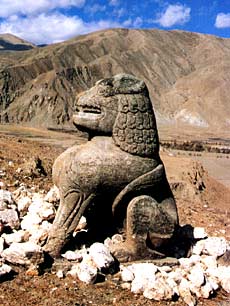
Dusong Mangbujie. Besides the huge earth heap, the pair of stone
lions in front of the tomb are the most valuable surface artifacts.
They are each 1.5 meters high, placed on a 1.2-meter-long and
0.8-meter-wide rectangular pedestal. Facing the tomb, they sit chin
up and chest out, powerful and expressive. They are obviously in
the early style of stone lions, with bald heads and hairy backs.
With decisive carving and smooth lines, the two lions can stand
among the best carving works of the Tang Dynasty in China, and are
even more precious in Tibet.
Stone lion at the tomb of Tibetan king
??
Besides the three tombs for which occupants are known, other
tombs' occupants, according to Tibetan chronicles, are Mangsong
Mangzan, Jiangca Lamu, Chide Zuzan, Mou Ru and Mou Ni, etc. Of
them, Jiangca Lamu and Mou Ru were merely crown princes and their
mounds are smaller. Scholars find all the tombs are in a line from
east to west and mainly placed in patrilineal order. The eastern
group included Songtsen Gambo, Mangsong Mangzan, Dusong Mangbujie,
Chisong Dezan and Chizu Dezan; while the eastern are Chide Songzan,
Mou Ru, Mou Ni and Jiangca Lamu.
?? ?
Similar in form and structure, all the tombs were of piled stone
and packed earth; the earth was 10-20 centimeters thick, sometimes
containing stone slabs and sometimes wood. Its construction is no
less formidable than that of Qin and Han tombs.
?? ?
Once they established their powerful regime, these Tibetan kings
gathered mammoth amounts of wealth, and built magnificent palaces,
monasteries and large-scale tombs. Most of the surface buildings no
longer exist, but, according to historical documents, uncounted
precious historical relics and treasures were buried in each tomb.
What is more, most of them haven't been looted, leaving a large
amount of cultural treasure, which, when located, can assist
immeasurably the study of Tibetan history and culture.