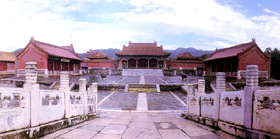
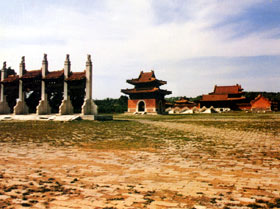
The location is at Malanyu, northwest Zunhua, Hebei Province,
125 kilometers from Beijing. Included among the tombs are the
Xiaoling of Emperor Shun Zhi, Jingling of Emperor Kang Xi, Yuling
of Emperor Qian Long, Dingling of Emperor Xian Feng, Huiling of
Emperor Tong Zhi, four tombs of empresses including Empress Dowager
Ci An and Empress Dowager Ci Xi, and five tombs of imperial
concubines, in addition to a princess' tomb.
??
The East Tombs are the largest and most complete complex of
imperial tombs in China. Of these, the Yuling mausoleum of Emperor
Qian Long and Dingling mausoleum of Emperor Dowager Ci Xi are the
most magnificent. But in 1928 the underground palaces were blown
open by warlord Sun Dianying, many precious articles were looted
and the tombs suffered heavy damage.
Scenery around the East Tombs is most beautiful. Qing
government rules designated the tomb area as geomantically
favorable and forbidden to people. Fifteen tombs are arranged from
east to west along the southern foot of Changduan Mountain. Behind
the tombs are rolling hills and in front is a long spirit path.
Along the central axis of the complex form a unique natural scene
is presented as the temples and palatial structures, with red walls
and golden tiles among pines and cypresses of verdant green,
glitter in the sunshine. They seem as islets dotting a vast green
sea. The Dragon Beard Ditches of each tomb, large and small, zigzag
and coil like dragons; streams under stone bridges are like white
belts through the forest of pines and cypresses. In early morning
or late afternoon one can see through green branches and leaves the
beamed eaves, pavilions and garrets, stone sculptured human figures
and stone animals appearing through the foliage to be draped in
thin yellowish gauze kerchiefs.
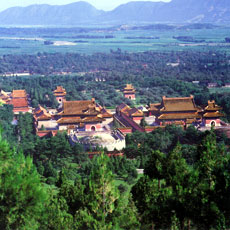 |
The Qing East Tombs at Zunhua, Hebei
???
Construction of the East Tombs?It was said that,
during the Shun Zhi reign of the Qing Dynasty (1644-1661), Emperor
Shun Zhi went hunting on a trip that reached the area of Xiaoling
mausoleum at the foot of Changduan Mountain. Reining in his horse
to a stop, he looked around and found the place quiet and beautiful
in a luxuriant setting among green mountains. He took off his
banzhi (an animal-bone thumb guard worn by archers), threw
it into sky and told his bodyguard: "Where the banzhi
drops is to be my burial place."
??
In the second year of the Kang Xi reign (1663), Shun Zhi's tomb,
Xiaoling mausoleum, was built at the foot of Changduan Mountain
marking the beginning of the Qing Dynasty East Tombs. After that,
Emperor Kang Xi and his concubines were also entombed in East
Tombs.
???
As construction was about to begin, Emperor Kang Xi sent higher
officials of the Ministry of Rites from the Manchu and Han
nationalities, together with two imperial commissioners, to map the
location of the tombs. Later, another pair of higher officials of
the Ministry of Public Works from the Manchu and Han nationalities
were sent to inspect. Talented officials from eight banners and
other officials from the Ministry of Public Works also assisted in
the management.
??
During construction, equipment commonly used included compass,
hoisting jack and winch. Construction methods were strictly
prescribed. For instance, the foundation must be dug deep with many
wooden stakes and pegs. The foundation of Long'en Palace of Empress
Dowager Ci Xi was dug more than four meters deep, and 685 cypress
stakes and 8,881 pegs were driven into the ground with earth packed
tight around them. The roof of the castle of Empress Dowager Ci
Xi's mausoleum has five layers of plaster alternating with layers
of compacted earth. Each plaster layer was 9.9 cm thick. In
addition, the juice of glutinous rice was added to the plaster,
resulting in a castle roof still in solid condition despite many
years' erosion by wind and rain. As another example, for
underground palace was built, iron hooks, stakes and pegs were
added to normal stone connectors again resulting in a very solid
underground palace.
????
Layout of the East Tombs?In the center of East Tombs
under the main peak of Changduan Mountain is the tomb of Emperor
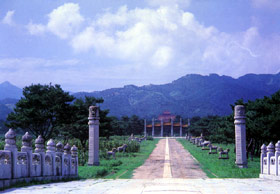
Shun Zhi. On the five-kilometer-long spirit path are the large red
gate, locker palace, big and small decorated arches, stone
creatures, gate of dragon and phoenix, single-arch bridge,
five-arch bridge, seven-arch bridge, dismount tablet, Long'en
palace, Long'en Gate, silk burning furnace, Long'en Hall, color
glazed gate, gate with two supporting pillars, five stone arches,
soul tower and roof of the castle. All these building structures
are arrayed along a brick spirit path twelve meters wide.
???
The big red gate is the main entrance of the East Tombs. A
magnificent, six-pillar stone arch stands in front of the gate. A
golden colored picture carved on the stone arch remains faintly
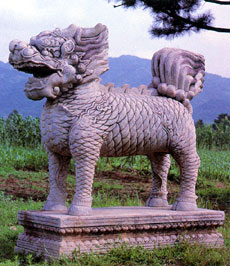
visible. Besides, there are a stone unicorn and the tablet
inscribed "Officials Dismount From Horse Here" to illustrate the
dignity of feudal emperors. On both sides of the red gate was
originally a wall of geomantic omen, with only traces
remaining.
?? ?
Through the red gate and to the right on the spirit path there
once was a locker palace where the people paying homage at the
tombs changed their clothes. Now, it no longer exists.
?? ?
The spirit path was paved with three layers of large bricks and
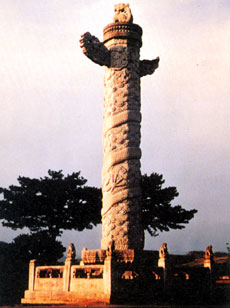
decorated with stone creatures. Starting from the stone ornamental
column (or watching pillar), eighteen pairs of stone animals and
human figures were arranged at fixed intervals. Among them are
horses, elephants, unicorns, courtiers and military officers. There
are eight pairs of such creatures in Yuling Mausoleum and five each
in other mausoleums.
???
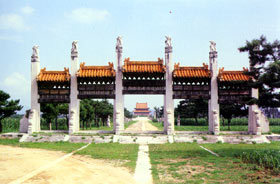
Beyond the stone creatures, the big decorated arch is the main
structure on the spirit path. This arch is double eaved with four
ornamental columns, each over ten meters high. In the center of the
arch stand two Tablets of Devine Merit and Sage Virtue each set on
the back of a dragon headed turtle. The tablets are made of jade
carrying inscriptions by Emperor Shun Zhi both in Manchu and
Chinese.
??
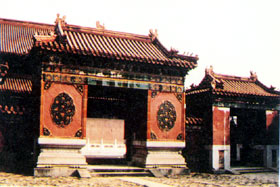
After the big stone arch is the gate of the dragon and phoenix.
It is a building with six pillars with dragon and phoenix patterns
on glazed bricks and tiles. Stepping in the gate of dragon and
phoenix makes one feel as though he / she has entered a room.
Between the big red gate and the gate of dragon and phoenix,
various buildings are arranged in a variety of visual angles,
giving visitors a series of new and constantly varying impressions
of the compound.
?? ?
On the north end of the spirit path is a small pavilion. Inside
the pavilion is a stone tablet set on the back of a stone turtle.
The tablet is inscribed with the Emperor's reign title and the name
of the mausoleum. Lying to the east of the small pavilion are a
sacred kitchen and two three-room storehouses. The sacred kitchen
is a five-room unit used for cooking sacrificial offerings; the
storehouses are compounds for horse breeding. Immediately north of
the small pavilion are three bridges each with three arches,
matching the others on the approach to the small pavilion. Under
the bridges flows the Yudai (Jade Belt) Stream (also known as
Dragon Beard Ditch).
???
Further north is Long'en Palace. On both sides as one enters
Long'en Palace are five wing rooms and three guard rooms. On east
wing are tea houses and dining rooms; cakes and fruits were served
in the west wing rooms. At that time were submitted tributes from
here by the Ministry of Rites. The guard rooms were used by those
on duty.
???
The Long'en Gate has five rooms with single eaves. High red
walls flank the gate which is directly in front of the Long'en
Palace. Under the eave is the name of Long'en Palace carved on a
horizontal board in Manchu and Chinese. This was the site of
memorial services. The platform once held a brass tripod, deer and
cranes, all long since disappeared.
???
The palace is fronted by a brick slope. East and west of the
main room are wing rooms and at the south end is a silk burner,
used by prayers to burn paper money or place sacrificial
offerings.
???
The back door of Long'en Palace is decorated with color glazed
tile in three arches. A wall divided the palace's rear area into
two segments, the imperial court and a living area.
???
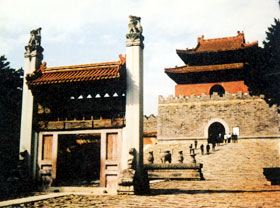
On the north face of the palace stands the color glazed door.
Passing through the two pillars door, one sees a five-piece stone
altar. A stone incense burner placed in the center of the altar is
decorated with patterns and its four legs are in the shape of
elephant trunks. The burner is flanked by stone flower vases and
candlesticks.
?? ?
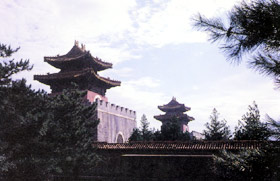
After the five-piece stone altar is the magnificent Soul Tower
with double eaves in the style of flying rafters. The slopes are
flat and gutters curve up. Inside the tower is a tablet inscribed
with the title of the tower and the name of the tomb in Manchurian,
Chinese and Mongolian languages.
???
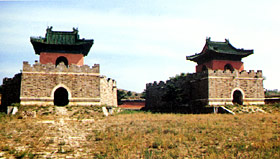
Under the Soul Tower is the Square Castle. On both sides of the
castle is a city wall extending around the entire tomb area, which
is called Baocheng (Treasure Castle). The forepart of the Baocheng
connects with a glazed screen wall formed into the shape of a
crescent moon; hence the name, Crescent Moon Castle. There are
stairs on both sides of the Crescent Moon Castle which lead to the
Soul Tower and there is a paved path on the upper part of Baocheng
lined with a lower wall.
?? ?
The large mound in the center of Baocheng is the grave of the
Emperor and Empress which is called Baoding (Precious Dome) or
Dulongfu (Single Dragon Mound). To the south side of Baoding is a
glazed screen wall under which is a tunnel leading to the
underground palace of the Emperor and Empress.
The Tombs of Emperors and Empresses ?In the Dongling
area there are five emperors' tombs, four mausoleums for fifteen
empresses and five cemeteries for 136 concubines. Outside the
geomantic wall were originally located cemeteries of princesses and
crown princes. With each emperor's tomb in the center, the
cemeteries of empresses and concubines were built closest around
it. All emperors' tombs were placed either to the east or the west
of Xiaoling Mausoleum.
??
Xiaoling Mausoleum?The Xiaoling Mausoleum is
central of the Shun Zhi mausoleum. It is located at the foot of
Changduan Mountain in the center of the mausoleum complex. Emperor
Shun Zhi, also going by the name of Fu Lin (1636-1661), was the
first emperor after the Qing court moved inside the Great Wall.
Only six when he ascended the throne. The eighteen years of his
reign brought great changes to China and its history.
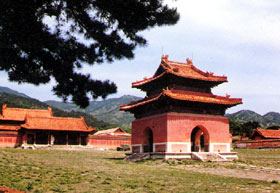
Stele pavilion at Xiaoling, tomb of Emperor Shun
Zhi
??
In the first year of Shun Zhi reign (1644), a peasant army led
by Li Zicheng overthrew the Ming rule in Beijing, which was in turn
betrayed by traitor Wu Sangui and the Qing Army defeated Li Zicheng
and occupied Beijing. Shortly, Shun Zhi came to Beijing from
Shenyang and made Beijing the capital. In the 18th year (1661) of
his reign Shun Zhi died in Yangxindian (the Hall for Cultivating
Character) in the Forbidden City. In the summer of the second year
of Kang Xi reign (1663), Shun Zhi's coffin was buried in
Xiaoling.
??
Half a kilometer east of Xiaoling Mausoleum is Xiaodongling
where seven empresses and concubines were buried, induding Xiao
Huizhang and Duan Shun.
???
Jingling Mausoleum?This is the tomb of Emperor
Kang Xi, located to the east of Xiaoling. Built in 1681 in the 20th
year of the Kang Xi reign, it is nearly as large as Xiaoling
Mausoleum and columns of the Long'en Palace are particularly
magnificent. The Kang Xi reign lasted for 61 years, one of the
longest in Chinese history.
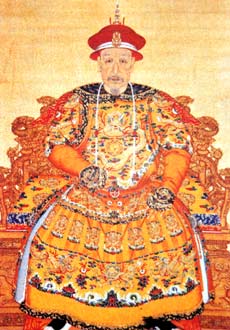
Portrait of Emperor Kang Xi
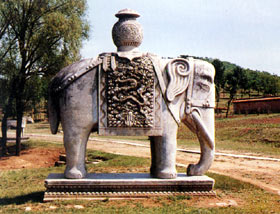
Stone elephant on the spirit path to Jingling, Mausoleum of Emperor
Kang Xi
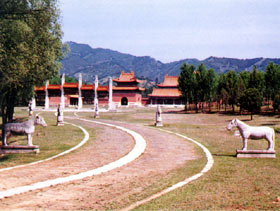
Stone horses on the spirit path to Jingling
Ornamental pillar at Jingling
??
To the east of Jingling are two cemeteries for Kang Xi's
concubines, including Tai Fei and Jing Fei.
Tombs of Qing Emperor Kang Xi's two
concubines
??
Yuling Mausoleum?The mausoleum is the tomb of
Emperor Qian Long, located in Shengshuiyu west of Xiaoling
Mausoleum, coveting an area of over 690 mu. Qian Long's
reign lasted for 60 years from 1736 to 1795.
Scared path to Yuling
The stone archway at Yuling
Stone animal on the spirit path to Yuling
Two-pillar Gate and Soul Tower at Yuling
Glazed gate at Yuling
The Hall of Grand Favor at Yuling
?? ?
In the 60th year of his reign (1796), Emperor Qian Long
enthroned his son and became overlord for four years. When Qian
Long was on the throne China was flourishing, but as he left the
throne it was beginning to decline. In the 4th year of the Jia Qing
reign (1799) Qian Long died at age 89.
???
Yuling Mausoleum is a tomb in which the emperor, two empresses
and three concubines were buried. At present the underground palace
of this tomb is open to public. A traditional arch stone structure,
unique in construction, the underground palace is 54 meters long,
consisting of three rooms and four doors with an area of 327
meters. Carved on the walls and ceiling of the palace are
large-size eight stone bodhisattvas, four heavenly kings and
Buddhas, five-piece stone altar, with thousands of words of
Buddhist sutra and incantation in Sanskrit and Tibetan. All these
carved works are in sharp relief with clear-cut lines and vivid
figures. As many patterns as there are, they are arranged
systematically with differentiation between principal and
subordinate. This underground palace with its art treasury is a
witness to the luxurious life led by feudal rulers, as well as a
crystallization of the wisdom of the laboring people.
?? ?
The cemetery of concubine Yu Fei lies half a kilometer west of
Yuling. The latter housed 35 remains including those of Wulanala,
Qian Long's empress.
?? ?
Dingling Mausoleum?It is the tomb of Emperor Xian
Feng, located in Pinganyu, west of Yuling. During Xian Feng's reign
from 1851-1861 the Qing government was on the verge of collapse.
The Taiping Heavenly Kingdom Revolution (I85I-I864) and the Second
Opium War took place during that time. On the 11th year of his
reign (1861), Emperor Xian Feng died at the imperial Summer Resort
in Chengde, Hebei Province, at the age of 31, a victim of a life of
dissipation. In the 4th year of the Tong Zhi reign
(1865), Xian Feng was buried in Dingling. Empress Xiaodexian was
also buried in this underground palace. There are two other
empresses' tombs from the Xian Feng reign. One is called Puxiangyu
East Dingling and another is called Putuoyu East Dingling.
??
The Puxiangyu East Dingling?It is the tomb of
Niuyoulushi, another empress of Emperor Xian Feng. She was
respected as Empress Dowager Ci An after Xian Feng died. Together
with Empress Dowager Ci Xi, she attended to state affairs behind
the screen after a coup d'etat in 1861. But military and political
powers were retained by Ci Xi. In 1881, Ci An died in Zhongcuigong.
Cause of her death was a mystery.
The tombs of Empress Dowager Ci An and
Ci?Xi
Soul Tower at the tomb of Empress Dowager Ci An
and Ci Xi
Carved base railings of the Hall of Grand Favor at
the tomb of Empress Dowager Ci An and Ci Xi
Carved stone ramp at the center of the staircase leading to the
Hall of Grand Favor at the?tomb of Empress Dowager Ci An and
Ci Xi
The Putuoyu East Dingling?It is the tomb of Xian Feng's
concubine, Nalashi. After Xian Feng died, Zai Chun, Nalashi's
six-year-old son, succeeded to the throne under the reign title of
Tong Zhi. So she was promoted to be empress dowager and her title
of honor is Ci Xi. In the 11th year of Xian Feng reign (1861) she
worked hand in glove with her brother-in-law Yi Xin, launched a
coup d'etat, wiped out her political enemies and directed state
affairs from behind the screen. Thus, she became an unofficial
empress during reigns by Tong Zhi and Guang Xu for 48 years. The
Empress Dowager died in 1908. Three years after she died, the Qing
Dynasty came to its end with the Revolution of 1911. Ci Xi's tomb
was exquisitely constructed in a unique style. It ranks as the best
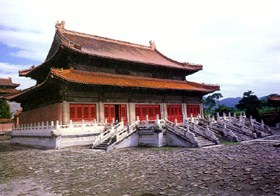
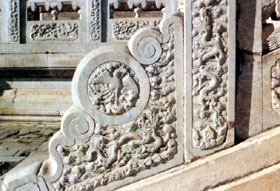
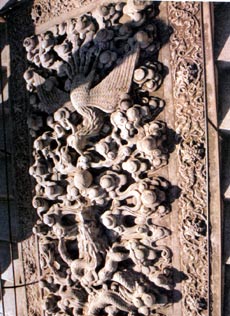
for building details among the tombs of the Qing Dynasty. Railings
around Long'en Palace are replete with carved motifs of roaring
waves, floating clouds, dragons and phoenixes symbolizing
auspicious omens. The stone steps in front of the palace are carved
with three-dimensional phoenixes and dragons playing with pearls
appearing as living dragons and phoenixes moving and dancing in
fleecy clouds. Motifs of phoenixes are purposefully arranged above
those of dragons. According to tradition, dragon symbolizes emperor
while phoenix stands for empress so dragon should be put above
phoenix.
??
Carved on walls are intricate designs marking happiness,
prosperity, and longevity. On the arch beams and ceilings are
gilded golden paintings such as a golden dragon coiled around all
exposed pillars. These kinds of designs are not seen in other
mausoleum palaces. The underground palace of Ci Xi's tomb has been
opened to visitors. This is the first underground tomb of an
empress to be excavated in China, so far.
Huiling Mausoleum?It is the tomb of Emperor
Tong Zhi, located in Shuangshanyu, 6 kilometers southeast of
Jingling. Tong Zhi became emperor when he was six years old. He
reigned as a puppet emperor for thirteen years from 1862 to 1874
and died at the age of 19, short-lived emperor of the Qing
Dynasty.
The Huiling, tomb of Emperor Tong Zhi
?? ?
Huifeiling is the tomb of Emperor Tong Zhi's concubine, half a
kilometer west of Huiling.
???
Another tomb, the Zhaoxi Tomb of Empress Xiaozhuangwen, is
located outside the big red gate. Why should one tomb be built
outside the big red gate? The reason is that originally she was a
concubine of Huangtaiji Emperor Tai Zong (1592-1643). When Emperor
Kang Xi was on the throne she was respected as empress dowager.
During the reigns of Yong Zheng and Qian Long, 45 years after her
death, she was regarded as Empress Xiaozhuangwen. She was Emperor
Shun Zhi's mother but she lived over 20 years longer than Shun Zhi.
She died at the age of 75 in the 26th year of the reign of Kang Xi
(1687).
???
At the beginning of Kang Xi reign, she had a strong hand in
state affairs from behind a screen placed at the rear of the throne
in her position as empress dowager. She set a precedent for Ci Xi
to usurp power later on. She said to Kang Xi before she died:
"Emperor Tai Zong has been dead for a long time, his tomb shouldn't
be disturbed for me. Besides, I am always concerned about you and
your father, so after I die my body should be buried near Xiaoling
Mausoleum that I would be satisfied''
??
Tai Zong was her first husband, Huangtaiji, who was buried in
Zhaoling Mausoleum, Shenyang, according to court rules her body
should be buried near Zhaoling Mausoleum. Still, there is a
question why she chose Xiaoling Mausoleum in preference to the
expected Zhaoling Mausoleum. The reason is not merely that Emperor
Kang Xi and his father were dear to her heart. There is a story
behind it.
It is known that at the beginning of Shun Zhi reign she was
respected as the mother of the country. But as she remarried her
brother-in-law, she became wife of regent Dorgon. Though this may
not have been an astonishing act, it is, nevertheless, rare in
Chinese history. Regent Dorgon was haughty and domineering when he
was on throne, falling into disrepute and becoming the target of
very strong public criticism by the time he died. She was, of
course, reluctant to be buried with him under these
circumstances.
??
Huangtaiji was her former husband but since she had married her
brother-in-law after his death, both feudal concepts and religious
superstition militated against the burial with her first husband.
Thus she did not have much choice but to ask to be buried near
Xiaoling Mausoleum.
??
At first, complying with Xiao Zhuangwen's last words, Kang Xi
built a "Zhananfeng Temple" on the south of Xiaoling Mausoleum. But
in the second year of his reign (1724), Emperor Yong Zheng built
the present mausoleum for her, calling it "the West Zhaoling
Mausoleum." Based on the name, it approximated in appearances the
Zhaoling Mausoleum of Huangtaiji in Shenyang, the West Zhao]ing
Mausoleum is several hundred kilometers from Zbaoling Mausoleum,
the only instance of such a burial among Qing Dynasty
mausoleums.
??
Grave Robbers?After the fall of the Qing Dynasty,
and because factions from the Revolution of 1911 could not agree,
separationist warlord regimes fought ceaseless wars against one
another. In the chaos of war, grave robbers were very active. Tomb
guards left by former Qing governments no longer had wages, so they
often stole, or helped to steal, what they were guarding. Trucks
full of cultural relics stolen from mausoleums were common sights
on the roads of Jixian County at that time. Under the rule of
warlord Zhang Zuolin in Northeast China, the time saw so much was
stolen that even most trees in the mausoleum areas were felled.
??
In 1928, such a large scale grave robbing operation occurred
that almost all the underground funeral objects of the Huifeiling,
Yuling Mausoleum and Putuoyu East Dingling disappeared.
???
On June 12 of that year, Ma Futian, Regimental Commander in the
28th Army of Zhang Zuolin quietly occupied Malanyu. Sun Dianying,
another warlord, however, ordered Tan Wenjiang, one of his military
leaders to capture the tomb area. At dawn on July 2, Ma Futian was
driven away and Tan's army looted the mausoleums in Malanyu. After
that, Sun's army went straight to the area of Qing East Tombs,
pretending to engage in war exercises in the area.
??
Tan Wenjiang placed policemen all around, denying access to the
area and signs declared the army was "protecting the Tombs" to
reassure the way.
??
At midnight the engineering corps blew up the entrance, opening
the passage leading to the underground palace. The stone door was
pried open to give access to the rear room of the grave. Then Sun
Dianying gave first priority to officers above battalion commander
level to collect treasure for themselves. Finally, ordinary
soldiers were allowed to take the leftovers.
??
The robbers first took the large treasure objects placed around
the remains of Ci Xi, such as jadeite watermelons, grasshoppers and
vegetables, jade lotus and coral. They even grabbed objects found
beneath the body and ravaged the corpse itself, taking her imperial
robe; tearing off her under clothing, shoes and socks, and taking
all the pearls and jewels on her body. They even pried open Ci Xi's
jaws and took the scarce pearl from her mouth. Finally they looted
the objects under the coffin which had been favorites of Ci Xi when
she was alive.
?? ?
While Tan Wenjiang was robbing Ci Xi's tomb, Han Dabao, Brigade
Commander under Sun Dianying led another army to Yuling Mausoleum
and declared his intention to conduct war exercise. They blew the
entrance of the underground palace, struck through the first,
second, third and fourth stone doors and rushed into the rear room
of the tomb. The coffins of Emperor Qian Long and his two empresses
and three concubines were pried open: all the valuables from these
coffins were looted and the skeletons thrown into the mud.
?? ?
The looting operation was directed by Sun Dianying, who
inspected from his car. When a truck had been filled with the
valuable booty, the army fled quickly. The soldiers then rushed to
Yuling Mausoleum and the underground palace of Putuoyu East
Dingling and looted what they could.
???
Finally, local riffraff snuck into the two underground palaces
to pick up leftovers. This kind looting left nothing in those two
mausoleums except broken coffins; an inestimable lost.
???
Newspapers reported the grave robbing and the news spread
throughout China and around the world. People were outraged.
Emperor Aisin-Gioro Pu Yi, who had dismissed Sun from his post,
sent telegrams to Chiang Kai-shek; Yan Xishan, Commander of
Garrison Force in Beijing; the Central Committee of Kuomintang, and
local newspapers asking them to punish Sun Dianying severely. Many
others also called for punishment. However, Sun Dianying bribed
those who were in a position to discipline him and nothing was
done.