On a farm in Songjiang District, not a single machine sound can be heard instead you can hear buffalo, goats and chickens.
The chickens hang around among figs and goats chewing vegetable leaves in the sheepfold. It could be a traditional farm, except that the orderly lined vinyl houses tell a different story. This is a modern organic farm in suburban Shanghai.
Organic produce has become widely embraced as an increasing number of people care more about the quality, rather than the quantity, of food they eat. The organic trend has already swept Europe and it is now making inroads in China.
About 52.2 percent of Chinese consumers have accepted the idea of organic food and some have already eaten organic produce, according to the 2008 Biofach China International Organic Trade Fair and Conference. There are now more than 2,500 organic food producers across the country, Biofach says.
Organic food refers to produce grown without conventional pesticides and artificial fertilizers. This keeps it free of contamination by human or industrial waste.
Organic food is also processed without ionizing radiation or food additives. If livestock are involved, they must not be given antibiotics or growth hormones. Most countries also state that organic produce can not be genetically modified.
Chen Conghong, managing director of Beijing Organic Farm Development Co, one of the earliest organic farming companies in China, says organic food has many benefits over produce grown on regular farms.
"Since no pesticides and artificial fertilizers are used in the growing process, organic vegetables are much safer than ordinary ones," Chen say. "Organic may also be more nutritious."
Beijing Organic has set up organic farms in more than 10 cities across China, including Beijing and Shanghai, as well as some in the provinces of Heilongjiang, Yunnan and Shandong.
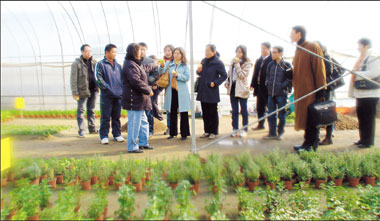
The 33.3-hectare organic farm in Songjiang District grows leafy green vegetables.
Another benefit of organic produce, says Chen, is better taste.
Many consumers find organic pumpkins, turnips and tomatoes taste sweeter while ordinary ones have a watered-down flavor.
"Consuming organic foods is more important as a green lifestyle and not just about pursuing safe and tasty foods," says Axel Bartkus, managing director of NurnbergMesse (China) Co, the local subsidiary of its Germany-based parent that organizes exhibitions, including organic food fairs, around the world.
Bartkus says the idea of organic food first appeared in Germany - the biggest organic-consuming nation in the world - early last century when a group of people became worried about the environmental pollution caused by modern industry and agriculture.
Organic farming was at first only done at small family-run farms and the foods were only available locally. It was not until the 1970s that organic farming developed at an enormous speed when serious damage to the environment scared most Germans.
"Leaving a sustainable Earth for future generations is the main goal of organic farming," says Chen.
Though artificial fertilizers and pesticides help vegetables grow much faster, they eventually lead to "dead earth." The use of artificial fertilizer makes it difficult for plants to grow as the earth hardens over time. Farmers then use even more artificial fertilizer to produce the same harvest.
The vicious circle eventually leads to knots of clay in the soil, which will no longer support crop growth.
However, setting aside land free of artificial fertilizers is not easy, according to Chen. Land must sit idle for three years before it can be used for organic farming. Once organic crops are planted, it still requires a lot of work to keep them free of chemicals.
"Everything used on the land should be 100 percent natural," says Chen. "Setting up an independent ecological cycle within the farm is crucial."
The farm's employees dig out their own underground water source, feed the goats with leftover organic vegetable leaves. The chickens and ducks hang around in the fig garden and eat fruit or insects.
Goat and bird excrement ferments together with some leftover organic vegetables on the ground covered by a ventilation cloth. Once it's ready, it will be used as an organic fertilizer. To avoid pollution from machines, the fields are ploughed by a buffalo and all vegetables are collected by hand.
Another challenge for organic farmers is controlling pests without using pesticides.
Several methods are used. Small yellow boards with glue will kill pests attracted to bright colors. Insect traps that give off the scent of the females will prevent insects from reproducing in the area. And bug zappers are used to kill flying insects at night.
All these methods can help prevent about 80 percent of pest damage at ground level, but there is no effective way to kill pests underground.
"Chemical pesticides can accomplish the task quickly, but we won't allow it at the cost of healthy soil," says Chen.
A failure to control pests can lead to a poor harvest, which is one of the risks that contribute to higher prices for organic produce.
"Many people complain about the high price of organic food, which is usually more than twice the price of ordinary food," says Chen. "But they should also take into consideration the high cost of organic farming."
Organic vegetables don't grow as quickly as those fed by artificial fertilizer. If a vegetable can be harvested in 30 days after using artificial fertilizers, expect at least seven days more for it to mature on an organic farm.
It is also more difficult to prepare fertilizer properly for different kinds of organic vegetables while you can add the exact quantity of nitrogen, phosphorus and potassium needed in artificial fertilizers. Since organic farming is new to China, farmers are still seeking ways to solve various problems such as pest damage.
Chen believes that as organic-farming techniques improve in China, costs will decline. But this doesn't mean she would drop the price of organic produce.
"Most of the organic farming companies depend on government support," says Chen. "I hope that when costs drop, organic farms can earn more profits on their own and contribute to an independent positive cycle."
How do you know if the produce is organic?
There are various labels attached to so-called organic foods that confuse people.
You need to find at least two certification labels rather than one to prove organic food is authentic.
The first is the China Organic Product label patterned as a green circle with a red seed in the middle.
The other one is the label of the organic food quality certification organization. This label can vary as the government will give credit to different certification organizations each year.
The difference between green food and organic food
There are strict standards for organic food, including planting, processing and certification.
Organic foods have to be planted on fields that have been free of chemicals for at least two or three years. They must be grown free of conventional pesticides and artificial fertilizers. And they also have to be processed without ionizing radiation or food additives.
Livestock must not be given antibiotics or growth hormones. The policy maker (usually the government), producer and quality certification organization should all be independent from one another.
The government will give credit to a number of qualified certification organizations for organic foods each year. And those quality certification organizations will be responsible for examining the quality of organic food in the market.
At the organic farm in Songjiang District, grows leafy green vegetables.
Green food is, actually, transitional products from ordinary to organic. It first appeared in China in the 1990s with the help of the Ministry of Agriculture. Much less pesticides and artificial fertilizer are used in the growth of green food, but they are not totally free of such chemical.
AA-grade green foods are free of all pesticides, artificial fertilizers and additives -- just like organic food -- but don't have a strict set of certification rules like that of organic produce.
(Shanghai Daily December 30, 2008)




