Remote Antiquity and Slave Society (1.7 million years ago-476 B.C.)
China has a recorded history of nearly 4,000 years, but archeologists have traced the beginnings of human civilization in China to a much earlier time. China’s earliest primitive human discovered so far is known as “Yuanmou Man,” a fossil anthropoid unearthed in Yuanmou in Yunnan Province who lived approximately 1.7 million years ago. The better-known “Peking Man,” discovered in the Zhoukoudian area near Beijing, lived about 600,000 years ago. Peking Man was able to walk upright, make and use simple tools, and make fire. By the start of the Neolithic Age in China about 10,000 years ago, people were cultivating rice and millet with farming tools, something revealed by relics found in the ruins of Hemudu in Yuyao, Zhejiang Province, and Banpo, near Xi’an City, Shaanxi Province. These relics date back some 6,000-7,000 years.
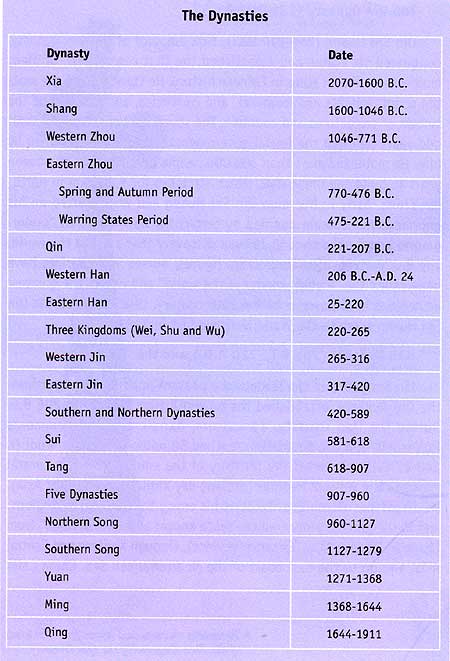
According to tradition, the Xia Dynasty (2070-1600 B.C.) was the first Chinese dynasty that ruled a state. The center of its activities was the western section of modern Henan Province and the southern section of modern Shanxi Province, and its sphere of influence reached the northern and southern areas of the Yellow River. The Great Yu, King of Xia, was succeeded by his son Qi, and his descendants until the Xia Dynasty was overthrown by Shang. Written records of the Shang Dynasty (1600-1046 B.C.) exist—some cast in bronze, some inscribed on tortoise shells or animal bones. These and other relics reveal that Chinese in the Shang Dynasty had magnificent abilities in bronze work, were involved in agriculture, and had formed a slave society. The Western Zhou (1046-771 B.C.) Dynasty saw further development but Chinese historians differ on whether people then maintained a slave society or developed an incipient stage of feudalism. This era was followed by the Spring and Autumn (770-476 B.C.) and Warring States (475-221 B.C.) periods when silk production advanced considerably and steel production started. Periods of economic and social upheaval when independent states vied for power, they are also known as dynamic cultural periods that produced several of the world’s greatest philosophers: Lao Zi, Confucius, Mencius and Sun Zi, whose book The Art of War even in modern times is an international best seller.
The Qin Dynasty (221-207 B.C.)
Qin Shi Huang (259-210 B.C.), first emperor of the Qin Dynasty, conquered six states and established the first centralized, unified, multi-ethnic feudal state in Chinese history. He standardized the written script, weights and measures, and currencies, and established the system of prefectures and counties. The sovereigns of the next 2,000-odd years followed the feudal governmental structure established by him. He mobilized more than 300,000 people over a period of a dozen years to build the Great Wall, which stretches for 5,000 km in northern China. Early in his reign Qin Shi Huang had work started on his enormous mausoleum guarded by terracotta warriors of an “underground army” unearthed in 1974, a discovery that amazed the world. The 8,000 vivid, life-size pottery figures, horses and chariots have been called the “eighth wonder of the world” and one of the greatest archeological discoveries of the 20th century. UNESCO added the Qin Shi Huang tomb to the World Heritage List in 1987.
Han Dynasty (206 B.C.-220 A.D.) and the “Silk Road”
Liu Bang, one of the leaders of a peasant uprising that overthrew the Qin Dynasty, established the powerful Han Dynasty in 206 B.C. During the Han Dynasty, agriculture, handicrafts and commerce flourished, and the population reached 50 million. Emperor Wudi (r. 140-87 B.C.) expanded the territory of the empire from the Central Plains to the Western Regions (present-day Xinjiang and Central Asia). He dispatched Zhang Qian twice as his envoy to the Western Regions, and in the process pioneered the route known as the “Silk Road” from Chang’an (today’s Xi’an, Shaanxi Province), through Xinjiang and Central Asia, and on to the east coast of the Mediterranean Sea. China’s silk goods were traded to the West along the Silk Road. As contacts between the East and West increased, Buddhism spread to China in the first century. In 105, an official named Cai Lun invented a technique for making fine paper, creating a revolution in communications and learning.
Tang Dynasty (618-907)
After the Han Dynasty came the Three Kingdoms Period (220-265), the Jin Dynasty (265-420), the Southern and Northern Dynasties (420-589) and the Sui Dynasty (581-618). Then came the Tang Dynasty, established by Li Yuan in 618 with its capital at Chang’an (Xi’an). Agriculture, handicrafts and commerce flourished; technologies for textile manufacturing and dyeing, pottery and porcelain production, smelting and shipbuilding were further developed. Beautiful woodblock printings of dictionaries and almanacs and Buddhist scriptures were in circulation. Trade was facilitated by institution of a courier service and the introduction of stagecoaches. The Grand Canal also helped the flow of merchandise. Chang’an became a cultural and international trade center and—along with Luoyang, Yangzhou, and Guangzhou—a major commercial center. During the Tang Dynasty cultural relations were established with many countries, including Japan, Korea, India, Persia and Arabia. China’s influence reached far into the northwest, even extending to many city-states in Central Asia. The Tang Dynasty was the time when Buddhism reached its height in China.
Song, Yuan, Ming and Qing Dynasties (960-1911)
Following the Tang Dynasty came a period of almost continual warfare known as the Five Dynasties and Ten States. In 960, Zhao Kuangyin, a general of the State of Later Zhou, established the Song Dynasty (960-1279), known in history as the Northern Song Dynasty. When the Song Dynasty moved its capital to the south, it became known in history as the Southern Song Dynasty. China in the Song Dynasty was in the forefront of the world in astronomy, science and technology. Bi Sheng invented movable type made of clay, an invention that greatly increased the number of books published.
In 1206, Genghis Khan established the Mongolian Khanate. In 1271, Kublai, a grandson of Genghis Khan, conquered the Central Plains, founded the Yuan Dynasty (1271-1368), and made Dadu (today’s Beijing) the capital. Kublai ended the centuries-long situation in which many independent regimes existed side by side by forming a united country that brought Xinjiang, Tibet and Yunnan under its sway. During the Song-Yuan period, the “four great inventions” in science and technology of the Chinese people in ancient times—papermaking, printing, the compass and gunpowder—were further developed, and spread abroad.
In 1368, Zhu Yuanzhang established the Ming Dynasty (1368-1644) in Nanjing, reigning as Emperor Taizu. When his son and successor Zhu Di (1360-1424) ascended the throne, he built and expanded the palaces, temples, city walls and moats in Beijing. In 1421, he officially moved the capital to Beijing. During his reign, he dispatched a eunuch named Zheng He to lead a fleet of many ships to make seven far-ranging voyages. Passing the Southeast Asian countries, the Indian Ocean, Persian Gulf and Maldives Islands, Zheng He explored as far as Somalia and Kenya on the eastern coast of Africa. These were the largest-scale and longest voyages in the world before the age of Columbus.
The Manchus of northeast China established the Qing Dynasty (1644-1911) in 1644. The best known of the Qing Dynasty emperors, Kangxi (r. 1661-1722) restored the central empire’s rule over Taiwan, and resisted invasions by tsarist Russia. To reinforce the administration of Tibet, he also formulated the rules and regulations on the confirmation of the Tibetan local leaders by the Central Government. He effectively administered over 11 million sq km of Chinese territory.
Modern Period (1840-1919)
During the early 19th century, the Qing Dynasty declined rapidly. Britain smuggled large quantities of opium into China, making the Qing government impose a ban on the drug. In an effort to protect its opium trade, Britain launched a war against China in 1840. The Qing government finally signed the Treaty of Nanking, a treaty of national betrayal and humiliation, with the British government. Many countries, including Britain, the United States, France, Russia and Japan, forced the Qing government to sign various unequal treaties following the Opium War. China was gradually relegated to a semi-colonial, semi-feudal country.
The Revolution of 1911 led by Dr. Sun Yat-sen was one of the greatest events in modern Chinese history, as it overthrew the 200-odd-year-old Qing Dynasty, ending over 2,000 years of feudal monarchy, and established the Republic of China (1912-1949).
New-Democratic Revolution (1919-1949)
The May 4th Movement of 1919 is regarded as the ideological origin of many important events in modern Chinese history. Its direct cause was the unequal treaties imposed on China after the First World War. Out of strong patriotism, students initiated the movement, and it further developed into a national protest movement of people from all walks of life. It also marked the introduction into China of various new ideologies, among which the spread of Marxism-Leninism was worthy of special mention. Under the influence of Russia’s October Revolution of 1917, 12 delegates, including Mao Zedong, representing communist groups in different places throughout the nation, held the First National Congress in Shanghai in 1921 to found the Communist Party of China (CPC).
The Chinese people led by the CPC underwent successively the Northern Expeditionary War (1924-27), War of Agrarian Revolution (also known as “Ten-Year Civil War,” 1927-37), War of Resistance Against Japan (1937-45) and War of Liberation (1945-49). Owing to the cooperation and joint resistance of the CPC and Kuomintang the Japanese aggressors were defeated. But shortly after the anti-Japanese war, the Kuomintang launched a civil war again. After the three-year War of Liberation led by the CPC, the Kuomintang government was finally overthrown in 1949.
People’s Republic of China (1949- )
On October 1, 1949 a grand ceremony was witnessed by 300,000 people in Beijing’s Tiananmen Square, and Mao Zedong, chairman of the Central People’s Government, solemnly proclaimed the founding of the People’s Republic of China (PRC).
During the initial post-Liberation period, the Chinese government successfully carried out land reform in areas accounting for over 90 percent of the total national agricultural population, and 300 million farmers were granted approximately 47 million ha of land. Amazing achievements were made during the First Five-Year Plan period, from 1953 to 1957. The average annual increase rate of the national income reached over 8.9 percent. China established basic industries necessary for full industrialization hitherto non-existent domestically, producing airplanes, automobiles, heavy machinery, precision machinery, power-generating equipment, metallurgical and mining equipment, high-grade alloy steels and non-ferrous metals.
The ten years from 1957 to 1966 was the period in which China started large-scale socialist construction. Though China suffered from the mistakes in its policies during the period, it also accomplished a great deal. The nation’s total industrial fixed assets quadrupled between 1956 and 1966 and the national income increased by 58 percent in constant prices. The output of essential industrial products increased by several or even a dozen times. Large-scale agricultural capital construction and technical transformation got underway. Unfortunately, the “cultural revolution,” which lasted for ten years (1966-1976), made the state and its people suffer the most serious setbacks and losses since its founding.
The Jiang Qing counter-revolutionary clique was smashed in October 1976, marking the end of the “cultural revolution,” and the beginning of a new era in Chinese history. The CPC reinstated Deng Xiaoping, previously general secretary of the CPC, to all the Party and governmental posts he had been dismissed from during the “cultural revolution.” In 1979, China instituted a guiding policy of “reform and opening to the outside world” under Deng’s leadership, and the focus was shifted to modernization. Major efforts were made to reform the economic and political systems. China was step by step establishing a road with Chinese characteristics, a road that would lead to socialist modernization. Profound changes have come about in China since the country embarked on the policy of reform and opening-up. The situation in the country is the best ever, characterized by a swiftly and vigorously advancing economy and markedly improved living standard.
After Jiang Zemin became general secretary of the CPC Central Committee (in 1989) and president of the state (in 1993), he led China’s third-generation leaders to uphold and carry on the policy of reform and opening-up initiated by Deng Xiaoping. As a result, China’s policies enjoyed wide popular support in a stable political situation, burgeoning economy, and active diplomatic engagement.