Subtropical Xishuangbanna, Yunnan Province is home to 13 ethnic minorities, including the Dai, Hani, Blang, Yi and Aini, all of whom go about their daily business clad in colorful folk costumes. Xishuangbanna resembles a real-life Xanadu, far removed from temporal life. Of the ethnic minorities living here, Dai people have the longest history.
Dai Bamboo Dwellings
Dai bamboo houses form part of a two-story horticultural backdrop of jadeite bamboo, banana and coconut trees, cacti and other tropic plants. Domestic poultry is kept on the first floor, and family members live on the second. This generally comprises a sitting room, entered through a door at the top of a staircase, and bedroom. The sitting room is the larger of the two, and has a bamboo mat at its center where host and guests sit and chat, and a fire pit for cooking equipped with a three-legged rack for pots, kettles and pans. At the rear of the sitting room, separated from it by a bamboo curtain or wooden board, is the family bedroom that also has a bamboo mat. Outside the sitting room are a corridor and balcony where cylindrical bamboo containers for fetching water and water jars are stored, and where the Dai women sit and embroider. These bamboo buildings are generally roomy and airy - perfect for the Xishuangbanna climate.
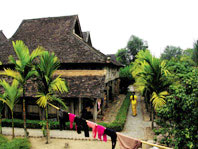
On being invited to a Dai bamboo house the visitor immediately enters an ambient Dai culture. The host is happy to give detailed explanations of the significance and function of each part of the house. The roof ridge, for example, symbolizes a phoenix' tail and its eaves the wings of an egret. In the sitting room is the drop pillar, or backbone of the building, which is sacred. It symbolically protects the whole house, so may not under any circumstances be leaned on or have goods stacked against it. When building a new house, leaves are placed under this pillar in the belief they will make the building more solid. There are two other pillars symbolizing the man and woman of the household, the bigger one at the center representing the master, and the shorter one to the side the lady of the house.
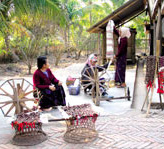
From the ceiling hang daily use tools like ploughs, harrows, looms, reeling frames, bamboo fish hampers and baskets, and also musical instruments. Each household is elaborately decorated in a way that celebrates and renews Dai history and culture.
People of the Water
The Dai people have a reverential love of water, as to them it is the source of all life. In the Dai epic Bata Maga Peng Shangluo, the creator Yingba combines water with other substances to create a world where water defines the earth and is the origin of all things.
Dai homes are usually built beside rivers and streams. A colorful holy tower inlaid with mirrors is built over the village well to invoke blessing and protection from the gods, and also covers it, keeping out dust and insects. Dai children know better than to play near this sacred tower.
Running water is an integral aspect of Dai life. Children swim and play in the streams running beside villages all day along, as their mothers sit nearby doing the family wash. At dusk the village women go to the stream to bathe.
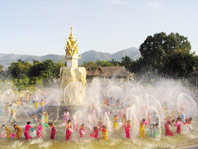
At the Dai New Year Water-Splashing Festival in mid-April all Dai people living in various parts of Yunnan Province celebrate their intimate relationship with water. It is probably the biggest and most significant of the hundreds of minority festivals held in Yunnan.
On water-splashing day, all Dai people, young and old, dress in their best. Early in the morning sacrificial offerings are made to Buddhist temples in each village. First they pour drops of water before sand towers and sacrificial offerings in tribute to their families. Young women then pour clean water into a wooden container fashioned in the shape of a dragon and pour fragrant water out of its mouth to wash away any dust on the statue of Buddha. The people bathe their eyes in this water and pray for Buddha's blessing and protection. Seniors are next and sprinkle water over each other as they pray. Then the younger villagers gently pour drops of water on the elders to express their benediction before splashing water over each other for fun as well as blessings. Drums, gongs, water-splashing and the chorus "water, water, water" all attract passersby to join in this happy celebration.
Other festival activities are cockfighting, peacock dancing, embroidered pouch throwing by young men and women, firing Gaosheng bamboo rockets, dragon boat racing and flying Kongming lanterns (paper lanterns with no opening that inflate when lit and float upwards). At nightfall everyone sings and dances by lamplight, and any domestic or overseas travelers that happen to be passing by are irresistibly drawn to join in the jubilations.
Delicious Dishes
The extent of Dai warmth, sincerity and hospitality comes over very strongly on a visit to a Dai household. On walking into a Dai restaurant or dwelling, a beautiful Dai girl approaches, carrying a water basin in one hand as she sprinkles water over you using a twig with the other to express welcome and blessing.
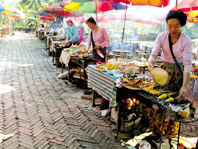
Main Dai dishes are generally pork, chicken, fish and beef cooked to crisp, piquant or spicy perfection. Famous national dishes include lemon-grass grilled fish, steamed lemon-grass wrapped chicken, fried cowhide, chicken boiled with sour bamboo shoots, pineapple purple rice, yellow ant eggs, water-fresh snails boiled with sour bamboo shoots, fried moss and pickled cow tendon.
Lemon-grass grilled fish is the most popular Dai dish. Lemon grass wrapped around fish prior to grilling gives it a crisp and fresh taste. Dozens of other dishes are made this way.
Dai fragrant bamboo rice is a must-to-taste. Fragrant bamboo is slender and gives off a scent from its inner membrane. The fresh bamboo is cut into tubes and stuffed with polished glutinous rice. An appropriate amount of water is then added. After the rice has soaked for 7 or 8 hours, banana leaves or lemon-grass are stuffed into the opening of the bamboo tubes, which are then placed in the fire pit. The rice is cooked after steaming in the bamboo tubes for about 10 minutes. In order to eat it, the bamboo tubes must first be pounded with a wooden mallet until soft enough to peel off the bamboo in strips. There at last is the fragrant bamboo rice with its upper layer of white bamboo membrane, tender, fine and smooth to taste.
For those who enjoy a beverage, Dai sour dishes are a delight as they are the traditional accompaniment to a glass of wine. Dai people are partial to pickled food, and well-known sour dishes include sour pig's knuckle, sour bamboo shoots, sour hedgehog meat, sour fish and sour carp soup.
Notes for Travelers:
1. When visiting a Dai household, do not take a quick peek at the host's bedroom as it is out of bounds to anyone outside their family.
2. Taboo in the sitting room
There are three pillars in a Dai sitting room, two of them between the bedroom and sitting room, and the outer Lucky Pillar that may be leaned on. The inner Pillar to Heaven as a solemn function. When a family member dies, the body is rested against it and bathed, dressed and shrouded in preparation for cremation. The pillar beside the fire pit should never be leaned on as, according to Dai belief, it is the Pillar Supporting the Sky.
3. Points of attention when entering a bamboo dwelling
After entering the house, everyone sits down in order of seniority.
Dai people think of the doorsill as a choke point for men and ghosts.
A stool is only for sitting on and must never be used as a pillow.
One should never step over the fire pit, nor move the three-legged rack over it.
Stairs should be climbed softly.
There must never be any whistling at night.
Ignoring any of the above rules of etiquette would be construed as disrespect for the host.
4. If you can't catch the Dai New Year's Day Water-Splashing Festival, there is always the travelers' Water-Splashing Festival held every afternoon at Ganlan Ba by the Xishuangbanna Dai Ethnic Park Company. Enjoy!
Tourism Information in April
1. Guangxi Zhuang "March the 3rd" Songfest
Date: April
Location: Wuming County, Guangxi
Sponsor: Wuming County People's Government
Events: Zhuang folk songs, ethnic sports show (long linked shoes, stilts, top whipping, bamboo carrying), and ethnic snacks exhibition.
2. Hainan International Coconut Festival
Date: April 1-10
Location: Haikou City, Wenchang County, Tongshi City, and Sanya City, Hainan Province
Events: Coconut City Lantern Show, Coconut Street, Li and Miao Ethnic Minorities Gala, International Dragon boat Festival, Ethnic Martial Arts, Recreation and Sports Performance, Li and Miao Wedding Ceremony, and Offering Sacrifices to Ancestors.
(China Today April 13, 2004)
|