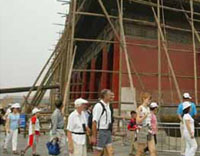
Background: the civil engineering project for the main buildings of the Hall of Martial Prowess, started on October 17, 2002, has by now been brought to completion. Taking this part of ancient architecture as an experimental site for the whole restoration work of the Forbidden City is not a choice at random, since this group of architecture, worn down in years gone by without repair, forms a rather independent compound and has never been opened to the public. All these made it suitable for a trial project, a prelude to an overall revamping of the Palace Museum.
The whole renovation project, said Jin, is as planned to be finished in three phases.
Initially from October 2002 to October 2005, repairing the Meridian Gate, the Hall of Imperial Peace (Qin'andian), and rooms along the central axis; second, from November 2005 to the eve of 2008 Olympic Games, restoring the major halls along the central axis, such as the Hall of Supreme Harmony (Taihedian), the Palace of Heavenly Purity (Qianqinggong), as well as the Six Rear Palaces of the East and West (Dongxiliugong); third, from 2008 to 2020, finishing the whole work.
This is, as learned, the biggest overhaul to the Forbidden City since the Revolution of 1911.
The renovation means to carry forward the things traditional
Reporter: the renovation of the Forbidden City is a big thing that requires much deliberation, which was ever questioned by many architects, historians and social personages. Then why on earth did the overhaul, the biggest one of a century kick off this time?
Jin: since the Forbidden City came into being in 1420, the maintenance and repairing work has virtually never ceased, except the period from 1911 to 1948 the due work came to a halt because of the limited social conditions. The work is confined to the protection of a salvage-nature even in a long period after the founding of New China in 1949, far from an overall renovation. What we say about carrying forward traditions we mean that the project this time has not many things new to deal with, but only bigger in scale. We will fully respect the traditions of our predecessors, making repairs on the bases they laid down. We must preserve for the 21st century and for the generations to come a Forbidden City which is of real and complete value as cultural relics, meanwhile making it to play a better and unique role in present-day society.
Fully restore the grandeur as in the flourishing periods of Kangxi and Qianlong
Reporter: since you say not to have many new things added into the project, what's the real purpose of the renovation?
Jin: It is aiming at protecting the Forbidden City as an intact whole, and resume its appearance under the reigns of emperors "Kangxi" and "Qianlong", the heydays of the Qing Dynasty.
Reporter: but who can tell, as some experts doubted, how the Forbidden City really looked like during that time?
Jin: we don't mean simply to restore every hall and palace to its original shape at that time but divide the goal into the following three aspects. First of all, to show the Forbidden City as what it should look like in the prime of the Qing ruling; secondly, to raise the technology and materials used to the level as in the prime period, which, in fact, needs much efforts at the present stage; thirdly, to enhance project management, ancient architecture protection, utilization and administration to an advanced level and realize strictly modernized management.
The overall maintenance and repair do not confine only to ancient buildings
Reporter: currently the biggest concern from the society is-- how on earth the Forbidden City is being renovated?
Jin: the overall maintenance and repair must have to fulfill five tasks. First, to protect the original layout of the Forbidden City and make every effort to improve its internal and external environments; second, on top of keeping the appearance and artistic value of ancient buildings, efforts must be made to protect their value as cultural relics and historic pieces; third, to revamp the infrastructure of the Forbidden City, since many of them, laid down half a century ago, are too old to meet the demand for modern management and opening to visitors; some will even spoil the scene of the Forbidden City; fourth, some ancient buildings in the imperial palace are still improperly occupied and used by units of, and those not of the Forbidden City, and this has exerted a great pressure on the needs of houses for exhibition, preservation, office and management, and for tourism purposes. The problem must be dealt with properly and get solved. Besides, as a world-renowned museum, the exhibition halls are in urgent need to be enhanced in artistic flavor with some modern facilities to synchronize the grandeur of the ancient buildings.
Contradiction between reparation and opening to visitors the biggest question:
Reporter: could you tell us how the renovation plan is worked out?
Jin: what we are doing to the Forbidden City is in accordance with the scientific procedure laid out by the Law of the People's Republic of China on the Protection of Cultural Relics-investigation, appraisal, draft of plan and implementation. For every building, our work is based on its real conditions as well as early-stage studies and on-the-spot examinations.
For more than one year, we arranged and conducted many preliminary studies except for the aforesaid experimental project, including surveying and prospecting work on buildings of cultural relic value involved in the first stage. Renovation plan must be mapped out on the basis of these work and discussed by experts and approved by higher-level departments as a due procedure.
Reporter: then what's the biggest problem in the renovation work? When putting up the Forbidden City, almost all precious timbers in the country were consumed and exhausted, which is simply impossible to use any of them today. Are materials and technology the problems?
Jin: we certainly have problems in materials and technology, but they are not unsolvable, for we have a professional team for preserving ancient buildings since the 1950s. Of course our traditional technology and techniques are not carried on too well, the skill of pasting, for example, is now facing extinction. That's why we launched a trial project and tried to preserve traditional technology techniques as much as possible. The biggest problem, however, is the clash between reparation work and opening to visitors.
"Not to change the original state of cultural relics"
Reporter: ever since the renovation of the Forbidden City, arguments on "restore the old as used to be", or "restore the old as something new" have never ceased. How to deal with the relations between traditional materials and modern techniques?
Jin: the principle of "restore the old as used to be" is put forward by Mr. Liang Sicheng, architect of an older generation and pioneer of the nation's undertakings in cultural relic protection. These are literary words on ancient building preservation, but not legal terms. A more precise expression is "not to change the original state of cultural relics" provided by the Law on the Protection of Cultural Relics, and this is also the basic principle for revamping work this time.
I don't think there should exist much argument on traditional materials and new techniques. Traditional techniques are "non-substantial cultural relics", and therefore should be preserved and protected. Traditional way is always the first choice. Then why we still have to introduce in modern techniques? I believe that modern techniques can bring us a thoroughly new understanding of ancient buildings, and may solve those problems not found out or not well solved in the past.
The application of new techniques and materials must be under three conditions. First, they are mature and effective; second, they carry no harms; third, they don't affect future protection work, and nothing should be done before making experiments.
Underground exhibition hall under feasibility studies
Reporter: another important part of the renovation work is the building of an underground exhibition hall with advanced facilities, but that invited hot debates?
Jin: currently the Palace Museum houses more than 1 million pieces of treasures, which should be displayed as much as possible. However, the result is not so good due to poor exhibition conditions here and limitations on ancient building protection. So the proposal of building an underground exhibition hall was made.
The Palace Museum has entrusted authoritative engineering unites for the investigation and surveying work on the spot, who are now busily doing the work of calculating, analyzing and report drafting.
Whether such an exhibition hall can be dug? Will the whole proceedings effect any impact on the Forbidden City as a whole? Will it reduce the resisting capacity of palace complex in the face of a seismic disaster for example? All these questions are subject to experts for the answer after the releasing of scientific data.
(People’s Daily November 14, 2003)