|
Population: 20,899
Major area of distribution: Yunnan
Language: Jino
Religion: Polytheism
Numbering 20,899 in all, the Jinos live in the Jinoluoke Township of Jinghong County in the Xishuangbanna Dai Autonomous Prefecture, Yunnan Province.
The language of this ethnic minority belongs to the Tibetan-Myanmese group of the Chinese-Tibetan language family. Its structure and vocabulary have much in common with Yi and Myanmese. Without a written language of their own, the Jino people used to keep records by notching on wood or bamboo.
Jinoluoke is a mountainous area stretching for 70 km from east to west and 50 km from north to south. The climate there is rainy and subtropical with an average annual temperature of 18 to 20 degrees. The rainy season lasts from May to September with July and August having the heaviest rainfall. The rest of the year is dry.
Jino land is crisscrossed by numerous rivers and streams, the longest being the Pani and the Small Black rivers. The major crops are upland and wet rice and corn. The famous Pu'er tea grows on Mount Jino. Jinoluoke also has a long history of cotton-growing and is abundant in such tropical fruits as bananas and papayas. Elephants and wild oxen roam the dense primeval forests which are also the habitat of monkeys, hornbills and other birds. Jinoluoke is also rich in mineral resources.
History
It is said that the Jinos migrated to Jinoluoke from Pu'er and Mojiang or places even farther north. It seems likely that they still lived in a matriarchal society when they first settled around the Jino Mountain. Legend has it that the first settler on the mountain ridge was a widow by the name of Jiezhuo. She gave birth to seven boys and seven girls who later married each other. As the population grew, the big family was divided into two groups to live in many villages, or rather two clans that could intermarry. One was called Citong, the patriarchal village, and the other was Manfeng, the matriarchal village. With the passage of time, the Jino population multiplied and more Jino villages came into existence.
Until some 40 years ago, Jino people from far and near still went to offer sacrifices to their ancestors in the matriarchal and patriarchal villages every year.
The Jino matriarchal society gave way to a patriarchal one some 300 years ago. But the Jinos were still in the transitional stage from a primitive to a class society at the time the People's Republic was founded in 1949.
Most Jinos are farmers. In 1949 they still cultivated land by a slash and burn method, not knowing how to irrigate their crops. Land was communally owned by clans or villages and farmed collectively except in some villages where land was privately owned.
The Jonos are great hunters. When men go out hunting, they shoulder crossbows with poisoned arrows or shot-guns. They are also experts in the use of traps and nooses to catch wild animals. They hunt in groups and divide the game equally among the participants. But the pelts of animals go to the men who shot them. While the men hunt, the women gather wild fruit in the forests. Edible herbs are also collected for soup.
The early ancestors of the Jinos, united by ties of consanguinity into a big family, dwelled in the Jizhuo Mountains in very ancient times. But the social structure of the Jinos had changed by 1949. The basic unit of society was no longer the clan by blood-ties following the emergence of the communal village in which people of different clans lived together. The boundaries of the villages were marked with wooden or stone tablets on which swords and spears were carved. The land within the boundary was communal property, and each village was inhabited by at least two clans whose members could intermarry. Two elders were elected to take care of village administration as well as sacrificial rites and production. Each village was a small, self-contained world.
Primitive egalitarianism still manifests itself to these days in Jino customs. The meat of wild beasts brought back by hunters is divided equally among all adults and children in a village. Even a small deer is cut into very tiny pieces and shared out among all the villagers, including the new-born.
Zhuoba (the village father) and Zhuose (the village mother) were the leaders in a communal village. Being the oldest people in the village, they were respected by all. They became village leaders by virtue of their seniority, not because they were brave in war or eloquent in speech. No matter how mediocre they might be, even if they were blind or deaf, they had to serve as village elders so long as they were the oldest people in the community. After their death, the next eldest in the same clan would be chosen as successors.
Their functions were tinged with time-honored traditions or religion. For instance, the yearly sowing could only begin after the elders had animals slaughtered and offered to the spirits at a ceremony during which the elders put a few seeds in the soil, before the other villagers could start sowing on a big scale. The elders also fixed the dates for holidays. The beating of a big drum and gong in elders' homes ushered in the new year, and all the villagers, young and old, would rush to the elders' homes to sing and dance.
Life style
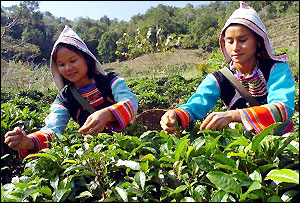
The Jinos live in bamboo houses built on stilts on flat hilltops. The men usually wear collarless white jackets and white or blue trousers made of flax or cotton. Before liberation most men divided their hair into three tufts. Women, as a rule, prefer multi-colored and embroidered collarless short gowns and short black skirts rimmed in red and opened at the front. Many wear long skirts and puttees. They also wear their hair in a coil just above the foreheads, and sling across their shoulders sharp-pointed flax hats. Both men and women go barefooted, and have thick bamboo or wooden sticks plugged into the holes in their earlobes. Those with big holes in their earlobes are considered most beautiful. The Jinos carry things in baskets on their backs with straps tied on their foreheads.
Monogamy is practiced in Jino society. But before marriage the prospective brides and grooms are permitted to have sex. If a woman brings her illegitimate child to live in the home of her husband, both the mother and child are not looked down upon. In some villages, special houses are built for unmarried young men and women to spend the night. But once married, a woman must remain faithful to the husband throughout life. Divorce is rare.
A dead body is put in a coffin carved out of a single log and buried in a communal cemetery. The personal belongings of the dead – work tools and clothing, and a copper pot of silver for some of the rich – are buried as sacrificial objects. Above the grave, a small thatched hut with bamboo tables inside is set up to provide a place for the relatives of the dead to offer meals to the departed soul for a period of one to three years.
Being animists, the Jinos believe that all things on earth have souls. Ancestral worship constitutes an important part of their religious activities. When there was a drought or something untoward happened, a shaman was sent for to mumble prayers and kill oxen, pigs or dogs to appease the trouble-making spirits. Shamans also used to cure diseases with herbal medicines.
The Jinos learn to sing when still very young. They are good at improvising poems and setting them to agreeable melodies extemporaneously. At holiday gatherings, the young dance to songs sung by elders. There are many Jino festivals. The biggest one takes place on New Year's Day in March and is celebrated at different dates in different villages. There are worships for "Large Dragon" and "Small Dragon," both of which meant to get rid of disasters and pray for good harvests. A festival is held annually in the wake of a harvest, at which all Jinos gather to help themselves to newly harvested rice.
(China.org.cn June 21, 2005)
|