|
Population: 396,610
Major area of distribution: Yunnan
Language: Va
Religion: Buddhism
The Va ethnic minority, with a population of 396,610, lives in Ximeng, Cangyuan, Menglian, Gengma, Lancang, Shuangjiang, Zhenkang and Yongde counties in southwestern Yunnan Province. Some are found scattered in the Xishuangbanna Dai Autonomous Prefecture and the Dehong Dai-Jingpo Autonomous Prefecture. Ximeng and Cangyuan counties are the main places where the Va people live in compact communities. In the areas where the Va people live, there are also Hans, Yis, Dais, Hanis, Lahus, Jingpos, Blangs, De'angs and Lisus.
Ximeng, Cangyuan, Menglian and Langcang are situated between the Lancang and Nu rivers, blocked by undulating mountain ridges some 2,000 meters above sea level. Traditionally this area was called the Ava hilly region.
With a subtropical climate, the fertile Ava region has plentiful rainfall and only 40 frost-free days a year. It is suitable for the growth of dry rice, paddy, maize, millet, buckwheat, potatoes, cotton, hemp, tobacco and sugarcane, as well as such subtropical fruits as bananas, pineapples, mangoes, papayas and oranges.
The Va language belongs to the Austroasiatic family. Before the founding of the People’s Republic of China in 1949, except for some parts of the area where an alphabetic script was used, the Va people had no written language, and they kept records and accounting or passed messages with material objects or by engraving bamboo strips. Each strip ranged from half an inch to an inch in width. Objects used implied specific meaning or feelings. For instance, sugarcane, banana or salt meant friendship, hot pepper anger, feather urgency, and gunpowder and bullets the intention of clan warfare. An alphabetic script was created for the Va people in 1957.
Customs and habits
The monogamous family was the basic unit of the Va society. Family property generally was inherited by the youngest son, while daughters were denied the right to inherit. A man was allowed to have more than one wife.
Men and women had sex freedom before marriage. Small groups of young men and women met and sang love songs. After giving their chosen partners betal nuts or tobacco leaves as a token of love, they could go to sleep together. Such freedom ended upon marriage. Marriages were arranged by parents, and the bridegrooms had to pay several cattle as betrothal gifts. Eloping used to take place as a result of forced marriages.
Most of the Va villages were built on hilltops or slopes. Some villages in the Ximeng area have a history of several hundred years and embrace 300 to 400 households. When a family built a new house, others came to help and presented timber and straw as gifts. Generally the house was completed in one day by collective effort. The "big house" of a big chieftain or a rich person was marked by a special woodcut on top. The walls were decorated with many cattle skulls still carrying horns. The other sections were the same as commoners' houses, built on stilts, and the space below was used for breeding domestic livestock. Before iron cauldrons were introduced into the area, the Vas used big bamboo tubes to cook rice, and the cooked rice was divided into equal shares by the hostess at the meal. They loved to chew betel nuts and drink liquor.
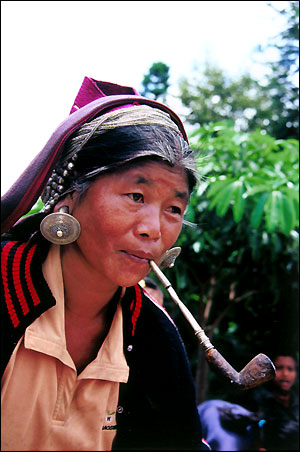
The Va people dress differently according to different areas. Men's garments consist of a collarless jacket and very wide trousers. Their turbans are usually black or red and their ears are pierced, through which red and black tassels are threaded. Young men like decorating their shins with circular ornaments woven with bamboo strips or rattan. A Va woman wears a black short dress and a straight long skirt with folds. She has a silver (or rattan) hoop round her head and silver necklets and chains of colored beads round her neck. Round her hips are many circular hoops of rattan. Va women are fond of bracelets round their wrists and earrings.
Religion In the past the Va people living in the central area of Ava Mountain were worshippers of nature, believing that all the mountains and rivers and natural phenomena had their deities. They were believed to bring good or bad fortune to people. The loftiest god for the Vas was "Mujij." whose five sons were believed to be the deities in charge of the creation of heaven, the creation of earth, lightening, earthquake and the bringing up of the Va people, respectively. There were also deities of water, trees and so on. Even stomach ache and skin itching were believed to be caused by gods.
Frequent religious activities were held to obtain protection from deities and ghosts. Every year the activities started with making sacrifices to the deity of water, praying for good weather and good harvests. Cattle were carved up and their tails cut off as offerings. "Latou," or the hunting of human head, remnant of the primitive customs, had been abolished with the influence of the more advanced neighboring ethnic minorities.
Apart from sacrificial ceremonies held by the whole village, many families also held their own sacrificial offerings. These involved chickens, pigs or oxen and cost a lot of wealth and time. It was estimated that the Vas in this area spent one-third of their yearly income on religion and superstition, and the amount of labor wasted averaged 60 days per capita annually.
In Cangyuan and Shuangjiang counties, some of the Va residents, influenced by the Dais, became followers of Lesser Vehicle of Buddhism. Christianity had spread into a part of the area.
Social economy
In 109 BC, Emperor Wu Di of the Han Dynasty set up Yizhou Prefecture which covered an area extending to the east of Gaoligong Mountain. As a result, the forbears of today's Vas, Blangs and De'angs came under the rule of the Han Dynasty. Thereafter, through the Tang, Song, Yuan, Ming and Qing dynasties, the Va people had had inseparable ties with other peoples in the hinterland.
Between the Tang and Ming dynasties, the Vas mainly engaged in hunting, fruit collecting and livestock breeding – the preliminary stage of agricultural economy. After the Ming Dynasty, agriculture became their main occupation, and they had passed out of the primitive clan communes into village communes. However, development in various areas was not balanced. Over a long time in the past, the Vas living with the Hans, Dais and Lahus had had their culture and economy develop faster through interchanges.
As a whole, however, development of the Va society was rather slow before liberation. This was due mainly to long-term oppression by reactionary ruling classes and imperialist aggression. There were three areas in terms of social development: The Ava mountainous area with Ximeng as the center and including part of Lancang and Menglian counties, inhabited by one-third of the total Va population. There, private ownership had been established, but with the remnant of a primitive communal system still existing.
The area on the edges of Ava Moutnain, covering Cangyuan, Gengma and Shuangjiang counties and part of Lancang and Menglian counties, and the Va area in the Xishuangbanna Dai Autonomous Prefecture, where two-thirds of the Va people live. There, the economy already bore feudal manorial characteristics.
In some areas in Yongde, Zhenkang and Fengqing, where a few Vas live with other ethnic peoples, the Va economy had developed into the stage of feudal landlord economy.
Post-1949 development
In December 1949, the Vas, together with other ethnic groups in Yunnan Province, was liberated. In 1951, the central government sent a delegation to the Ava mountainous areas, helping the Va people solve urgent problems in production and daily life, and to settle disputes among tribes. The Menglian Dai-Lahu-Va Autonomous County was set up in 1954 and the Cangyuan Va Autonomous County in 1955. They were followed by the founding of Ximeng Va Autonomous County in 1964 and the Cangyuan Va Autonomous County in 1965. In the course of practicing regional autonomy, many Va cadres were trained, paving the way for implementing the Communist Party's united front policy, for further winning over and uniting with the patriots from the upper strata of the Vas, and for carrying out social reform in Va areas.
Different steps and methods were adopted by the government in social reform, taking the unbalanced socio-economic development in various areas into consideration. In Zhenkang and Yongde the Vas, together with local Hans, carried out land reform and abolished the system of feudal exploitation and oppression. Then they carried out socialist reform in agriculture. In most of the areas in Ximeng, Cangyuan, Shuangjiang, Gengma and Menglian, exploiting and primitive backward elements were reformed in gradual steps through mutual aid and cooperation, with government support, so as to pass into socialism.
Two important economic measures were taken in the Va areas to improve production and people's life. One was to provide the poor Va peasants with food and seeds, draught cattle and farm tools, while helping them build irrigation projects to extend rice paddy fields. The other was to set up more state trading organizations to expand state trade. These measures brought changes to local production and daily life, enabling the people to do away with usury and exploitation by landlords.
Through transforming mountains, harnessing rivers and extending paddy fields, the Va people in the Ximeng area changed their primitive cultivation methods.
In pre-liberation days, eight out of 10 Va people were half-starved. For several months in a year they had to eat wild vegetables and wild starchy tubers. Their ordinary meal was thick gruel cooked with vegetables. However, by 1981 they owned 1,600 hectares of paddy fields, achieving good yields. In some fields the output per hectare came to 7.5 tons.
Industry was unheard of in the Ava mountainous areas in the past. Now there are hydro-power stations, tractor stations and locally-run workshops producing and repairing farm tools, smelting iron and processing food. The first generation of workers has come into being.
Industrial and agricultural development brought marked changes to the commerce, transport and communications, culture and education and health of the Va people. A case in point is Yanshi Village in Cangyuan County. There wasn't a presentable house except those owned by the village head. Now it has grown into a rising township, with a bank, a health center, primary and middle schools, a farm tool plant and tailors' shops as well as many stores. The village has become an economic and cultural center.
Many new schools have been set up in the Va areas. Nine out of 10 Va children are at school. Cultural centers, film projection teams and bookstores broaden the knowledge of the Va people and enrich their life. Every county in the Ava mountainous area has hospitals.
Over the past 30 years and more a new atmosphere of unity has prevailed in the Va areas. The old enmities, resulting from abduction of oxen and headhunting, have been replaced by mutual help in production and construction through mediation. Clan warfare which was common in pre-liberation days, seldom takes place.
(China.org.cn June 21, 2005)
|