| Tools: Save | Print | E-mail | Most Read |
| Making A Difference |
| Adjust font size: |
Advancing the cause of women's rights and legal justice, Guo Jianmei regards herself as a lonely idealist, but one who remains optimistic nonetheless. The past 12 years could not have been busier or more meaningful for Guo, the founder of
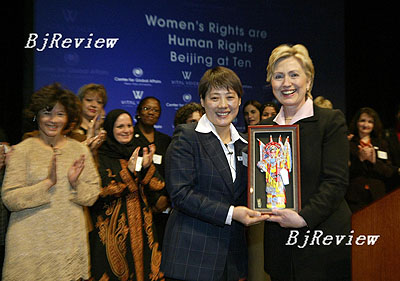
Over the 10 years between 1996 and 2006, the center has provided over 60,000 legal consultancies, covering a wide rang of topics on marriage, family, property rights and labor rights. The center has represented under-represented women for free in over 600 cases, among which over 100 have been reported by the media and greatly influenced law makers. Guo's work has now been internationally recognized, when she was awarded the Global Leadership Award on March Taking action Guo graduated from the Department of Law at In 1995 Guo participated in the Fourth World Conference on Women held in "It was a moment of revelation for me," she said, and it prompted her to found Her pioneering spirit and determination to make a difference soon led to Guo resigning from her stable government position to focus on her project full time. This was despite the fact that she was married with an eight-year-old girl and the family was not well-off. "Quitting my job was quite a big thing at that time. Many people, including my parents, thought I had gone out of my mind and felt pessimistic about my new choice," recalled Guo. December 1995 witnessed the inauguration of the Center for Women's Law Studies & Legal Services of Peking University, the country's first NGO focusing on legal aid for women. Working at two rented hotel basement rooms, the center, which became fully operational in March 1996, had seven employees, four of whom, along with Guo, were professional lawyers. At that time, the legal aid system and NGO community were still in their infancy in Guo recalls that what surprised her most was not the difficulties in logistics and publicity in the early days, but the social backlash that came out of nowhere. Many of her peers thought she was either pursuing overnight fame or was too incompetent to find clients as other commercial lawyers did. "Back then Never give up However, even at the lowest point of her career, she held firm to her belief that her nongovernmental legal aid organization for women would develop into something big one day. Although Chinese women enjoy equal status with men in the Constitution, in reality women, especially those with financial difficulties, formed a large under-represented group. Among this group of women were many trying to seek legal aid to protect their interests. Guo's gut feeling proved to be correct and soon after she opened her doors enquiries for help came flooding in. The center ambitiously decided to represent any victim who could not afford a lawyer. Handling these lawsuits, Guo saw the looks of desperation from women who had nowhere else to turn to. These images strengthened her resolve. One difficult part of the work was collecting evidence in an environment where people would not trust her, but the most unbearable thing for Guo was the negative attitude of certain judges toward legal aid. She will never forget her experience in court in one early case. When appealing to represent a poor woman, the judge asked Guo a string of questions. Was she a lawyer? How could she represent such people? How much could the client pay? Couldn't she find other clients? During the trial, the same judge even refused to give Guo the time to make her opening statement. She lost the case and burst into tears. They lost a lot of cases in the early days. "I never expected offering legal aid could be so difficult," said Guo. Due to these failures, two of the four lawyers left in the first year and Guo herself began to have doubts about going on. Thousands of women today can thank their lucky stars that she didn't. Government making progress For a long period after the founding of the People's Republic of Propped up by laws and regulations, the establishment of a legal aid system began appearing on the agenda of governments at different levels. According to statistics of the For the last few years, the Chinese Government has continued to adjust policies to ensure legal aid is available to under-represented groups. One aspect of this is the reduction of litigation fees from April 2007. These have been slashed by 90 percent in administrative cases and fees for labor dispute cases now only cost a nominal 2.5 yuan. This policy will undoubtedly benefit low-income earners who need access to the courts. "This is an important measure to make legal means affordable to the public," said Wan Exiang, Vice President of the Supreme People's Court. Despite government efforts to give poor and under-represented people equal opportunity for legal service, there remains a huge gap between supply and demand, which leaves a big gap for nongovernmental legal aid organizations. Overloaded Guo's center had a turnaround in 1997 when the office was moved out of basement into an office building and the center started to hire renowned legal experts as consultants. Yet the new difficulty is the ferocious workload as more and more seek help. Guo said in 1997 the four full-time lawyers in her center offered a total of 10,000 legal consultations and handled over 140 lawsuits. It was a very stressful period. Under such circumstances, Guo came up with a new strategy of prioritizing lawsuits in certain areas so that an individual case could be the reference for future cases. The three areas are women's rights in marriage and family affairs, as well as women's personal and labor rights. After handling a large number of influential cases, the center has started to win recognition both domestically and internationally. Celebrity guests who have visited the center include former At the end of 2002 Guo suffered severe anxiety and insomnia. She was diagnosed with depression, the result of years of overwork, and told to take six months off. The break gave her time to reflect and understand that it was no use for her to become angry at the frequent injustices she encountered. Instead she took a leaf out of Nobel Peace Prize laureate Mother Teresa's book, who undertook humanitarian work in a peaceful state of mind, however harsh the conditions were. Work smart Guo went back to work in October 2003. Since then a big shift in her approach has been the intensified partnership with government and the media. The center has now taken the initiative to use the strength of the government and media out of court to solve the problems of victims. "Our goal is to influence people in power," said Guo. In the same period, the legal aid cause has developed at an amazing speed. According to the Legal Aid Center under the Ministry of Justice, by the end of 2006, the number of governmental legal aid organizations had reached 3,149 and handled a total of 310,000 cases. Government subsidies for legal aid increased from 152 million yuan in 2003 to 370 million yuan in 2006. With the maturity of the government legal aid system, it is handling many more cases, allowing Guo to shift the focus of the center to thoroughly studying social problems concerning women's rights, like gender discrimination. In recent years the center has handled a number of lawsuits on gender discrimination in the labor market and rural women's land rights and achieved success. During the drafting of the country's Property Law, the center put forward a suggestion to the legislature containing two concepts on women's property rights, which have been written into the text of the law. On Guo's desk is a thick pile of government invitations to legislative seminars, including one on the upcoming employment promotion law and labor contract law. At these seminars, Guo is often asked for her perspective on the protection of women's rights. "Although some government branches are still doubtful about nongovernmental legal aid agencies, this does not inhibit the trend for us to approach 'mainstream' society," she said. The development of nongovernmental legal aid organizations is still facing many problems. Recruiting suitable lawyers and a shortage of capital remain the two biggest issues. But despite this, the foundation has been laid for providing a service to those most in need of legal services, and through people like Guo that can only be good for the women of ( |
| Tools: Save | Print | E-mail | Most Read |
 |
| Related Stories |
|
|
Product Directory China Search |
Country Search Hot Buys |
