|
Peerless hero Genghis Khan (Temujin, 1162-1227) was born of the Mongol tribes. An outstanding strategist and statesman, he was known as Emperor Tai Zu, founding emperor of the Yuan Dynasty.
The period from the late 12th to the early 13th centuries saw strengthened economic contacts between different tribes as production skills and resources developed. Genghis Khan consolidated all Mongol tribes at the demand of the Mongols. In 1206, the tribes elected him the Great Khan, with the reign title of Genghis Khan, and the tangled warfare that had tom the tribes for generations ceased. He saw that political, military and law systems were formulated, with unified written language used. This had brought the Mongols onto a new stage of development.
In 1211 and 1215, Genghis launched large-scale military campaigns against the Kin. He led his army southward to the north bank of the Yellow River and captured the Kin's capital, Zhongdu (Modern Beijing).
In 1219, Genghis Khan commanded a western expedition, conquering Huacizimo and defeating Russian-Qincha allied forces along the Kaleka River, extending Mongol influence over Central Asia and Southern Russia. Territories seized were granted to his three sons, Juji, Jagatai and Ogdai.
However, when Genghis Khan personally led an attack on Binzhou and Longzhou, he met powerful opponents and suffered serious losses.
His opponent in the north was Tun Tianxiao, who was promoted to official in charge of prefecture affairs because of his contributions to the fight against the Mongols. His name was changed to Yang Woyan. Yang had determined to die for the state. He said, "I am not a real man if I die not for the state." Marshal Yang and his subordinate, Liu Xingge, who was a member of the peasant uprising, fought against Mongols in Binzhou and Longzhou. The Mongols were repeatedly defeated and suffered serious losses.
In mid-July, 1227, Genghis Khan died of illness in Qingshui County (modern Qingshui, Gansu Province), but his tomb is located in Ejin Horo Banner (a county-level administrative division) in the Ih Ju League (an administrative division containing several banners) of the Inner Mongolia Autonomous Region. It was said that Ih Ju was a gathering place for seven banners in Ordos. Each year, the seven banners held a meeting in a big temple. These huimeng, meetings of sovereigns or their deputies in ancient China to form alliances, were held for more than three hundred years. At first, a permanent site was designated for the meetings, but later the meeting place was changed as league leaders changed. After the tomb of Genghis Khan was built in Ejin Horo Banner, the heads of the seven banners in Ordos then met in March of the lunar year, a time for holding memorial ceremonies for Genghis Khan. Thereafter, Ih Ju also came to mean the mausoleum of Genghis Khan.
The name of the Ordos tribe also is closely linked to the Genghis Khan mausoleum. It was said that during the Hong Zhi reign of the Ming Dynasty, Da Yanhan unified all the Mongol tribes. He divided the Mongol area into two regions (Left and Right regions). Each region, in turn, was divided into three tribes, and titles and territories were granted to some nobles, giving them jurisdiction over the fiefs. Right Region was the fief of the third son of Da Yanhan. He had 'jurisdiction over all the tribes in Ordos. As an assistant of his father, he also had jurisdiction over Tumote and Yongxiebu tribes in the Right Region. At that time, the tomb of Genghis Khan (Eight White Yurts) was in Ordos, which means "defending the tomb." He also named his tribes Ordos. Today, the Ih Ju League is also called Ordos.
Why was the tomb of Genghis Khan built in Ordos? The story is that, in 1226, Genghis Khan led a western expedition to Western Xia, arriving at the Ordos Plateau in the southwestern part of Mongol in the spring to scenery of enchanting beauty that attracted him. Looking at the beautiful scenery, Genghis Khan was joyous, declaring: "I want to be buffed here after my death." In the second year of the western expedition (1227), after Genghis Khan's death the duke and head of the Mongol nobles transported his coffin over a great distance to bury him on Ordos Plateau. From then on, the palace was also called the Mausoleum of the Master.
Genghis Khan's mausoleum is on Gader Aobao (Mound). The mound was used as a landmark for travelers and also was a place for offering sacrifices to ancestors. As one ascends the mound, the mausoleum of Genghis Khan can be seen among a growth of green trees. Coffins for Genghis Khan and his three consorts, his two brothers, his fourth son, Tule, and Tule's consort, were buried there.
The present mausoleum of Genghis Khan was renovated after 1949. During the Anti-Japanese War in 1939, Japanese imperialists colluded with reactionary Mongol leaders headed by King De. Traitors sent by King De tried to open and loot the tomb and transfer it to Guisui. Broad public indignation throughout Inner Mongolia created a strong protest. As a result of the appeal by the broad masses and King Sha, an anti-Japanese Mongol, the Kuomintang government, forced to form a committee, arranged transfer of the tomb. At first, the tomb was moved to Xinglong Mountain, in Yuzhong County, Gansu Province. Eleven years later, the tomb was transferred to Taer Temple in Qinghai Province.
The tomb of Genghis Khan
When the funeral procession arrived at Yan'an on its way to Gansu Province, it was warmly received by the Central Committee of the Chinese Communist Party general headquarters of.the Eighth Route Army and the local government. On June 21, 1939 a big memorial meeting organized by more than one hundred units was held in honor of Genghis Khan. About ten thousand people attended. The CPC Central Committee and Chairman Mao Zedong sent wreaths. Comrades Xie Juezai, Teng Daiyuan, Wang Ruofei and others attended the memorial meeting.
After 1949, in response to public demand, a special team was organized in the spring of 1954 in the Inner Mongolia Autonomous Region. A delegationary procession went to Qinghai and returned the coffin of Genghis Khan to Ejin Horo on April 1. The CPC Central Committee allocated funds (800,000 yuan) for rebuilding the mausoleum of Genghis Khan.
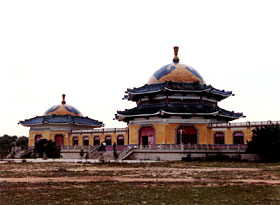
The newly built mausoleum is more magnificent. The main part of the mausoleum are three Mongolian yurt-like chambers and two corridors built in the form of an L. It contains an antechamber, a coffin chamber, west and right annexes and west and right corridors. Besides, there is an altar surrounded by railing. With steps lead up to the entrances of the three Mongolian yurt-like chambers and the antechamber, with a vaulted-eave roof, is octagonal. The eave is set with deep blue glazed files and the vaulted ceiling is covered with yellow glazed tiles, inlaid with blue cloud designs. The three yurt-like chambers are bright and colorful with white walls and vermilion doors, as the entire mausoleum displays strong Mongolian artistic characteristics.
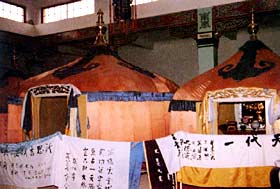
Inside scene of the tomb of Genghis Khan
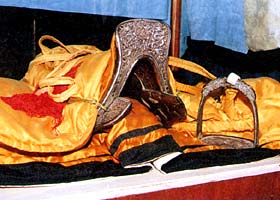
The antechamber is the Genghis Khan memorial hall. At the center of the hall stands a statue of Genghis Khan. At the back of the antechamber is the coffin chamber with four yellow yurt-like tombs behind three large flags. Legend says that one of the flags, with a wooden post, a huge iron spearhead and a tassel, was used by Genghis Khan on his western expedition. In addition, three saddles and other equipment once used by the Mongol leader are exhibited there.
Saddle
The Genghis Khan tomb is different from other Yuan Dynasty imperial tombs, because it only contains coffins and not remains. Locations of actual burial sites of other emperors in the Yuan Dynasty are also unknown. So far, no information has been found on locations of the Yuan tombs. Differing opinions on the Yuan tombs appear in the official history, in bypaths of history, and in research papers of scholars at home and abroad.
The book Caomuzi (Ming Dynasty Notes of Ye Ziqi) says, "According to official practices and custom, tombs are built for emperors after their deaths. After an emperor dies, he will be buried in a different place. The ground will be leveled by many horses and a baby camel will be killed on the site, after which thousands of cavalrymen will camp at the place to defend the 'tomb.' When the ground is covered with grass the next year, the cavalrymen withdraw from the burial location and people will only be able to see smooth grassland. No one will know where the emperor was buried.
"When people want to visit the tomb to honor the memory of the emperor, the mother of the baby camel will be brought to lead the way. When the mother camel paces up and down the place and utters a sad grunt, people can know that it is the 'tomb.'"
With no tombs for Mongol nobles after their death, imperial temples were built in order to allow commemoration of royal ancestors. This kind of temple was called Eight White Yurts, discussed in the book Origin and Development of the Mongols. The mausoleum of Genghis Khan, containing Eight White Yurts, was also called Eight White Yurts, which were built in the mausoleum to memorialize Genghis Khan, his consorts, his brothers, his fourth son, Tule, and Tule's consort. In the Yuan Dynasty, the system for memorial ceremonies remained the same for one hundred years.
The providing of a permanent mausoleum for Genghis Khan in Ejin Horo was a lengthy process divided into three stages. The first stage was from his death in 1227 to the beginning of the Ming Dynasty when documents indicate the earliest mausoleum of Genghis Khan was on a plateau between Altay Mountain and Kente Mountain on the Western Ordos Plateau. The second stage was from the early Ming Dynasty to the Tian Shun reign (1457-1464). The Ordos tribe defended the tomb of Genghis Khan on those grasslands in the early Ming and later the Ordos tribe moved east to the Ih Ju League. The tomb of Genghis Khan also moved to Ih Ju with the Ordos. Since the tomb was usually relocated in those times near prince's residence, it could be moved frequently. The tomb was settled in Wangaizhao for perhaps nearly 200 years.
The third stage was in the early Qing Dynasty (1649). After Elin, a court official in Right Region, was made a prince, he transferred Eight White Yurts to his fief. By commemorating the heroic ancestors of his people, he wanted to increase his own stature. The permanent site for Eight White Yurts was named Ejin Horo. Since Elin transferred the tomb of Genghis Khan to Ejin Horo, it has remained where it was for more than three hundred years, though leadership of the league changed frequently.
|