|
Xiaoling is located at Dulongfu on the south slope of the Purple Hills in the east suburbs of Nanjing. In the place is a thick growth of age-old pine trees and cypresses, with a stream winding in the hills. Some famous ancient Buddhist temples and tombs are found here.
Xiaoling is the mausoleum of the first Ming Dynasty emperor Zhu Yuanzhang. It is one of the largest imperial mausoleums existing in China, as a historical monument put under state protection. From the "Officials and Others Dismount Here" Tablet in the front to the Square Walls at the back, it is 2.62 kilometers. Records note the red wall of the mausoleum at 22.5 kilometers in circumference. The perimeter of the red wall is two-thirds that of the dh] wall at that time. Although no wooden structures were found existent over the last six hundred years, one still has some idea of the mausoleum built on a large scale. Xiaoling has its layout and architecture the same as those of the Ming Tombs on the outskirts of Beijing, but on a much greater scale than the latter. This speaks of the fact that all Ming Dynasty imperial tombs were modeled after the former.
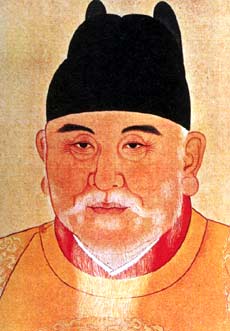
Zhu Yuanzhang was from a poor peasant family. Orphaned at a tender age, he became a Buddhist monk in Huangjue Monastery because he had no one to support him.
Portrait of Ming Emperor Tai Zu (Zhu Yuanzhang)
Later, he joined Guo Zixing in his peasant uprising. After Guo died, he took over the command, and with an insurrectionist army of peasants under him, he overthrew the rule of the Yuan Dynasty and ascended to the throne in 1368. He titled his dynasty Ming, under the reigning title of Hong Wu. Not long after, Zhu Yuanzhang took a fancy to Dulongfu (Single Dragon Hill) on the south slope of the Purple Hills and set out to build his mausoleum. He saw to it that Kaishan Temple, built in the Six Dynasties, was moved from its original site at Dulongfu to Zixiadong. But as the temple was nearing completion at the south side of Zixiadong, some geomancers talked nonsense, saying it was not good for the mausoleum to have the temple there. The old monks had to move and built the present Linggu Temple known as "The First Grove Under Heaven," a name given by Zhu Yuanzhang. There were once about one thousand monks in the temple during its most active age. The hall, without a single beam or column, was built at that time. It dates back more than six hundred years.
Construction of the Xiaoling mausoleum took five years. The year of 1381 during the Hong Wu reign saw its completion. The next year, Empress Ma, the consort of Zhu Yuanzhang was buried there. She was posthumously honored as Xiao Ci and for this the mausoleum was named Xiaoling. In the l6th year of the Hong Wu reign, adding to the structures of Xiaoling was a large temple hall built which had earned Li Xin, an official in charge of the construction work, a promotion.
In the 25th year of the Hong Wu reign (1392), Zhu Biao, the crown prince was buried in the eastern area of the Xiaoling, known as Dongling, or Eastern Mausoleum. In the 31st year of Hong Wu (1398), Zhu Yuanzhang was buried in the Xiaoling. Such Xiaoling peripheral tomb projects lasted to the 3rd year of the Yongle reign (1405). A "Tablet of the Divine Merit and Sage Virtue of Xiaoling of the Great Ming" was the final project. Xiaoling construction spanned thirty years.
The entrance to Xiaoling Mausoleum is just opposite the present Nanjing Agricultural College. Three tablets of the Ming Dynasty have been brought from their original locations to the entrance. One is the tablet inscribed with "Officials and Others Dismount Here." In order to show respect for the emperor, all officials were to dismount from their horses and walk to the mausoleum.
The second tablet is the Shenlie Hill tablet. It was erected in the 10th year of the Jiajing reign (1531). The third one is the Restricted Area tablet. It was erected by Emperor Chong Zhen, the last emperor of the Ming Dynasty in I641, three years before peasant insurgents led by Li Zicheng entered Beijing. The inscriptions on the tablet reiterated previous order: Execution for anyone found destroying the mausoleum.
It was evident that Emperor Chong Zhen wanted to glorify the soul of the deceased Tai Zu, Emperor Zhu Yuanzhang. By doing so, he wanted to bolster the crumbling Ming regime.
Big Golden Gate, the front gate of the Xiaoling Mausoleum, is 755 meters beyond the "Officials and Others Dismount Here" tablet. The gate tower has been destroyed, but three gateways are still intact. North of Big Golden Gate is the big stone tablet--Tablet of the Divine Merit and Sage Virtue of Xiaoling of the Great Ming. The tablet is 8.8 meters high and carries the inscription in regular script which extols Emperor Zhu Yuanzhang's merits. The pavilion housing the tablet was destroyed, so now there are only the big tablet, four walls around that tablet and the gateway in the place, known as Square Walls.
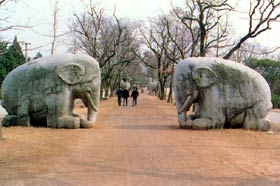
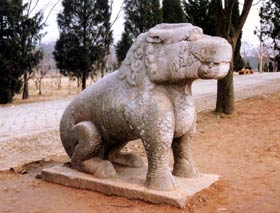
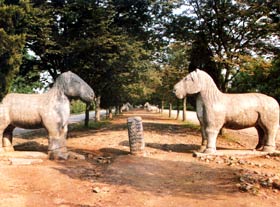
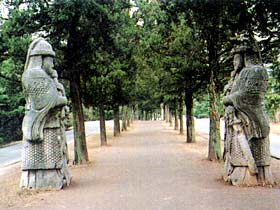
Walking northwestward from Square Walls, there is an imperial bridge, beyond which is the spirit path lined with twenty-four stone animals and eight stone human figures along both sides. From east to west, the procession starts with four lions (two on each side), four xiezhai (mythical beasts), four camels, four elephants, four qilin (Chinese unicom) and four horses. In each group one pair is standing, the other kneeling.
Stone elephants
Stone unicorn
Stone horses
As the spirit path turns northward there are a pair of ornamental stone pillars, two pairs of stone military officials and two pairs of stone civil officials.
In each group of stone figures, one pair is of young officials and the other is of older ones. The military officials wear helmets, hold ceremonial clubs, and swords at their waists. The civil officials wear court caps and hold tablets. These stone carvings have artistic characteristics of the early Ming Dynasty. They are rare art treasures.
Stone sculptures lining the spirit path to Xiaoling in Nanjing
At the end of the sculpture avenue is the Lingxing (Lattice) Gate. The archway has collapsed, with only six steles still standing there. Beyond the Lattice Gate is a small river to the north slope of Plum Hill. There are three stone bridges (surviving from five bridges of the past) spanning the river. From the bridges northwards were buildings built on a straight line from south to north.
Two hundred meters from the bridges is a vermilion wall. To mark the site of the mausoleum are the characters "Ming Xiaoling Mausoleum" inscribed over the front gate in the wall. Inside the gate are two tablets, placed for political reasons, with inscriptions by Emperor Kang Xi and Emperor Qian Long respectively, as eulogies to Emperor Zhu Yuanzhang.
Moving further in, the foundation of Ling’endian (Hall of Prominent Favor) can be seen, with a small exhibition room which has been built on its base to display a portrait of Zhu Yuanzhang and a collection of Ming cultural relics.
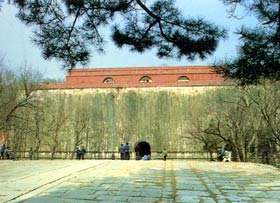
Beyond the Hall of Prominent Favor, four walls about twenty meters high enclose an arched passage way whose fifty-four stone steps slope down to the tomb gate. Walking through the dark, cool arched passage, one has a feeling of mystery and wonder. At the end of the passage is a tablet inscribed 'Tomb of Emperor Tai Zu of Ming." The area is covered with grass and surrounded by trees, a naturally scenic setting. Upward on a small path along the wall is the foundation of the Soul Tower, which was destroyed long ago. Renovation in recent years has strengthened the foundation ruins, and some hints to the architecture of the tower can still be seen. Behind high, castle-like walls is a mound 400 meters in diameter under a luxuriant growth of pines and cypresses, and beneath it is the underground palace where the emperor is buried. Layout of the underground palace may be the same as that of Dingling in Beijing.
Soul Tower
Records say there were originally 100 thousand pine trees and a thousand deer at the mausoleum. Each deer had a silver badge attached, known as "longevity deer" and no one was allowed to harm the animals on pain of severe punishment. By late Ming and early Qing, no deer remained.
A folk legend about Xiaoling Mausoleum circulated among the people holds that after Emperor Tai Zu died, thirteen coffins were carried through thirteen city gates at the same moment. Thus, people wonder whether Emperor Tai Zu was buried in Xiaoling. Some people said Zhu Yuanzhang was buried under Wansuidian (Longevity Hall) in his palace; some said he was buried under the Sanqing Hall in Chaotian Palace in the western part of Nanjing, and some said he was buried under Wansuishan (Longevity Hill) in Beijing.
A folk legend spread like this because Zhu Yuanzhang was a person who was always suspicious of others. During his lifetime, he killed many opponents and was afraid that, after he died, some would desecrate his grave for vengeance. The legend of Zhu Yuanzhang's tomb is something like the story about Cao Cao (153-220), who is said to have had seventy-two tombs built for him. The legend about Zhu Yuanzhang's tomb may also be copies from emperors in former dynasties, though all are conjecture. Archaeological excavations on Xiaoling will provide definite answers on this subject.
|