|
Qianling, the tomb of the third Tang emperor, Li Zhi, and Empress Wu Zetian, is located on Liangshan Mountain, 6 kilometers north of Qianxian County seat and 80 kilometers from Xi'an. Here also stands the Qianling Mausoleum and Museum.
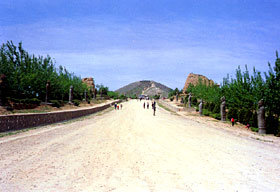
Located on the peak of lofty Liangshan Mountain, Qianling is the most typical and best preserved of all the eighteen Tang mausoleums.
Tang Emperor Li Zhi (628-683) was the ninth son of Emperor Tai Zong and Empress Zhangsun. With the help of his maternal uncle Zhangsun Wuji, he was made crown prince and ascended the throne upon Tai Zong's death. Though he was muddle-headed and weak-minded and accomplished little, the flourishing and stable state of early Tang was maintained during the first years of his reign, thanks to such veteran officials as Zhangsun Wuji and Chu Suiliang who actually usurped state power. However, once Wu Zetain moved into the palace, things began to change in the Tang regime power structure.
Wu Zetian (624-705), also named Wu Zhao, was from Wenshui, Shanxi Province and born in Guangyuan (then Lizhou), Sichuan. Her father, Wu Shiyue, was a successful wood merchant who was later appointed supervisor-in-chief of Lizhou Prefecture. As a concubine of Tai Zong, Wu Zetian cut her hair and became a Buddhist nun in Ganye Monastery upon his death in 649. In 654, she was taken out of the monastery and brought into the palace by Emperor Gao Zong, who bestowed on her great favor by making her his chief concubine. The next year the Emperor deposed Empress Wang and named Wu Zetian his empress, allowing her to participate in state affairs. He dismissed and ostracized Chu Shuiliang and in 659 forced Zhangsun Wuji to commit suicide. From then on, Li Zhi remained in poor health, "faint, heavy-headed and sightless" as the chronicles described him, and Wu Zetain attended to most court affairs.
Once when Gao Zong intended to give up the throne to crown prince Li Hong (eldest son of Wu), the son was poisoned by his mother. In reality Wu Zetain had taken power upon Zhangsun Wuji's death. After the emperor's death, she defied imperial prohibitions on queen mother holding court and, after disposing of emperors Zhong Zong and Rui Zong in short order, took the throne herself and titled her reign "Zhou," becoming the first empress in Chinese history to rule the country.
Well-versed in culture and history and excelling in trickery, she was ruthless in her tactics. Upon ascension, she recruited treacherous courtiers to kill many Tang imperial clansmen and high officials. She then put the blame on these "wicked" officials when public sentiment grew restive, as a way of relaxing the populace. But she also had talented people enlisted, placing them in important posts, and was receptive to criticism and advice from her courtiers, somewhat like Tai Zong.
Her political competence first showed itself when Tai Zong was still alive. Tai Zong had a strong horse called Lion which was so fiery-tempered nobody could tame it. One day Wu told Tai Zong she could make it docile with three implements: a whip, a hammer and a dagger. First, she would flog it tame with the whip; if that didn't work, she would hit it with a hammer; finally, if necessary, the dagger would cut the horse's throat. Tai Zong appreciated that spirit.
It was in this way she controlled her courtiers, maintained her autocratic rule for over half a century and strengthened centralized state power. Though she changed the Li house's Tang Dynasty into the Wu's Zhou Dynasty, she had trouble choosing a successor and finally ordered in her will a return of the throne to the Li house's offspring.
Emperor Gao Zong had ascended it to the throne in 649 and after a reign of 34 years died ill December 683, at age of 56 in Zhenguan Hall, Luoyang. He was buried in Qianling in August 684. Wu Zetain was crowned in 684 and after a reign of 21 years died at 82 in the Hall of Fairy Dwelling, Palace of Rising Sun, Luoyang, in 705. In May 706, she was buried with Gao Zong in Qianling. Thus, it can be inferred that construction of Qianling took between 40 and 50 years.
Located on Liangshan Mountain, 1,049 meters above sea level, Qianling Mausoleum was flanked by Leopard Valley to the east and Sand Canyon on the west. This limestone mountain was cone-shaped and its top consisted of three peaks, the highest of which is the northern peak containing the Qianling underground palace. The southern peaks, lower than the northern one and facing each other, each has earth mounds on its surface resembling nipples, thus they got the name Naitoushan (Nipple Hills).
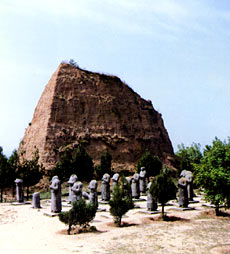
The Qianling, joint burial place of Tang Emperor Gao Zong and Empress Wu Zetian
According to Maps to the History of Chang'an City, the Memorial Temple was originally beside the Nipple Hills. In it were displayed portraits of Di Renjie and 59 other noted courtiers. Being the most southern mounds, the Nipple Hills formed a natural doorway to Qianling Mausoleum, adding to its magnificence and making it unique among the eighteen Tang mausoleums in the area north of the Weishui River.
Qianling was a grand and imposing structure. The Maps records: Qianling was originally enclosed by two walls. Investigation and prospecting uncovered remains of the inner wall, four gates, a sacrificial hall and some corner parts of the outer wall. The inner wall, 2.4 meters thick, enclosed 240,000 square meters with four sides in a trapezoidal shape. The north and south segments were each 1,450 meters long, the east wall was 1,582 and the west wall 2,438. Four gates were each 2.7 meters wide. The southern gate was called Zhu Que Men (Rosefinch Gate), the northern Xuan Wu Men (Mystical Power Gate), the eastern Qing Long Men (Black Dragon Gate) and the western Bai Hu Men (White Tiger Gate). Describing buildings on the grounds, the History of Administrative Statues of the Tang Dynasty says, "in 798, 378 houses were completed around each of Xianling, Zhaoling, Qianling, Dingling and Tailing." Now only their sites remain.
What is inside Qianling still awaits excavation. The above mentioned history book recorded "the tomb chamber of Qianling was closed up with a stone gate sealed with iron to make it secure."
An inscription on the Seven Tiered Tablet reads: Emperor Gao Zong willed in his last words that his favourite books and works of calligraphers be brought into the tomb.
What remains today on the surface of Qianling is mainly carved stone works. Exquisite and elegant, they have stood upright on top of Liangshan Mountain for over 1,200 years, and are demonstrations of the skills of Tang carvers, gems of the ancient Chinese art of stone carving. Most of these stone pieces line the sides of the spirit path, from outside Rosefinch Gate to the north:
The first carved stones are a pair of ornamental pillars. Symbol of the tombs, they are octaprismatic and their shafts, plinths and crown were all decorated with line carvings. These tall and upright columns are impressive introductions to the magnificent cemetery.
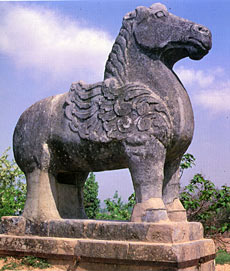
Next, because supreme rulers considered themselves so upright their reign would be prosperous, they also wanted pairs of winged horses and rosefinches, representatives of propitious birds and beasts, to guard a prosperous underground life. The winged horses, wings decorated with slender, delicate lines, are in a flying gallop. The rosefinches, in high relief, were beautifully shaped and sturdily carved. It is said that because rosefinches were a gift from Afghanistan for the funeral and could serve as guards, a pair of them were erected in front of the tomb.
Winged horse
Further along were five pairs of stone horses with stone saddles and stirrups only three pairs of the original stone human figures leading the horses survived.
Beyond the stone horses were ten pairs of stone figures, named Shi Ong Zhong, modeled after the emperors' bodyguards. With helmeted heads and heavy long robes, the figures stood with sword in hands, eyes straight ahead, playing a major role in creating a majestic atmosphere in front of the tomb.
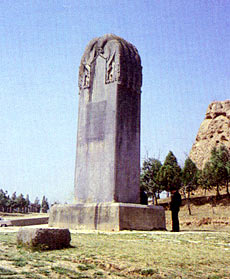
Further on were two stone tablets. The east one, called Uncharactered Tablet, was erected blank as a term of Wu Zetian's will. Her will read: "My achievements and errors must be evaluated by later generations, therefore carve no characters on my stele." This blank tablet was 6.3 meters high, 2.1 meters wide and 1.5 meters thick. During the Song and Jin dynasties, however, quite a few travelers did inscribe it, changing the uncharactered tablet into a charactered tablet. Altogether thirteen sets of inscriptions were counted, though most of them have been blurred by time. Only the 'Travel of the Military Commissioner of the Campaign Commander of the Jin Dynasty" in Nüzhen script, with a Chinese translation beside it, was well preserved. Now, the Nüzhen script has disappeared. This rare script was a precious aid for the study of Nüzhen scripts and the history and culture of China's minority nationalities.
"Uncharactered Tablet" at Qianling
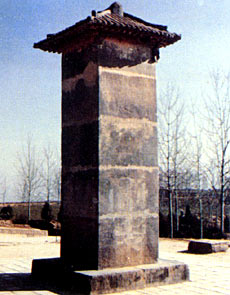
The west tablet, Tablet Telling the Emperor's Deeds, was composed of seven tiers and thus also named Seven-Tiered Tablet. It was 6.3 meters high and 1.9 meters wide. Written by Wu Zetian and carved in the handwriting of Emperor Zhong Zong, the inscription, totaling more than 8,000 characters, sang the praises of Emperor Gao Zong for his military and administrative achievements. All the characters and symbols were filled with gold powder, brightening the cemetery.
Seven-section Stele at Qianling
Beyond the stone tablets and on the right side of the spirit path were 61 stone figures attesting to the Tang Dynasty's power and prosperity as well as its friendly relations with minority peoples in frontier areas and with other central Asian countries. These 6I figures of chief-rains and foreign guests were ordered here by Wu Zetian to commemorate the minority chieftains and foreign special envoys who attended the funeral. Wearing tight-sleeved clothes, broad belts and leather shoes, these figures cup their hands in front in an attitude of prayer. More than half of them had their heads defaced, but the only two, in the western row, whose heads are complete, have prominent noses and deep eyes, and were clearly from the Western Regions or Central Asia. Some of the figures had their nationalities, official titles and names on their backs.
Stone statues of foreign envoys at Qianling
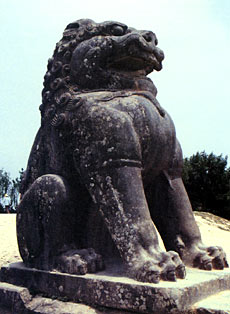
In front of each of the inner wall's four gates were a pair of stone lions; the best are the pair by Rosefinch Gate. Of heroic proportions, this pair had curved hair, bulging eyes, big mouths and sharp teeth, presenting perfect images of stem and fierce-looking lions. They are symbols of dignified, autocratic Tang rulers.
Stone lion
According to the chronicles, Qianling mausoleum covered an area of about 40 square kilometers, within which are scattered many attendants' tombs, 17 of them located in the southeast section. Since 1949, tombs of Princess Yong Tai, Xue Yuanchao, Li Jingxing, Prince Zhang Huai and Prince Yi De have been unearthed. They are substantially the same, both in surface appearance and in underground structure: each tomb was surrounded by a wall, to the south of which were ornamental pillars, stone figures and stone sheep in precise order. The tombs themselves were composed of a passage way, an archway, a shaft, a corridor and ante-and rear-chambers. On two sides of the shaft were a series of niches containing a variety of three-color figurines, pottery and porcelain articles.
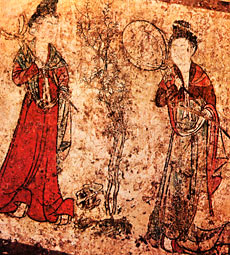
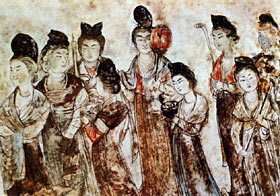
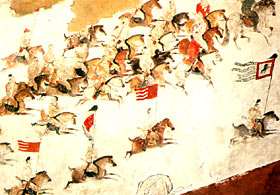
Frescoes adorned the walls and tops of the passage, the archway, the corridor and chambers. Some were "Painting of Maidservants," reflecting the parasitic imperial life; some were architectural designs, reflecting Tang Dynasty architecture; others are "Painting of Polo Game" and ''Paintings of Envoy and Guests," depicting cultural exchanges and the friendly relationships between China and the world. Rich and extensive in themes, well composed and skillfully executed, these frescoes illustrate the high level of Tang paintings and add a new chapter to China's ancient painting history.
A painting of maids
A painting of maids
In addition, the stone gate, the memorial tablet and outer coffin within the tomb were decorated with line sculptures of figures, animals and plants.
Though all the attendant tombs had suffered from looting, there were still numbers of cultural relics to be found. As many as 4,300-odd articles were unearthed from the three tombs of Princess Yong Tai, Prince Yi De and Prince Zhang Huai. All these relics are exquisitely made and vivid representations, each peculiar in its own way.
Mural of procession at attendant tombs of Princess Yong Tai, Prince Yi De and Prince Zhang Huai at Qianling
The three-color figurines from Princess Yong Tai's tomb were delicate and colorful and decorated with exotic line carvings. The 300 objects of gold, jade, bronze and tin, all ingeniously cast and delicately carved, look pleasing and tasteful.
Out of Prince Yi De's tomb have come fragments of funeral eulogium carved concavely on jade, with the background inlaid in gold, and painted pottery figurines of riders, with horses gilt faced and figures fully armed (and each dressed differently), all cultural treasures. Horsemen differed in expressions and postures: Some are playing the flute, some blowing the trumpet and still others waving a whip to spur the horse. Unearthed from the tomb of Prince Zhang Huai, the figurines of civil officials, warriors and painted tomb guarding beasts, all over one meter high, are lively shaped. All these are materials contributing to the study of Tang Dynasty’s politics, economy and culture.
|