 |
|
|
|
Governor: Zhang Zuoji
Capital: Harbin
Government office address: Zhongshan Road, Nangang District, Harbin
Tel: 0451-262 7188, 262 7194
Postcode: 150001
Website: www.hlj.gov.cn | |
|
|
|
|
Geographic location
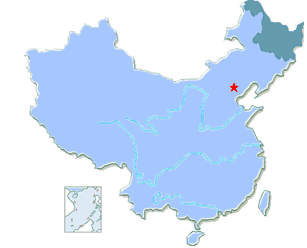
Heilongjiang Province is located in the northeast China, at the highest latitudes and the northernmost end of the country. It neighbors Russia across the Heilongjiang and Wusuli rivers running in its north and east respectively; in the west, it adjoins the Inner Mongolian Autonomous Region; and to its south is Jilin Province. It covers an area of 454,000 sq km, accounting for 4.7% of the nation's total. Under its jurisdiction are 13 prefectures and cities, 66 counties (cities), 1,211 townships (towns) and 14,488 villages. | |
|
| |
|
Heilongjiang 2004 - The Year in Review |
|
|
General Economy |
|
Gross domestic product (GDP) |
GDP for 2004 was 530.3 billion yuan, up 11.7% from the previous year. |
|
GDP ratio (primary, secondary and tertiary industries) |
The primary industry yielded a value added of 58.78 billion yuan, 12.2% more than that of the previous year; the secondary industry, 315.53 billion yuan, a growth of 12.9%; and the tertiary industry, 155.99 billion yuan, a growth of 9.3%. |
|
Revenue and expenditure |
Provincial revenue was 34.93 billion yuan, an increase of 22.1% over the previous year. Provincial expenditure was 75.85 billion yuan, an increase of 20.4%. |
|
Consumer price index (CPI) |
CPI was up 3.8% from the previous year. |
|
Investment in fixed assets |
Fixed asset investment was valued at 151.53 billion yuan, up by 22.1% from the previous year. |
|
Major Industries |
|
Agriculture |
In 2004, the province's total agricultural output value was 113 billion yuan, an increase of 18.5% from that of 2003. The grain output totaled 31.35 million tons, an increase of 24.8%. |
|
Industry |
The industrial added value totaled 281.44 billion yuan, an increase of 13.0%. |
|
High-tech |
The total added value from high-tech industries was 102.7 billion yuan, up by 28%. |
|
Construction |
Its added value was 34.09 billion yuan, up by 12.1%. |
|
Transportation |
Freight carried by various means of transport for the year was 7.1% up from the previous year to reach 107.89 billion ton-kilometers, while the number of passengers carried by various means of transport was 12.7% up to reach 42.01 billion person-kilometers. |
|
Postal and telecom services |
The annual turnover of postal and telecommunications operations totaled 29.01 billion yuan, 24.2% up from the previous year. |
|
Retail |
The annual turnover from retail sales reached 155.54 billion yuan, an increase of 13.0% from the previous year. |
|
Tourism |
Revenue from tourism totaled 25.03 billion yuan, up by 12.6%. |
|
Continued Effects of Market Reform |
|
Imports & exports |
The annual value of imports and exports totaled US$6.79 billion, an increase of 27.4% from the previous year. |
|
Economic and technological cooperation |
Business turnover from overseas project and labor contracts during the year totaled US$260 million, up by 29.5%, with 8,746 laborers working abroad at the end of the year. |
|
Foreign investment |
Foreign investment realized in monetary terms was US$1.45 billion, up by 12.2% from the year before. |
|
Urban Construction and Management |
|
Road transport |
The year saw the completion of 3,100 km of highways linking various townships. |
|
Social Undertakings |
|
Science and technology |
The provincial input in science and technology during the year totaled 5.83 billion yuan, an increase of 7.0%. Of the figure, 2.82 billion yuan was used in research and development, an increase of 11.9%. |
|
Education |
By the end of 2004, the province had a total of 59 institutions of higher learning. The number of students enrolled during the year stood at 150,000, up by 20.0%. |
|
Culture |
The province had a total of 87 professional performing organizations, 125 cultural and art centers, 97 public libraries, and 47 museums at the end of the year. |
|
Public health |
There were a total of 8,270 medical and healthcare institutions equipped with 116,000 beds and staffed with 147,000 medical professionals and technicians at the year-end. The centers for diseases control and prevention numbered 202, staffed with 7,000 professionals and technicians. |
|
Welfare and aid |
Various welfare units across the province were equipped with 40,000 beds and put up 33,000 homeless and vagrant people during the year. There were 6,207 urban community centers at the end of the year. Public donations totaled 28.8 million yuan. |
|
Poverty relief |
The year saw a reduction of 960,000 people living in absolute poverty. They began to have enough food and clothing. About 823,000 residents in 1,474 villages began to have easy access to drinking water. |
|
Population, Employment, Social Security and Living Standards |
|
Population |
The birth rate in 2004 was 7.27‰, and the mortality rate was 5.45‰. The natural growth rate of the population stood at 1.82‰. At the end of the year, the total population stood at 38.17 million. |
|
Employment |
The employed population stood at 16.81 million at the year end. |
|
Registered unemployment rate |
The registered urban unemployment rate was 4.47%. |
|
Social security |
In 2004, insurance plans for endowments, unemployment and medical treatment covered a population of 7.38 million, 4.76 million and 5.51 million respectively. About 1.57 million urban residents received minimum living allowance from the government. |
|
Residents' income |
The disposable income of urban residents was 7,471 yuan per capita, up by 11.9% from 2003. Rural residents' per capita net income was 3,010 yuan, a growth of 501 yuan, or 20% from the previous year. |
|
Geography and Natural Conditions |
|
Elevation extremes |
The province's topography is higher in the northwest, north and the southeast, and lower in the northeast and southwest. In its northwestern part, there is the Greater Hinggan Mountains, and in the north, the Lesser Hinggan Mountains. In the southeastern part, there are the ridges of Zhangguangcai, Laoye and Taiping, in addition to the Wanda Mountain. The Nenjiang River and Songhua rivers run across the province from south to north, forming the Sanjiang (three-river) Plain in the northeast and the Songnen Plain in the southwest. In its southeast, there is the Xingkai Lake. Hilly land and mountainous areas account for 70% of the province's land, with heights ranging from 300 to 1,780 meters above sea level. Plains, lying 50-250 meters above sea level, make up about 30% of the province's total area. |
|
Climate |
It has a continental monsoon climate, the kind between the temperate and frigid zones, with annual temperatures of –4°C to 4°C. The temperature difference between its north and south parts is 8°C. Its warm summer with plentiful rainfall and long-time sunlight is good for crops, its annual sun radiation power reaching 100-120 Cal per square centimeter. Most of the areas are windy in spring, and its southwestern part, in particular, is rich in wind energy source. |
|
Natural resources |
The province has 44.37 million ha of soiled land with rich organics, of which 40% is suitable for farming. Heilongjiang is one of the world's three major black soil zones, 67.6% of its total farmland of 1,180 ha is cultivated on either black soiled land, marshland or black calcium soil. Furthermore, the province has 4.33 million ha of pastures and 4.793 million ha of land reserved for farming. The province ranks No. 1 in terms of farmland and forest area; No. 7 in area of pastures; No. 4 in land to be developed; and No. 2 in land reserved for farming. Both of its total farmland area and the reserved land resources account for one-tenth or more of the nation's total. The average per head farmland and the average per head area of farmland operated by individual farmers are three times of the nation's average.
The province has the largest forestry industry in the country, occupying a very important position in China's forest ecology. The total area involved in forestry operation is 31.26 million ha, or 68.9% of the province's total land area. Its forests cover 19.19 million ha of land, with a total reserve of 1.5 billion cubic meters of live timbers. With 41.9% of its land covered with forest, Heilongjiang ranks the first among all China's provinces in afforested area, reserve of forest resources and timber output. It is the most important state-owned forest area and the largest timber center in China. In its forests are more than 100 species of trees, including 30 of high use-value. Natural forests, which constitute the principal part of its forest resources, are mainly distributed in the Greater and Lesser Hinggan Mountains and the Changbai Mountains.
A total of 131 minerals have been discovered in the province. And reserves of 74 of them have been surveyed. The deposits of 10 minerals lead the country, including petroleum, graphite, sillimanite, cast basalt, asbestos-use basalt, cement-use marble, colorant loess, lava ash, glass-use marble, and orthoclase. Its coal deposit is the largest among the three Northeast China provinces. Thirty-nine minerals have been mined, and the annual output value of various minerals ranks second in the country.
The province is an important energy base of China. In 1999, it produced 62.30 million tons of raw coal, making it a key coal supplier of the country. Its output of electricity and gas also occupies an important position in the country. Before the founding of New China in 1949, the province had only a hydropower station at Jingpo Lake Over the past decades, both hydropower and thermal-power stations have been developed over the past decades, and up to 1999, the province had altogether 200 power stations, with a total generating capacity of nearly 10 million mega w.; the generating volume of its hydropower was 1.4 billion mega w. hour. The Hayi Gas Project, the largest in Asia of its kind, produces 1.89 million cubic meters of gas a day.
Heilongjiang is one of China's water-rich provinces. Its numerous rivers form five water systems, including that of the Heilong River, Wusuli River, Songhua River, Nenjiang River and Suifeng River. Presently, there are about 6,000 lakes and reservoirs, covering a surface area of more than 800,000 ha. About 70% of its rainfall concentrates in the warm season, providing an ideal environment for all the plants and crops to grow.
The province also has a rich resource of wildlife. There are 86 species of wild beasts and animals in 20 families of six orders, accounting for 21.6% of the nation's total species. Of them, five are under first-class state protection, including sable, glutton, leopard, tiger and sika deer. There are 343 bird species in 57 families of 19 orders, making up 29% of the nation's total, of which 12 species are under first-class state protection, include white cranes, Chinese goosanders, stocks, and golden eagles. There are 2,100 species of wild plants, 17 of which are gymnosperm in 8 genera of four families; 1,747 species of angiosperm of 636 genera in 107 families; and 1,764 species of seed plants in 644 genera of 111 families. There are 2.5 million tons of reserved wild plants of economic value, including more than 250,000 tons of edible plants, over 1 million tons of wild grasses for paper-making and 1.25 million tons of medicinal herbs.
The province's major agricultural produces include soy beans, wheat, maize, potato, rice, beet, flax, and tobacco. |
|
Tourism resources |
Heilongjiang has abundant characteristic tourism resources. Its spots for ice and snow activities are the best in China. Snow-skiing period in the province lasts 120-140 days in a year. In mountainous area, snow on the ground can be 100-300 cm deep and it's of good quality. Among its smooth mountain slopes, 100 has been chosen as spots good for building large-scale skiing grounds. Its beautiful landscape, forests and grasslands, wetlands and rivers and lakes provide rich resources for developing eco-tourism.
Its unique history has also left it a rich cultural legacy and colorful customs. The Bohai State during the Tang Dynasty, the ruins of the Jin-dynasty capital in Huining and the ruins of Longquan Mansion are among those of historical interest.
The crossing-border tours to Russia launched on the border rivers of Heilong and Wusuli attract tourists from all over the country. Such cities as Harbin, Daqing and Yichun attract travelers with their distinctive style of northern frontier cities. In addition, there are the Zoo of Northeast China Tigers, the Reserve of Red-Crowned Cranes, the site for admiring the northern lights, the forest at a crate, and a number of large-scale enterprises of mining, farming and oilfields open to tourists. The province has set up 84 nature reserves (including seven at state-level and 17 at provincial level), which cover a total area of 2.30 million ha, or 5.05% of the province's total land area. | |
|