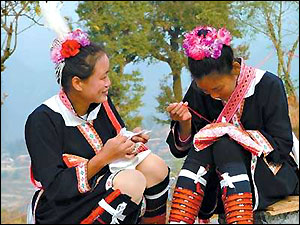
Population: 2,637,421
Major area of distribution: Guangxi, Hunan, Yunnan, Guangdong and Guizhou
Language: Yao and Miao
Religion: Polytheism
The Yaos, with a population of 2,637,421, live in mountain communities scattered over 130 counties in five south China provinces and one autonomous region. About 70 percent of them live in the Guangxi Zhuang Autonomous Region, the rest in Hunan, Yunnan, Guangdong, Guizhou and Jiangxi provinces.
Historically, the Yaos have had at least 30 names based on their ways of production, lifestyles, dresses and adornments. The name "Yao" was officially adopted after the founding of the People's Republic in 1949.
Half of the Yaos speak the Yao language belonging to the Chinese-Tibetan language family, others use Miao or Dong languages. As a result of close contacts with the Hans and Zhuangs, many Yaos also have learned to speak Chinese or Zhuang language.
Before 1949, the Yaos did not have a written language. Ancient Yaos kept records of important affairs by carving notches on wood or bamboo slips. Later they used Chinese characters. Hand-written copies of words of songs are on display in the Jinxiu Yao Autonomous County in Guangxi. They are believed to be relics of the Ming Dynasty (1368-1644). Ancient stone tablets engraved with Chinese characters can be found in a lot of Yao communities.
Most Yaos live in beautiful, humid mountain valleys densely covered with pines, firs, Chinese firs, Chinese cinnamons, tung oil trees, bamboos and tea bushes. The thickly forested Jianghua Yao Autonomous County in Hunan is renowned as the "home of Chinese firs." The places inhabited by the Yaos also abound in indigo, edible funguses, bamboo shoots, sweet grass, mushrooms, honey, dye yam, jute and medical herbs. The forests are teeming with wild animals such as boars, bears, monkeys, muntjacs and masked civets. Rich as they are in natural resources, the Yao mountain areas are ideal for developing a diversified economy.
History
Called the "savage Wuling tribes" some 2,000 years ago, the Yao ancestors lived around Changsha, capital of today's Hunan Province. Two or three centuries later, they were renamed the "Moyao." One of China's foremost ancient poets, Du Fu (712-770), once wrote: "The Moyaos shoot wild geese; with bows made from mulberry trees."
As time went on, historical accounts about the Yaos increased, showing growing ties between the Yao and the Han people. In the Song Dynasty (960-1279), agriculture and handicrafts developed considerably in the Yao areas, such that forged iron knives, indigo-dyed cloth and crossbow weaving machines became reputed Yao products. At that time, the Yaos in Hunan were raising cattle and using iron farm tools on fields rented from Han landlords.
During the Ming and Qing dynasties (1368-1911), farm cattle and iron tools spread among the Yaos in Guangxi and Guangdong, who developed paddy fields and planted different kinds of crops on hillsides. They dug ditches and built troughs to draw water from springs for daily use and irrigation. Sideline occupations such as hunting, collecting medical herbs, making charcoal and weaving were pursued side by side with agriculture.
Before the founding of the People's Republic, the Yao economy could be divided into three types:
The first and most common type, with agriculture as the base and forestry and other sideline occupations affiliated, was concentrated in places blessed with fine natural conditions and the greatest influence of the Hans. Here farming methods and social relations very much resembled those of the Han and Zhuang ethnic groups.
The second type was centered on forestry, with agriculture as a sideline. A few landlords monopolized all the forests and hillside fields, while the foresters and farmers had to pay taxes and rents no matter whether they went ploughing, hunting or fishing, built their houses, buried their dead, collected wild fruits and herbs, drank from mountain streams or even walked on the mountains. When the poor opened up wasteland, for instance, they had to plant saplings between their crops. As soon as the saplings grew into trees, they were paid to the landlords as rent. These exactions caused many Yaos to be continually wandering from place to place.
The third type, engaged in by a tiny percentage of the Yao population, was the primitive "slash-and-burn" cultivation. Although most land was owned by Han and Zhuang landlords, the Yao farmers had some of their own. In such cases, the land belonged to ancient communes, each formed by less than 20 families descended from the same ancestor. The families in a commune worked together and shared the products equally.
The Yaos practiced an interesting form of primitive cooperation called "singing-while-digging." This can still be seen in Guangxi today. At times of spring ploughing, 20 to 30 households work together for one household after another until all their fields are ploughed and sown. While the group is working, a young man stands out in the fields, beating a drum and leading the singing. Everyone sings after him.
Today hunting remains an important part of Yao life. On the one hand, it provides them with a greater variety of food; on the other, it prevents their crops and forests from being damaged by too many wild animals. After hunting, the bag is divided equally among the hunters. Sometimes portions are given to the children carried on the elders' backs, but the hunter who caught the animal is awarded a double portion. Sometimes, part of the bag is put aside for the aged people back in the villages.
For nearly 1,000 years before this century, most Yaos were ruled by hereditary headmen. The headmen obeyed the central government, which was always dominated by the Han or other large ethnic groups. After the Kuomintang took power early in this century, it pursued a system similar to the previous one, which meant rule through puppet Yao headmen and "divide and rule." These policies incited endless conflicts among the Yaos and caused them a great deal of hardship. It was not until the birth of New China that the Yaos realized equality with other ethnic groups as well as among themselves.
Customs and habits
The Yaos have such unique life styles that the various communities are quite different from each other. According to the Book of the Later Han Dynasty (25-220), the ancient Yaos "liked five-colored clothes." Later historical records said that the Yaos were "barefoot and colorfully dressed."
In modern times, the Yao costumes maintain their diversity. Men wear jackets buttoned in the middle or to the left, and usually belted. Some men like trousers long enough to touch their insteps; some prefer shorts akin to knee breeches. Men's dress is mainly in blue or black. However, in places such as Nandan County in Guangxi, most men wear white knee-length knickerbockers. Men in Liannan County, Guangdong Province, mostly curl their long hair into a bun, which they wrap with a piece of red cloth and top with several pheasant feathers.
Women's dress varies more. Some Yao women fancy short collarless jackets, cloth belts and skirts either long or short; some choose knee-length jackets buttoned in the middle, belts with both ends drooping and either long or short slacks; some have their collars, sleeves and trouser legs embroidered with beautiful patterns. In addition to the silver medals decorating their jackets, many Yao women wear silver bracelets, earrings, necklaces and hairpins.
Rice, corn, sweet potatoes and taros make up their staple food. Common vegetables include peppers, pumpkins and soybeans. Alcoholic drinks and tobacco are quite popular. In northern Guangxi, a daily necessity is "oily tea." The tealeaves are fried in oil, then boiled into a thick, salty soup and mixed with puffed rice or soybeans. The oily tea serves as lunch on some occasions. Another favorite dish is "pickled birds." The cleaned birds are blended with salt and rice flour, then sealed into airtight pots. Beef, mutton and other meat are also pickled this way and considered a banquet delicacy. Many Yaos think it taboo to eat dog meat. If they do eat it, they do the cooking outside the house.
A typical Yao house is a rectangular wood-and-bamboo structure with usually three rooms -- the sitting room in the middle, the bedrooms on both sides. A cooking stove is set in a corner of each bedroom. Some hillside houses are two-storied, the upper story being the sitting room and bedrooms, the lower story stables.
For those families who have a bathroom built next to the house, a bath in the evening is an everyday must, even in severe winters.
The Yaos have intriguing marriage customs. With antiphonal singing as a major means of courting, youngsters choose lovers by themselves and get married with the consent of the parents on both sides. However, the bridegroom's family used to have to pay a sizeable amount of silver dollars and pork as betrothal gifts to the bride's family. Some men who could not afford the gifts had to live and work in the bride's families and were often looked down upon.
In old Yao families, the mother's brothers had a decisive say in crucial family matters and enjoyed lots of other privileges. In several counties in Guangxi, for example, the daughters of the father's sisters were obliged to marry the sons of the mother's brothers. If other marriage partners were proposed the betrothal gifts had to be paid to the mother's brothers. This, perhaps, was a remnant of matrilineal society.
Festivals take place one after another in the Yao communities, at a rate of about once a month. Although festive customs alter from place to place, there are common celebrations such as the Spring Festival, the Land God Festival, the Pure Brightness Festival, "Danu" Festival and "Shuawang" Festival. The "Danu" Festival, celebrated in the Yao Autonomous County of Duan in Guangxi, is said to commemorate ancient battles. The "Shuawang" Festival, held every three or five years in the tenth month by the lunar calendar, provides the young people with a golden opportunity for courtship.
The Yaos worshipped a plethora of gods, and their ancestors. Their belief in "Panhu," the dog spirit, revealed a vestige of totemism. Yao communities used to hold lavish rites every few years to chant scriptures and offer sacrifices to their ancestors and gods. In some communities, a solemn ceremony was performed when a boy entered manhood. Legend has it that at the ceremony he had to jump from a three-meter-high platform, climb a pole tied with sharp knives, walk on hot bricks and dip a bare hand into boiling oil. Only after going through these tests could he get married and take part in formal social activities.
With growing scientific and cultural knowledge, the Yaos have, on their own initiative, discarded irrational customs and habits during recent decades, while preserving healthy ones.
The Yaos cherish a magnificent oral literary tradition. As mentioned above, singing forms an indispensable part of their life. When a group of people are opening up wasteland, one or two selected persons stand aside, beating drums and singing to enliven the work. Young males and females often sing in antiphonal tones all through the night. Extremely rich in content, some of the folk songs are beautiful love songs, others recount the history of the Yao people, add to the joyous atmosphere at weddings, synchronize working movements, tell legends about the creation of heaven and the earth, ask meaningful questions with each other or tell humorous stories. In many of them, the words have been passed down from generation to generation.
Besides drums, gongs and the suona horn (a woodwind instrument), the long waist drum, another traditional musical instrument, is unique to the Yaos. It was said to have been popular early in the Song Dynasty (1127-1279). The revived waist drum dance has been frequently performed both in China and abroad since the 1950s.
The Yaos are expert weavers, dyers and embroiderers. In the Han Dynasty (206 BC-AD220), they wove with fabrics made from tree bark and dyed it with grass seeds. In the Song Dynasty, they developed delicate designs dyed on white cloth with indigo and beeswax. The product became famous all over the country later.
Post-1949 life
The Yaos have an age-old revolutionary tradition. As early as the Han Dynasty, they fought feudal imperial oppression. During the Tang and Song dynasties, they waged more rebellions against their Han rulers. Still later, in the 15 years from 1316 to 1331, they launched more than 40 uprisings. The largest revolt lasted for a century from 1371. The frightened Ming (1368-1644) emperors had to send three huge armies to conquer the rebels.
The famous Taiping Rebellion, led by Hong Xiuquan in the 1850s against the Qing (1644-1911) feudal bureaucrats, received effective support from the Yaos. Many Yao people joined the Taiping army and were known for their bravery.
The Yaos played an active role in China's new democratic revolution which finally led to the founding of the People's Republic. The Yao Autonomous County of Bama in Guangxi today used to be the base area of the 7th Red Army commanded by Deng Xiaoping in the 1930s.
Democratic reforms were carried out after 1949 according to the different characteristics of the three types of Yao economy. The reforms abolished the feudal exploitation system and enhanced the progress of agriculture, forestry, animal husbandry and other forms of production.
Meanwhile, autonomous localities were gradually formed for the Yaos.
In August 1951, when a central government delegation visited Guangxi, it helped the local government set up Longsheng Autonomous County, the first one for the Yaos. From 1952 to 1963, eight Yao autonomous counties appeared, and over 200 autonomous townships covered smaller Yao communities. The policy of regional autonomy enabled the Yaos to be their own masters, ending the history of discrimination and starting an era of national equality and unity.
Local autonomous governments have made successful efforts to improve the people's lives. The Yao Autonomous County of Duan in Guangxi is a fine example. There the Yaos live in karst valleys. The soil is stony, erosive and dry. An old saying went that "the mountains start burning after three fine days; the valleys get flooded after a heavy rain." Now the saying is nothing more than history, as the government has helped remove the jeopardy of droughts and floods by building tunnels, dams and reservoirs.
Before 1949, the Yao area only had a few handicraft workshops. But now, there are many medium- and small-sized power plants and factories making farm machines, processing timber, and making chemicals and cement.
In the early 1950s, few Yao people had any education, but today, schools can be found in all villages. Almost every child of school age gets elementary and secondary education. Some elite students go on to colleges.
In the old days, the Yaos never knew such a thing as a hospital. As a result, pestilence haunted the region. Now, government-trained Yao doctors and nurses work in hospitals or clinics in every Yao county, township and village. Epidemics such as smallpox and cholera have been eliminated. With the people's health well protected, the Yao population has doubled since the founding of the People's Republic.
(China.org.cn June 21, 2005)