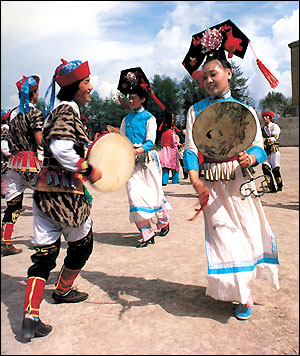
Population: 10,682,263
Major areas of distribution: Virtually scattered over all of China, the largest group, about 46.2 percent of the total, live in Liaoning Province, and the rest mostly in Jilin, Heilongjiang, Hebei, Beijing, Gansu, Shandong, Inner Mongolia, Xinjiang and Ningxia, as well as in Chengdu, Xi'an, Guangzhou and other cities.
Language: Manchu (in both script and spoken language) and Han (standard Chinese)
Religion: Shamanism
Like the Han people, the majority ethnic group in China, over 70 percent of the Manchus are engaged in agriculture-related jobs. Their main crops include soybean, sorghum, corn, millet, tobacco and apple. They also raise tussah silkworms. For Manchus living in remote mountainous areas, gathering ginseng, mushroom and edible fungus makes an important sideline. Most of the Manchu people in cities, who are better educated, are engaged in traditional and modern industries.
Manchus have their own script and language, which belongs to the Manchu-Tungusic group of the Altaic language family. Beginning from the 1640s, large numbers of Manchus moved to south of the Shanhaiguan Pass (east end of the Great Wall), and gradually adopted Mandarin Chinese as their spoken language. Later, as more and more Han people moved to north of the pass, many local Manchus picked up Mandarin Chinese too.
An ethnic group originally living in forests and mountains in northeast China, the Manchus excelled in archery and horsemanship. Children were taught the art of swan-hunting with wooden bows and arrows at six or seven, and teenagers learned to ride on horseback in full hunting gear, racing through forests and mountains. Women, as well as men, were skilled equestrians.
The traditional costumes of male Manchus are a narrow-cuffed short jacket over a long gown with a belt at the waist to facilitate horse-riding and hunting. They let the back part of their hair grow long and wore it in a plait or queue. During the Qing Dynasty (1644-1911) the queue became the standard fashion throughout China, eventually becoming a political symbol of the dynasty. Women coiled their hair on top of their heads and wore earrings, long gowns and embroidered shoes. Linen was a favorite fabric for the rich; deerskin was popular with the common folk. Silks and satins for noble and the rich and cotton cloth for the ordinary people became standard for Manchurians after a period of life away from the mountains and forests. Following the Manchus' southward migration, the common people came to wear the same kind of dress as their Han counterparts, while the Manchu gown was adopted by Han women generally.
In places around Aihui County, Heilongjiang Province, however, Manchu people lived by their old traditions and customs and used their own ancient language until 1949, when the People's Republic of China was founded.
Houses of the Manchus were built in three divisions, with the middle used as a kitchen and the two wings each serving as bedroom and living room. By tradition, the bedroom had three "kang" (brick beds which could be heated in winter), which were laid against the west, north and south walls. Guests and friends were habitually given the west "kang", elders the north, and the younger generation the south. With windows generally open to the south and west, the houses stayed warm in winter and cool in summer.
A favorite traditional Manchu meal consisted of steamed millet or cakes of glutinous millet. Festivals were traditionally celebrated with dumplings, and the New Year's Eve with a treat of stewed meat. Boiled and roast pork and Manchu-style cookies were table delicacies.
Monogamy has always been practiced by the Manchus, with young people engaged at the age of 16 or 17 by parental will.
On the wedding day, the bride had to sit the whole day on the south "kang", an act inaugurating "future happiness." When night fell, a low table with two wine pots and cups would be set. The bride and bridegroom would, hand in hand, walk around the table three times and sit down to drink under the light of a candle burning through the night on the south "kang". They were congratulated amid songs by one or several guests in the outer room. Sometimes the ceremony was marked with well-wishers casting black peas into the bridal chamber before they left the new couple. On the fourth day, the newlyweds would pay a visit to the bride's home.
A variety of manners were observed by the Manchus. Children were required to pay formal respects to their elders regularly, once every three to five days. In greeting their superiors, men were required to extend their left hand to the knee and idle the right hand while scraping a bow, and women would squat with both hands on the knees. Between friends and relatives, warm embraces were the commonest form of greeting for all men and women.
The Manchus used to believe in Shamanism, which in the early days was divided into the court branch and the common folk branch. The former was generally practiced by priestsorcerers in the palace. During the early Qing period, those eligible for the office of "shaman" were mostly clever and smart people with a good command of the dialect of the royal Aisin-Gioro clan. Shamans were employed to chant scriptures and perform religious dances when imperial services were held. Shamanism remained popular among the Manchus in the area of Ningguta and Aihui County in northeast China until the nation-wide liberation.
Shamans of the common Manchus generally fell into two categories: village shamans, who performed religious dances to exorcise evil spirits through the power of the gods, and clan shamans who presided only over sacrificial ceremonies. Every village had its own shaman, whose sole job was to perform the spirit dance. Only seriously ill patients saw a real doctor. Religious rite was generally performed by a shaman attired in a smock and a pointed cap festooned with long colored paper strips half-concealing his face. Dangling a small mirror in front and bronze bells at the waist, he would intone prayers and dance at a trot to the accompaniment of drumbeats.
Military successes and triumphal marches or returns were inevitably celebrated with sacrificial ceremonies presided over by shamans. Up to the eve of the country's liberation, making animal sacrificial offerings to the gods and ancestors was still a big event among the Manchus in Aihui County.
The Manchu funeral arrangement was unique. No one was allowed to die on a west or north "kang". Believing that doors were made for living souls, the Manchus allowed dead bodies to be taken out only through windows. Ground burial was the general practice.
Jumping onto galloping horses from one side or onto camels from the rear was the most popular recreational activity among the Manchus. Another favorite sport was horse jumping in celebration of bumper harvests in the autumn and on New Year holidays at the Spring Festival.
Skating is also a long established sport enjoyed by the Manchus, as it is by the whole Chinese people. In the Qing Dynasty before the mid-19th century, skating was even undertaken by Manchu soldiers as a required course of their military training. Pole climbing, swordplay, juggling a flagpole, and archery on ice are the more interesting sports of the Manchu people.
History
The ancestry of the Manchus can be traced back more than 2,000 years to the Sushen tribe, and later to the Yilou, Huji, Mohe and Nuzhen tribes native to the Changbai Mountains and the drainage area of the Heilong River in northeast China.
As testified to by the stone arrowheads and pomegranate-wood bows they sent as tributes to rulers of the Western and Eastern Zhou period (11th century-221 BC), the Sushens were one of the earliest tribes living along the reaches of the Heilong and Wusuli rivers north of the Changbai Mountains.
After the Warring States Period (475-221 BC), the Sushens changed the name of their tribe to Yilou. They ranged over an extensive area covering the present-day northern Liaoning Province, the whole of Jilin Province, the eastern half of Heilongjiang Province, east of the Wusuli River, and north of the Heilong River. Stone arrowheads and pomegranate-wood bows still distinguished the Yilous in hunting wild boar. They also mastered such skills as raising hogs, growing grain, weaving linen and making small boats. They pledged allegiance to dynastic rulers on the Central Plains after the Three Kingdoms period (220-280).
During the period between the 4th and 7th centuries, descendants of the Yilous called themselves Hujis and Mohes, consisting of several dozen tribes.
By the end of the 7th century a local power called the State of Zhen with the Mohes of the Sumo tribe as the majority was formed under the leadership of Da Zuorong on the upper reaches of the Songhua River north of the Changbai Mountains. In 713, the Tang court conferred on Da Zuorong the title of "King of Bohai Prefecture" and made him "Military Governor of Huhan Prefecture." Da's domain, known afterwards as the State of Bohai, showed marvelous skills in iron smelting and silk weaving. With its political and military institutions modeled on those of the Tang Dynasty (618-907), this society adopted the Han script. Under the influence of the political and economic systems of the central part of China and the more developed science and culture there, speedy advances were made in agriculture and handicraft industries.
Then the Liao Dynasty (916-1125) conquered the State of Bohai and moved the Bohai tribesmen southward. Along with this movement, the Mohes in the Heilong River valley made a southward expansion. Gradually a people known as Nuzhens built a powerful state in the former domain of Bohai.
The early 12th century saw a successful insurrection led by Aguoda with the Wanyan tribe of the Nuzhen people as a key force in their fight against the Liao Dynasty, founding the regime of Kin (1115-1234). After the termination of the Liao, the Kin armies destroyed the Northern Song (960-1126) and rose as a power in opposition to the rule of the Southern Song (1127-1279). Moving to live en masse on the Central Plains, the Nuzhens gradually became assimilated with the Han people.
Early in the 13th century, the Nuzhens were conquered by the Mongols and later came under the rule of the Yuan Dynasty (1271-1368). With the largest concentration in Yilan, Heilongjiang Province, they settled on the middle and lower reaches of the Heilong River and along the Songhua and Wusuli rivers, extending to the sea in the east. The Yuan Dynasty enlisted the service of local upper-strata residents to create five administrations each governing 10,000 house-holds, known respectively as Taowen, Huligai, Woduolian, Tuowolian and Bokujiang. The Nuzhens at this time were still leading a primitive life. They developed and progressed, until Nurhachi's son proclaimed the name of Manchu towards the end of the Ming Dynasty (1368-1644).
The Ming Dynasty had 384 military forts and outposts established in the Nuzhen area, and the Nuergan Garrison Command, a local military and administrative organization in Telin area opposite the confluence of the Heilong and Henggun rivers, was placed directly under the Ming court. While strengthening central government control over northeast China, these establishments aided the economic and cultural exchanges between the Nuzhen and Han peoples.
From the mid-16th century onwards, repeated internecine wars broke out among the Nuzhens, but they were later reunified by Nurhachi, who was then Governor of Jianzhou Prefecture.
In 1595, the Ming court conferred on Nurhachi the title of "Dragon-Tiger General" after making him a garrison commander in 1583 and public procurator of Heilongjiang Province in 1589. Frequent trips to Beijing brought him full awareness of developments in the Han areas, which in turn exerted great influence on him. A talented political and military leader, he later proved his outstanding ability by welding together within 30 years all the Nuzhen tribes that were scattered over a vast area reaching as far as the sea in the east, Kaiyuan in the west, the Nenjiang River in the north and the Yalu River in the south.
Once the Nuzhens were united, Nurhachi initiated the "Eight banner" system, under which all people were organized along military lines. Each banner consisted of many basic units called "niulu" which functioned as the primary political, military and production organization of the Manchu people, and each unit was formed of 300 people. Members of these units hunted or farmed together in peace time, and in time of war all would go into battle as militia.
In 1619 Nurhachi proclaimed himself "Sagacious Khan" and established a slave state known to later times as Late Kin.
Political and cultural development
Under the strong influence of the Han people, the Manchu slave system soon underwent a speedy development towards feudalism, accompanied by intense class struggle and social reform made from above downwards. In pursuing their goal to conquer the country, the Manchu rulers began in 1633 to institute the Eight Banner system among the Hans and Mongolians under their control.
In 1635, Huang Taiji (1592-1643, eighth son of Nurhachi and later enthroned as Emperor Tai Zong of the Qing Dynasty) chose the name of "Manchu" to replace Nuzhen for his people. In the following year, when he ascended the throne, he adopted Great Qing the name of his dynasty.
In 1644 the Qing troops marched south of Shanhaiguan Pass and unified the whole of China, initiating nearly 300 years of Manchu rule throughout the country.
The Manchus made their contributions in defending China's frontiers from foreign aggression. As early as the mid-17th century, Russia made repeated incursions into areas along the Heilong River. In 1685, on orders of Qing Emperor Kang Xi, Manchu General Peng Chun led his "eight banner" troops and naval units in driving out the Russian invaders. The subsequent Treaty of Nerchinsk, signed on an equal footing in 1689, delineated a boundary line between China and Russia, and maintained normal relations between the two countries for more than 100 years.
Later, in the 18th and 19th centuries, troops sent by the Qing court repulsed British-backed Gurkha invasions of southern Tibet and local rebellions in Xinjiang, also incited by the British colonialists. These and other military exploits of the Manchu emperors brought into being a unified Chinese state that extended from the outer Hinggan Mountains in the north to the Xisha Islands in the south, and from the Pamirs in the west to the Kurile Islands in the east in the heyday of the Qing Dynasty.
The Manchu people have also added splendor to Chinese culture with many works of scientific significance. These include Shu Li Jing Yun (Essence of Mathematics and Physics), Li Xiang Kao Cheng (A Study of Universal Phenomena) and Huang Yu Quan Lan Tu (Complete Atlas of the Empire) compiled during the reign of Emperor Kang Xi. Man Wen Lao Dang (Ancient Archives in Manchu), Man Wen Tai Zu Shi Lu (A Manchu Biography of the Founding Emperor) and Yi Yu Lu (Stories of Exotic Lands) by Tu Lichen are among the famous works written in the early years of the dynasty, while Qing Wen Qi Meng (Primer of Manchurian), Chu Xue Bi Du (Essential Readings for Beginners), Xu Zi Zhi Nan (A Guide to Function Words) and Qing Wen Dian Yao (Fundamentals of Manchurian) are important works in the study of the Manchu language.
While the Manchu language was enriched in vocabulary, efforts were made by the Manchus to translate important works of the Han people into their own language. Along with government documents, such great works as The Three Kingdoms, The Western Chamber, A Dream of Red Mansions, Flowering Plum in the Vase and Strange Tales from a Lonely Studio all had their Manchu versions.
Notable achievements were made by the Manchu people in writing books in the Han language. Typical of these were the poems of classical styles written in the seventeenth century by the Manchu poet Nalanxingde who became known for his vivid description of the landscapes of Inner Mongolia and northeast China.
A Dream of Red Mansions written in the 18th century by the Manchu writer Cao Xueqin is a classic that occupies a prominent place in the history of world literature. With its story drawn from the life of a Manchu noble family, the novel gives incisive analysis and exposure of all the decadence of the Manchu ruling class. By dissecting China's feudal society, the author brought the country's literary expression to an unprecedented height.
Zhao Lian's Xiao Ting Za Lu (Random Notes at Xiaoting), a true account of the events, rites, personalities and institutions of the early Qing Dynasty, was a work of academic value for the study of the history of the Manchus and Mongols.
Also outstanding among the Manchus were many works by women writers. These include Qin Pu (Music Score) by Ke De, Hua Ke Xian Yin (Leisurely Recitation of Poems by the Flower Beds) by Wanyan Yuegu, Xiang Yin Guan Xiao Cao (Poems from Xiangyin Pavilion) by Kuliya Lingwen, and Tian You Ge Ji (Poems Written in Tianyou Pavilion) by Xilin Taiqing (Gu Taiqing). Her Dong Hai Yu Ge (Song of East Sea Fishermen) won her reputation as the greatest poetess of the Qing Dynasty.
Contemporary history
China was reduced to the status of a semi-colonial and semi-feudal country after the Opium War of 1840. During the war, many Manchus, as well as Hans, lost their lives in fighting for China's independence and the dignity of the Chinese nation. A 276-man Eight Banner unit under Major Fu Long, fighting to the last man at Tianzunmiao in Zhejiang Province, beat back the onslaught of British invaders five times in succession. In another battle fought in Zhenjiang City, Jiangsu Province, 1,500 Eight Bannermen yielded no ground in defiance of an enemy force ten times their strength.
The Second Opium War of 1856-60 ended with Russia annexing more than a million square kilometers of northeast China. Local Manchus and people of other ethnic groups in this area waged tenacious resistance against the aggression and colonialist rule of Russia.
In 1894, the Japanese launched a war against China and Korea, occupying large tracts of Chinese territory in eastern Liaoning Province. This aroused nationwide protest and gave rise to strong resistance by the Han, Manchu and Korean peoples, who sprang surprise attacks on the enemy day and night. Chinese troops and civilians defending Liaoyang, Liaoning Province, inflicted heavy casualties on the invading Japanese troops.
The year 1900 marked the outbreak of the Yi He Tuan movement or Boxer Rebellion, which was composed mainly of Han and Manchu peasants.
The Revolution of 1911 led by Dr. Sun Yat-sen won wide acclaim and support among the broad masses of the Manchu people. Manchus staged a series of armed uprisings including those of Fengcheng and other places led by the Manchu progressives, Bao Huanan and He Xiuzhai, who cooperated with the Han revolutionary Ning Wu. Manchu and Han intellectuals in Shenyang (Mukden) formed a "Progressives' Radical Alliance." Leaders of the alliance, Manchu intellectuals Bao Kun and Tian Yabin and Han progressive Zhang Rong, a member of the Tong Meng Hui (Chinese Revolutionary League), proposed the establishment of a "coalition republican government composed of Manchu and Han people." Though executed by the Qing government, the two Manchus represented the correct position many Manchu people took in the Revolution of 1911.
On September 18, 1931, Japanese forces launched a surprise attack on Shenyang and installed the puppet "Manchukuo" government to control the area.
The rigging up of the puppet "Manchukuo" soon gave rise to strong national protest throughout China. Anti-Japanese volunteers, anti-Japanese organizations and guerrilla units were formed with massive participation by Manchu people.
On September 9, 1935, a patriotic demonstration was held with a large number of Manchu students in Beijing participating. Many of them later joined the Chinese National Liberation Vanguard Corps, the Chinese Communist Youth League or the Chinese Communist Party, carrying out revolutionary activities on their campuses and outside.
After the nation-wide War of Resistance Against Japan broke out in 1937, guerrilla warfare was waged by the Communist led Eighth Route Army with many anti-Japanese bases opened far behind enemy lines. Guan Xiangying, a Manchu general, who was also Political Commissar of the 120th Division of the Eighth Route Army, played a vital role in setting up the Shanxi-Suiyuan Anti-Japanese Base.
Before the founding of the People’s Republic of Chins, the social and economic conditions of the Manchu people in northeast China was quite different from those of the people in the central part of the country. In the days of Japanese occupation, most land in the northeast was in the hands of landlords and rich peasants, with large tracts of farmland under direct control of the Japanese "Land Reclamation Corps." The Manchu people were subjected to plunder and enslavement. A compulsory "grain purchasing system" was enforced. All soybean, maize, corn and millet harvested by the peasants were taken by the Japanese and Chinese puppet officials, policemen and village heads. Food grain was strictly rationed after all the layers of corruption, leaving only swill for the average Manchus. Along with this were all sorts of military services and forced labor. A physical examination was required of all young Manchu peasants at the age of 19. With the strong ones conscripted into the Japanese military or the puppet army, the weaker ones were made coolies building highways, fortifications and factories or working in the mines. Life for them was extremely miserable. Treated like beasts of burden and tortured by cold and hunger they were forced to work 15 to 16 hours a day. Many perished under the lashes of the Japanese. Massacres of press-ganged Manchu workers by the Japanese were the rule upon completion of strategic military projects.
In Shenyang, Dalian, Anshan, Fushun, Changchun and Harbin, the Japanese and their Chinese helpers opened many big mines and factories. The capitalists ruthlessly exploited the workers, Manchus and Hans alike, and deprived them of their political right and personal safety.
Life was no better for many Manchu intellectuals, including scientific and artistic workers, teachers and government employees, since inflation and currency devaluation made things all the worse for those with meagre pay. This circumstance left no exception for the Manchu peasants living in the countryside south of the Great Wall. A few privileged old-timers and offspring of big families under the Qing Dynasty were the only ones better off than the general run. These were rent collectors or dealers in jewellery, calligraphy and Chinese painting.
In 1952, the government issued a decision protecting the right of people of all national minorities living in scattered groups to enjoy political equality. The decision stipulates that all minority people be duly represented in governments at all levels. Under this policy the Manchu people have their own deputies to the national and local People's Congresses and enjoy equal right with other nationalities running state affairs.
Manchu artists
Since 1949 many Manchu writers and artists have gained fame throughout China since liberation. Cheng Yanqiu was a distinguished Manchu Beijing Opera singer as well as a patriot. During the War of Resistance Against Japan, he quit the stage to show his hatred and contempt for the Japanese aggressors and returned to a quiet life on the western outskirts of Beijing. But soon after the national liberation of the country, he plunged himself into the work of training young opera singers.
Lao She, widely known as a patriotic writer and people's artist, was born into a poor Manchu family and had tasted all the bitterness of life in his childhood. Before liberation he wrote Camel Xiang Zi (or Rickshaw Boy) to make a thorough critique of the old society. During the War of Resistance Against Japan, he founded the National Writers' and Artists' Resistance Association, uniting and organizing Chinese writers and artists for the war against Japan. He continued to write novels after liberation. From 1950 to 1966, he wrote more than a score of plays including Dragon-Beard Ditch, A Woman Shop Assistant and Teahouse, winning wide acclaim among the people.
Luo Changpei, a famous Manchu linguist, was distinguished for his expert knowledge of the dialects and phonology of the Han language and for his studies in phonetic classification of classical Chinese, its pronunciation and its history. He also studied Chinese grammar, compiled dictionaries and promoted researches into the languages of minority nationalities. He helped create the language science of New China.
(China.org.cn June 21, 2005)