China's top-ten archaeological discoveries of 2005 were announced in Beijing on May 9, 2006.
1. Neolithic Xiaohuangshan Relics, Zhejiang Province
2. Neolithic Gaomiao Relics, Hunan Province
3. Prehistoric Zhongshui Relics Providing Proof of Rice Farming
4. Neolithic Liuzhuang Relics, Henan Province
5. Kiln Sites of Shang Dynasty on Mao'ernong Mountain, Fujian Province
6. Western Zhou Dynasty Cemetery in Hengshui, Shanxi Province
7. Aristocratic Cemetery of the Zhou Dynasty in Liangdai Village, Shaanxi Province
8. Mound Tombs in Jurong and Jintan, Jiangsu Province
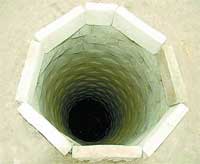
9. Remains of Han Dynasty Courtyards at Sanyangzhuang, Henan Province
10. Tomb Murals of Northern Wei in Datong, Shanxi Province
1. Neolithic Xiaohuangshan Relics, Zhejiang Province
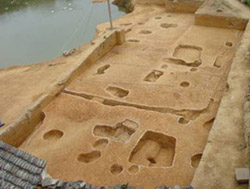
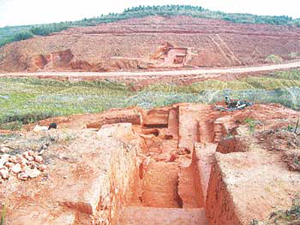
The Xiaohuangshan relics were found in Shangdushan Village of Shengzhou City in east China's Zhejiang Province.
The Neolithic site, which dates back some 9,000 years, covers an area of more than 50,000 square meters. Its discovery can very well cause the country's archaeological history to be rewritten as they are much older than those found at the Hemudu site in the province, which was previously thought to have been home to the earliest Neolithic culture in southeast China around 7,000 years ago.
At the site researchers have found several deep ditches, which they believe were storerooms, and some signs of barbecuing.
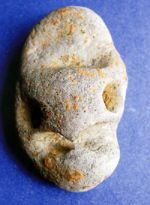
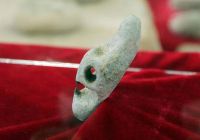
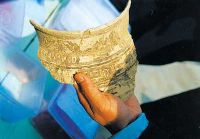
According to Wang Haiming, deputy director of the Zhejiang Archaeology Research Institute, a 9,000-year-old sculpted stone human head was found at the site. The head measures 7.6 centimeters high and has been roughly carved in basalt stone.
The facial features are not particularly accurate and by modern standards the work is crude. The forehead occupies almost half the face and the nose and mouth are somewhat mixed. But the eyes are symmetrical. Wang said although it didn't particularly resemble a human it would have been difficult for people living thousands of years ago to accurately portray facial features such as the eyes, forehead and chin.
Wang said the sculptor had selected a piece of stone that already resembled the shape of a human head with the forehead and cheek areas having been formed naturally. The sculptor added the details of the eyes and nose. The 9,000-year-old head is the earliest from a Neolithic site and holds significant value in the research of history and art.
2. Neolithic Gaomiao Relics, Hunan Province
Found at Yanli Village in Hongjiang City, central China's Hunan Province, the Gaomiao site, largely a shell mound, is one of the best-preserved locations of the Neolithic Age.
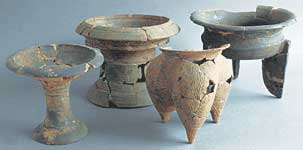
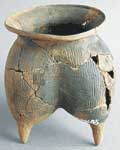
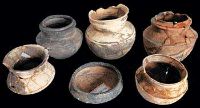
The site, with an area of some 30,000 square meters, has produced the country's earliest white pottery. In addition, a large amount of earthenware decorated with pictures of animals, birds and the sun has been excavated here. The bird patterns are reminiscent of the image of the phoenix worshipped in ancient China.
The findings suggest that phoenix worship can be dated back 7,400 years in central China. The worship of imaginary creatures like the dragon originated in ancient times when people prayed for sunshine, rain and good harvests, said He Gang, a researcher with the Hunan Institute of Archeology.
The bird patterns found at the Gaomiao ruins were dated as being some 400 years earlier than the phoenix designs discovered on ivory objects unearthed from the 7,000-year-old Hemudu site in southeast China's Zhejiang Province.
A sacrificial altar, the earliest such site discovered in China, has been unearthed at Gaomiao and covers an area of 1,000 square meters. The bones of dozens of animals including deer, pigs, cattle, bears, elephants and rhinoceros have been excavated from 39 sacrificial pits.
The most intriguing find was that of a 7,400-year-old woman's skeleton. He Gang said the well-preserved skeleton, which is 153 centimeters in length, suggests the woman was approximately 160 centimeters in height before her death.
A 7,400-year-old plaited bamboo mat found under the woman's skeleton is the oldest such article ever discovered in China. The carbonized mat is interlaced with weft and warp yarn and has an orderly arrangement of holes around it by way of a design.
The mat is more than 2,000 years older than bamboo baskets and other articles discovered at the Neolithic Liangzhu site in Zhejiang Province.
3. Prehistoric Zhongshui Relics Providing Proof of Rice Farming
Rice grains were found in a number of sacrificial pits at Zhongshui of Weining County, southwest China's Guizhou Province. The prehistoric site covers a total area of nearly 3,000 square meters.
"The rice was found in numerous pits and is believed to be upland variety as the grains are much smaller and the shoots are shorter than those of paddy rice," said Dr. Zhao Zhijun, a researcher with the Archaeology Institute of Chinese Academy of Social Sciences (CASS).
The discovery shows that rice was being systematically cultivated more than 3,000 years ago, said a source with Guizhou's bureau of cultural heritage.
Experts believe the rice, the oldest ever excavated in southwest China, will provide valuable insights into the evolution of rice strains.
According to Dr. Zhao, the discovery of the ancient rice along with ideal climate and soil conditions gives evidence of an advanced culture of agricultural production in the Zhongshui area. It provides important proof of rice farming, a subject that has been popular yet controversial among archeologists, agriculturists and historians for the past three decades.
Yet Dr. Zhao said scientists still need to determine whether the finds are paddy rice or dry rice and whether it was native to the Yunnan-Guizhou Plateau or had been introduced from other known rice production areas in the middle and lower reaches of the Yangtze River or the Sichuan Basin on the north of the plateau. "These are crucial in our research on highland rice farming," he commented.
South China with plenty rainfall and a mild climate is widely believed to be origin of rice farming. Many scientists believe that highlanders in the southwestern plateau were the first to cultivate rice. Excavation of Neolithic stone implements including farm tools appears to support their view, said Zhang Herong, a research fellow with the Guizhou Provincial Institute of Archeology.
Besides the rice finds, archeologists also unearthed from the site a large quantity of stone implements, pottery, jade and bronze pieces, Zhang said. It's inferred that ancient inhabitants had used surplus rice as a sacrificial offering for the dead.
4. Neolithic Liuzhuang Relics, Henan Province
A total of 336 tombs dating back more than 3,000 years were excavated in central China's Henan Province.
Arranged in a U shape, the tombs were unearthed at Liuzhuang Village near Hebi City. Funeral objects were discovered in 208 of the tombs including tomahawks, strings of turquoise stone beads, ancient cooking vessels and basins.
The most noticeable is a tomb containing a coffin made of 13 pieces of stone. The sarcophagus is 2.25 m long and 0.45-0.5 m wide. In addition, archaeologists found that in nearly 20 tombs stones had been put alongside the head or feet of the entombed person. Judging from the funeral objects in each tomb and their shape and structure, archaeologists believe they belong to the ancestors of the people of the following Shang Dynasty (c.1600-c.1100 BC).
Stone coffin had been mostly used in north China on both sides of the Great Wall. The discovery in Liuzhuang, the first of its kind in central China, provides clues to the origin of the Shang people, said Zhao Xinping, a research fellow with the Henan Provincial Cultural Heritage and Archaeological Research Institute.
The Liuzhuang ruins cover more than 300,000 square meters. So far an area of 7,700 square meters has been excavated.
5. Kiln Sites of Shang Dynasty on Mao'ernong Mountain, Fujian Province
Six kilns of the Shang Dynasty (c.1600-c.1100 BC) were discovered in September 2005 on the ridge of Mao'ernong Mountain in Pucheng City, southeast China's Fujian Province. Most strikingly, a long, dragon-shaped kiln is estimated to hold up to 100 pieces of pottery at a time. It has been regarded as the earliest and best preserved "dragon kiln" in China.
A chimney was found at the end of the dragon kiln. Zheng Hui, vice director of Fujian Provincial Archaeology Research Institute, said, "A dragon kiln with a chimney is really rare not only in Fujian Province but in the whole country."
Usually constructed against mountain slopes, dragon kilns are well-known for their huge capacity. In addition, within them the temperature can rise and drop sharply and the flame can be controlled.
A large number of black-covered pottery artifacts have been unearthed. Excavation work is still going on at the site.
Besides the dragon kiln, archaeologists also found round and ellipse ones. Their stratigraphic relations clearly show that the development of kilns was from the round to the ellipse and then onto the dragon type.
6. Western Zhou Dynasty Cemetery in Hengshui, Shanxi Province
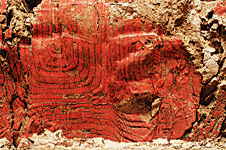
There are accounts of Huang Wei (pall) in the Confucian classic Li Ji (The Book of Rites) written around 2,000 years ago. A cloth covering a coffin, "Huang means the part of cloth on the coffin, and Wei means what droops on its sides," the book explains.
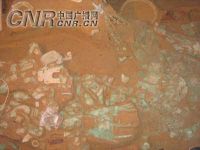
"Thousands of years passed and what we found were actually scarlet fragments blended with soil," said Song Jianzhong, deputy director of the Institute of Archaeology of Shanxi Province. "With any faintest touch, they would disintegrate."
Since late 2004 archaeologists unearthed 191 tombs of the Western Zhou Dynasty (c.1100-c.771 BC) at Hengshui in Jiangxian County, Shanxi Province. The excavation work brought to light information on a small ancient state named Peng that had never been recorded in historical documents.
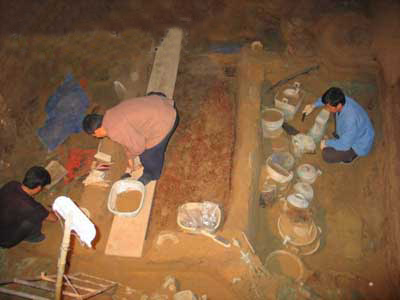
Lying on a slope the tombs each have a 20-odd-meter-long sloping pathway. Pengbo, Count of Peng State and his wife have the largest tomb. The couple were buried side by side with a large quantity of funeral objects including bronze ware and pottery. What's more, the pall sought by generations of archaeologists was finally found in the chamber of Pengbo's wife, who lay supine with hands crossed on her stomach.
"This is the oldest, best preserved and largest tomb decoration object discovered in China so far," Song said.
The pall unearthed in Hengshui must have been composed of two pieces of silk cloth, embroidered with phoenix patterns, according to Song. "With the stitching we found some marks of dislocated and reversed patterns, implying that two pieces of cloth were joined together after being embroidered," he said.
Archaeologists deduced that the pall, which covered the outer coffin, was preserved by silt that was formed after a mixture of soil and water had leaked in shortly after the burial. And the original pall must have been up to two meters long with each piece of cloth 80 centimeters wide.
They said that ancient Chinese considered the pall an imitation of bed curtains as well as one of the tomb decorations that "kept spirits from approaching the dead," according to some old reference books.
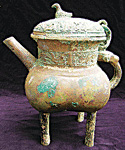
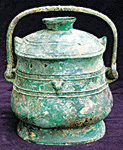
Exhumed along with the pieces of the pall were bronzes that carry inscriptions and indicate the existence of Peng, a previously unknown state of the Western Zhou Dynasty. Among the 41 bronze objects discovered in the two tombs were eight pieces of ding, an ancient cooking vessel with two loop handles and three or four legs. Probably the most significant bronze ware in history, ding was a symbol of power and status in the Western Zhou Dynasty.
Interestingly, archaeologists found more pieces of ding in the tomb of Pengbo's wife than in the husband's.
"It's quite rare in ancient China where males enjoyed higher status than females," Li Boqian, director of the archaeological research centre of Peking University, was quoted by Xinhua News Agency as saying. He added that it was probably because the woman was born into a family of higher prestige.
A series of 10 bronze chime bells, of great value in the study of China's musical history, were also uncovered in the tombs.
7. Aristocratic Cemetery of the Zhou Dynasty in Liangdai Village, Shaanxi Province
A three-month field investigation starting from April 2005 found a total of 103 tombs including four grand graves with passages and 17 chariot pits in Liangdai Village of Hancheng City, Shaanxi Province. The following excavation work produced a large number of funerary objects made of bronze, jade and gold from three graves and one pit. Judging from the size, shape and structure of the tombs as well as abundant funerary objects, archaeologists determined that the cemetery, covering a total area of 330,000 square meters, is for the burial of members of the aristocracy of a kingdom dating back approximately 2,800 years from the late Western Zhou (c.1100-c.771 BC) to the early Eastern Zhou Dynasty (770-256 BC).
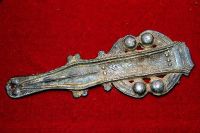
According to Jiao Nanfeng, director of the Institute of Archaeology of Shaanxi Province, articles unearthed from the graves include more than 600 pieces of bronze ware as well as numerous gold vessels and lacquer ware, many with carved dragon patterns, a symbol of rule in ancient China. The finds are considered to be highly important for the continued research into the political and economic systems and funeral customs of the Zhou Dynasty.
Liu Yunhui, deputy director of Shaanxi's bureau of cultural heritage, stated that an application will be made for the site to be designated under the sixth cluster of major historical and cultural sites under state protection. The State Administration of Cultural Heritage has approved the application and is awaiting the nod of the State Council.
Sun Bingjun, head of the excavation team, said two of the grand graves belong to a ruler and his wife who lived during the early part of the Spring and Autumn Period (770-476 BC).
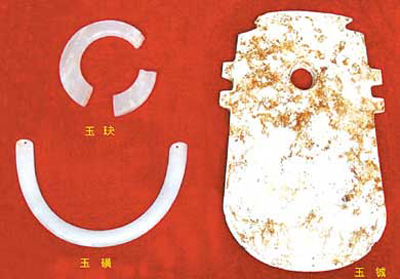
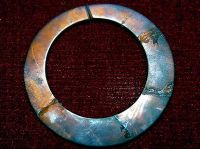
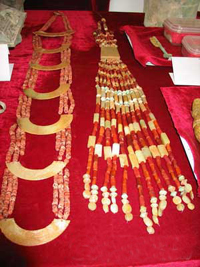
More than 500 pieces of intricately carved jade were found in the tomb of the wife of the ruler. These include jade jewelry inlaid with precious stones and jade carvings of silkworms and tortoises.
However, the finds seem to conflict with the Historical Records written by Sima Qian of the Western Han Dynasty (206 BC-AD 25), as it says that the area where the newly-found ancient tombs are located was the land of the State of Liang, said Chen Jiangfeng, an expert with the Institute of Archaeology in Shaanxi.
"From the inscription on the bronze wares unearthed from his grave we've learned that the ruler was Duke of Rui and the city now known as Hancheng was the land of the State of Rui instead of Liang," Chen said.
However, other archaeologists say the owners of the tombs cannot be determined at present and more information is needed for confirmation.
8. Mound Tombs in Jurong and Jintan, Jiangsu Province
In Jurong and Jintan counties of Jiangsu Province, from April to September 2005 archaeologists excavated 40 mounds, 233 tombs and 229 sacrificial pits dating back to the Zhou Dynasty (c.1100-256 BC), and produced more than 3,800 burial articles.
"Mound tombs" have been largely found in southern Jiangsu, southern Anhui, Zhejiang and Shanghai, all in the lower reaches of the Yangtze River. They were so named after their first discovery in Jurong in 1974. However, there has long been disagreement among archaeologists about their structure.
The new discoveries show that under a mound there is either only one or multiple tombs, and in most cases a burial pit was dug, which is different from previous assumptions.
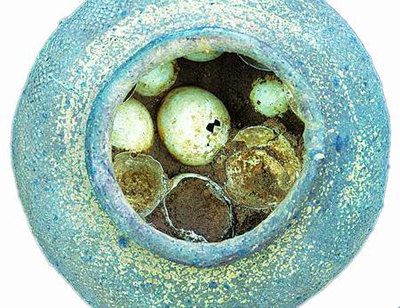
Another interesting finding was a pot of duck eggs pickled more than 2,500 years ago. The pot was covered with a lid and sealed with mud. So the eggs remained well preserved until they were discovered!
9. Remains of Han Dynasty Courtyards at Sanyangzhuang, Henan Province
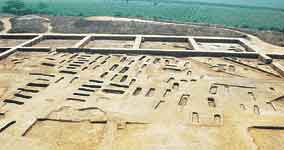
The remains of a total nine courtyards of the late West Han Dynasty (206 BC-AD 25) were first found in June 2003 along the ancient course of the Yellow River in Sanyangzhuang Village of Neihuang County, Henan Province.
Referred to as the "oriental Pompeii" when discovered, archaeologists say the village was submerged more than 2,000 years ago when the Yellow River burst its banks in a flood.
"The Sanyangzhuang site presents us with a vivid picture of Han Dynasty society, especially of its vast countryside, which has not been well recorded in literature," said Xu Pingfang, chairman of the Chinese Society of Archaeology and an expert in the Han (206 BC-AD 220) and Tang Dynasty (618-907) archaeology.
Excavation work on four of the courtyards, starting from July 2003, has so far unearthed a wealth of relics including tiled roofs, walls, wells, toilets, croplands and trees along with a large number of artifacts that provide insights into social and economic life of the time.
Like Pompeii the Sanyangzhuang Village was preserved intact. Life, as it was, stood still and frozen in time. Round and flat tiles were found in what is believed to be their original positions on the roofs after walls had partially collapsed. So, too, were articles for daily use such as stone and metal items and pottery apparently abandoned by families trying desperately to escape the flood.
In one courtyard excavation work revealed that the master room was actually undergoing maintenance when the flood water arrived. Unused flat tiles lay in heaps along with abandoned construction materials.
Also excavated were areas of farmland on which crops had grown. Experts say this provided first-hand material evidence for research into agricultural systems and the economy of the Han Dynasty. Farming methods adopted in the Western Han Dynasty greatly influenced China's agricultural development of later ages.
Some experts went as far as to suggest that the discovery of ridged farmland at Sanyangzhuang could correct past assumptions on farming culture in ancient China and even rewrite the country's farming history.
They said the distribution of courtyards and the croplands themselves have provided valuable evidence for studying the structure of organizations and relationships between different households in the Western Han Dynasty.
Flooding of the Yellow River has been regarded as one of the major dangers throughout Chinese history. Discoveries at the Sanyangzhuang ruins provided new information for studying the hydrological history of the Yellow River basin, they said.
10. Tomb Murals of Northern Wei in Datong, Shanxi Province
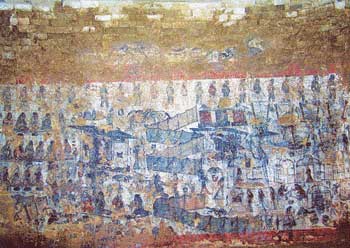
In July 2005 archaeologists unearthed 12 tombs of the Northern Wei Dynasty (386-534) in Shaling Village of Dalong City, Shanxi Province. In one of the tombs well-preserved murals were found, occupying a total area of 24 square meters.
The murals were painted in red, black and blue on all four walls of the tomb and on a pathway leading to it. Inscriptions on a piece of lacquer indicate that the tomb owner was a general's mother, a Xianbei lady who died in 435.
The discovery has supplied rich first-hand evidence to assist with the research of early ethnic dress and rituals, said Liu Junxi, head of the Datong Institute of Archaeology.
The mural on the northern wall is divided into two parts by a horizontal red line. The upper part depicts six exotic animals each symbolizing a constellation, while the lower part has seven rows of pictures. The first row portrays 19 well-dressed women. Under it is a large picture of an ancient ceremonial outing. A number of horse riders, musicians and soldiers carrying stream
ers and lances are positioned around a canopied carriage in which sits a man.
Eight females and ten males are portrayed on the eastern wall. In addition, a couple can be seen sitting in a large building in the middle of the mural. Both of them, perhaps the tomb owners themselves, wear big black hats indicating they belonged to a minority group.
A total of 26 male images have been found on the southern wall, on which a big banquet scene is painted, depicting various wine vessels, food, carriages and singing girls. Two scenes showing baking and brewing are also painted on this wall.
Images of soldiers wearing helmets and armor and of fairies are painted on the western wall and the ceiling of the pathway separately. "The soldiers are all in pairs, either in red clothes or armor, holding swords in one hand and shields in the other," Liu said. In sharp contrast with the menacing soldiers, the fairies look more amiable. They're half human and half dragon, with garlands on their heads.
The ancient artists outlined the murals first with red lines and then sketched out the entire picture in black before finally using colors to complete the work, according to Liu. She said the murals could be a reflection of real life at the time or simply an expression of the deceased's expectations of the after life.
(China.org.cn, July 5, 2006)