Dawn broke on a day in March 2005, Idelisi Abuduresule rose from his archaeological tools and precious relics and he stretched his stiffened body.
A researcher and head of the Xinjiang Cultural Relics and Archaeology Institute, Idelisi had just returned from the blowing sands of the Lop Nur desert. Rather than rest, with zeal he had immediately thrown himself into sorting and researching the cultural relics unearthed from the Xiaohe (Small River) Tombs.
Idelisi and his fellow archaeologists began the formal excavation of the Xiaohe Tombs two years ago, with the approval of the State Administration of Cultural Heritage. On an early morning in October 2003, Idelisi and the archaeological research team he headed set off from Alagan. Their caravan first traveled northwest and passed through an expanse of withered red cedars.
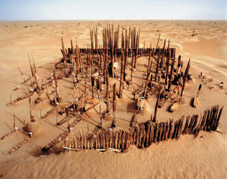
Then they headed northeast and entered the dry sands of the Lop Nur. As they traversed countless hills of sand, all seemingly low and regular, the team came upon a particularly huge dune carpeted by an array of dense wood stakes. They had arrived at the No.5 Cemetery of Xiaohe Tombs.
Idelisi and his team conducted a field excavation for three months, until the spring of 2004, when desert sandstorms prevailed and nature again reclaimed the region. In late September that year, Idelisi again organized his team and trekked back to the desert to continue excavation.
It was the summer of 1934 when the tomb complex was first formally discovered by Folke Bergman, a Swedish archaeologist. It once again was left alone in the remote Lop Nur desert until the late 1990s, when Chinese scientists translated Bergman's book on his expedition, Archaeological Researches in Sinkiang.
Decades passed, but the scene at No.5 remains as Bergman described in his book. On the surface of the dune are bended wood blocks of a sort rarely seen at other burial sites. Across the scene are scattered human bones, dismembered mummies and woven pieces of ancient wool.
"The scale of the Xiaohe Tombs is unprecedented," explains Yang Lian, a researcher with the Chinese Academy of Social Sciences. "The site may be the imperial tombs of the Loulan Kingdom. Regardless, the rediscovery of the tombs will no doubt play a very important role in the research of the Loulan civilization and the climatic changes in Lop Nur."
The complex has so far revealed hundreds of tombs in several layers as well as other relics. Its exterior is an oval-shaped sand dune protruding from the desert, rising 7.75 meters high and covering 2,500 square meters. Before excavation, a total of 140 wood stakes rose from the dune, and a south-to-north wood fence is well preserved at the center and the western end of the complex, while the central array divides the complex into east and west sections.
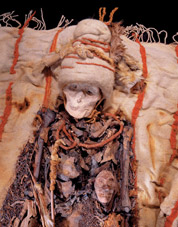
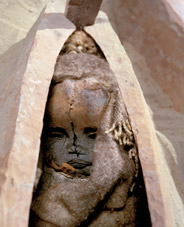
After complete excavation of the upper two layers in the west section, 33 tombs had been discovered, 25 adult-sized; eight for children. Unearthed from the tombs were 15 intact mummies, a wooden male corpse, and a rare wooden dried corpse. In addition, two sets of important remnants of sacrificial offerings and nearly 1,000 other relics were brought to light.
"Never before have such a large number of mummies
been found in a single site anywhere in the world," Idelisi said. "And it is still unclear how many more will be found."
At No.5 archaeologists also discovered miscellaneous large wood-carved figures, small wooden masks, engraved wooden arrows, red ox heads, snake-shaped wood poles and wood carvings of male and female genitalia.
"All these led us into a mysterious world permeated with an original, religious atmosphere," said Idelisi. "The rich cultural connotation of the Xiaohe Tombs is unparalleled among Chinese and foreign archaeological discoveries. The excavation and research on this site will not only play an important role in the archaeology of Xinjiang's ancient era, but it will also exert a deep and profound influence on continued archaeological research into the vast peripheral areas of Xinjiang."
After the field excavations of the No.5 Cemetery, the archaeological team shifted into indoor sorting and research. Also known as the "Cemetery of 1,000 Coffins" (to an exaggerated degree), the burial site is actually home to about 330 tombs. According to Idelisi, archaeologists have numbered 167 tombs and excavated 163.
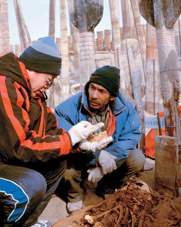
"Most of the tombs here still retain the same appearance as when they were buried, and this can help us better understand the social life back in the day," he said. "We have brought back 30-odd coffins and mummies, including boat-shaped coffins. And we have set samples from all the five burial layers for a research and determination of age. We've also taken samples from the stakes and coffin boards for a further determination of their age in light of the wood's growth rings."
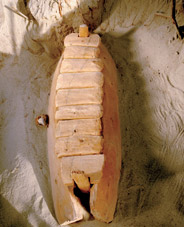
The dead were asleep in the dune in their boat-shaped wood coffins, arranged upside down on banks, thus symbolically separating life and death; time and space. Buried together with the dead in their coffins were simple articles. In addition to costumes, necklaces and bracelets, in each is a small straw basket, and the corpses are mostly covered with grass and wattles. Archaeologists are still at work attempting to interpret these special burial habits.
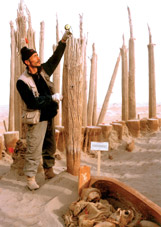
"When we unraveled the cowhide used to wrap the coffins, the wood looked as fresh as the day it was buried, and the tombs' occupants lay cleanly in their coffins, free from the invasion of a single grain of sand," said Idelisi. "From the excavations so far, we can deduce much about the burial process. The first step was digging a pit. Then the dead were put carefully in their coffins, which was later covered with a board and wrapped with cowhide. The final step was the erecting of wood stakes, filling the pit with sand and piling up the dune. While most of the wood stakes around the coffins were buried, the highest and largest stakes were exposed above the ground as notable marks of the tombs."
According to Idelisi, the excavation of the Xiaohe Tombs suggests that in their time, bronze ware had already appeared. But instead of being used for tools or articles of daily use, the metal was used mostly for ornamentation, including being inlaid to wood with symbolic meaning. Grass, wood, fur and hide were probably the elements of daily life.
The small baskets buried with the dead were tightly woven with plant stems and root fibers, and each was equipped with a handle. The ancient people of this area made use of the diverse texture of straws and skillfully wove triangle and terraced veins on the baskets. More extraordinary, the straws, which typically decay quite rapidly, were still fresh, despite the passage of thousands of years. In many of the baskets, there remained dried kernels of wheat and millet and other varied grain.
In writing his book, Bergman praised the ancient craftsmanship suggested by the baskets. Great skill was required, he wrote, and their mastery of shape and proportion was amazing, paralleling the patterns engraved on the wood stakes.
The corpses were wrapped in wool garments and the straw baskets were placed on the right side of the bodies. Idelisi inferred that the clothes worn by the long deceased were primarily a kind of cape that measured about 1.6 meters long and 1.2 meters wide. Tabby knitting was used to weave white, gray-white, light brown and dark brown wool. Decorative tassels made up the hemline.
Perhaps the most important discovery in the latest excavation is the few clay coffins. Unearthed from the bottom layer of the tomb were four clay-covered wooden coffins, each surrounded by a circle of six or eight high wood stakes. The coffin covers, in rectangular shape, were wrapped with thick clay. Under the covers were wood chambers, in which straw baskets and wood articles were buried along with each of the deceased. Discovered beneath the wood chambers were boat-shaped coffins for the female dead. In death, they were accompanied by such articles as wool capes, gold earrings, wool necklaces and wood-sculpted male genitalia.
The archaeological team also discovered a baby's tomb, which was believed to be the smallest of its kind in Xinjiang. "It is estimated that this infant died shortly after his birth... the boat-shaped coffin is just 55 centimeters long," Idelisi said. "The infant's entire body was wrapped in a yellowy wool cape, only his face exposed."
Also found were two boards of a coffin displaced due to tomb robbery and, according to a measurement of their sizes, it was theorized that (the one that had) gone missing was a boat-shaped coffin. If still intact, this coffin would be 245 centimeters long and would have been the largest in the archaeological discoveries in Xinjiang.
According to Idelisi, a formal report on their research will be soon be released. This will enable a better understanding of the unique burial habits and promote the study of the site. It is expected that this will also positively influence research into the rich archaeological past of Xinjiang.
(China Pictorial June 2, 2005)