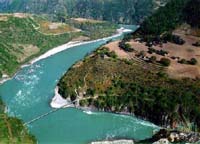
As hydroelectric stations spring up like mushrooms, among China's big rivers, the Yarlung Zangbo and Nujiang rivers are the only ones with their ecological integrity still intact. Following an upsurge in hydro-powered development, concerned parties set forth a plan to open up the Nujiang River. In this proposed terraced water conservation project, as many as 13 dams are to be built on the river. Some experts have voiced strong opposition to the project.
Rich species resources
Rising in the Danggula Mountains, the Nujiang River passes through China's Tibet and Yunnan, Myanmar, and eventually flows into the Indian Ocean. In its mid and lower reaches, the river cuts across Gaoligong and Biluo -- two snow-capped mountains located in Yunnan Province. Thus the natural drop comes to 1,578 meters in a 742-kilometer-long section of the river.
Due to the north-south position of the Hengduan Mountains that blocks the southern advance of Quaternary glaciers, the river basin has become the main passageway and refuge for migrating species in Eurasia. Plus changeable climate and unique geographical features have all turned this region into a land of rich biodiversity.
Though accounting for merely 0.4 percent of China's total area, the Nujiang River valley plays host to more than 20 percent of the country's higher-order plants and over 25 percent of wild vertebrates. Furthermore, there exist 77 species of wild animals and 34 species of native plants under state-level protection there. Of 48 known fish types living in the river, more than 30 are peculiar to the region, and four have been listed in the international red paper on wildlife protection.
"Primitive, exclusive and rich species resources have made the Nujiang River valley come out first in the list of China's 17 key protected biodiversity zones," said Prof. He Daming, director of the Asian International Rivers Center at Yunnan University. "These resources are precious wealth of the country, and belong to the whole of humanity. They have provided a rare gene pool. Along with the rapid development of biotechnology and gene technology, the scientific and economic value hidden in the species resources will be born out to be limitless."
Unique landscape
Mighty and imposing mountain systems, snow-capped mountain ranges, and turbulent rivers, in the mid and lower reaches of the Nujiang River can all be found as natural landscapes of the Northern Hemisphere except for deserts and oceans. Particularly, a local grand canyon spectacle has unparalleled views unlike anything seen the whole world over. For example, the sector of the canyon in the Nujiang Lisu Autonomous Prefecture is 310 meters long and 2,000 meters deep on average, second only to the Grand Canyon of the Colorado River.
The Three Parallel Rivers area (including the Jinsha, Nujiang and Lancang rivers) was first designated as a state-level scenic attraction, with the approval of the State Council, in 1988, and then inscribed on the World Heritage List as a natural property at the 27th session of the UNESCO's World Heritage Committee in July this year.
"To preserve the integrity and authenticity of world heritage sites is a fundamental principle," said Prof. Xie Ninggao, director of the Research Center of World Heritage at Peking University. In this respect, a bitter price has been paid at sites such as Zhangjiajie, Jiuzhaigou and Mount Emei where the Leshan Giant Buddha is located. "The detour of 'destruction followed by remedy' should not be made any more in our work," Xie pointed out.
Meanwhile, over ten ethnic groups including Lisu, Drung, Miao and Yi have lived in the Nujiang River valley, producing a rich and colorful local ethnic culture. As cultural diversity is drawing worldwide attention today, it has become an urgent task to conserve and carry forward this precious cultural heritage, which is based on distinctive natural environments and traditional lifestyles.
According to Li Wenhua, academician of the Chinese Academy of Engineering, the Hengduan mountainous area in the mid and lower reaches of the Nujiang River was formed due to the collision between the Indian Ocean and Eurasian plates. Both geological and ecological conditions are extremely fragile around there, which are irrecoverable once destroyed. "Currently, we are just making a start on scientific exploration in the river valley. To keep the 'pristine nature' and ecological integrity of the region, for further exploration, is our correct choice," Li said.
Damming project does more harm than good
"Based on years of research, what has destroyed aquatic resources the greatest extent is neither over-fishing nor industrial pollution but the construction of dams and reservoirs on the river," said Wang Xihua, deputy director of the Bureau of Fisheries with the Ministry of Agriculture.
For example, the hilsa herring (myxocyprinus asiaticus) is a delicacy living in the Yangtze River. With soft meat and delicious taste, the hilsa herring has been a popular dish for the Chinese, and its annual output used to average 500 tons, with a maximum of 1,500 tons. Unfortunately, the rare fish is now facing extinction, a significant reason for which lies in the fact that a power plant was built on the Yangtze River upstream from the Poyang Lake in the 1980s. The construction of the power station cut off the hilsa herring's migration route and consequently made it hard for the fish to spawn and procreate.
The Chinese sturgeon is another endangered life form in the Yangtze River which is currently under first-class state-level protection, and used to have huge numbers in history. However, when the Gezhouba Dam on the river closed in 1988, floods of sturgeon on their way to spawn upstream gathered and butted their heads against the wall of the dam. The scene was described as "horrible."
"Most of the 40-odd fishes in the Nujiang River are migratory. Once their upstream spawning grounds were destroyed, the consequences would be too dreadful to contemplate," Wang Xihua said. "Under the circumstances that China's freshwater fishery resources are reducing sharply, we appeal to competent authorities to stop building terraced water conservancy works on the river."
Fish is not the only species needing protection. According to Prof. Wang Xiangkun from the Beijing-based China Agricultural University, wild paddy resources, which are extremely deficient in China, are mainly distributed over Hainan Province and the Nujiang River valley. Actually, there are not many wild rice varieties left in Hainan today. Two varieties of wild rice growing in the Nujiang River valley contain quality, resistance, and environment-friendly defense genes that are indispensable for the breeding of high-grade rice. However, if the water storage project is put into practice, the two aforementioned varieties of wild rice in this region will be submerged and no longer in existence.
In the opinion of Liu Hongliang, academician of the Chinese Academy of Engineering, damming a river will not only destroy the local ecological environment and biodiversity, but touch off a chain of problems such as sedimentation, geological disasters, water pollution, and so on. For instance, confronted with sedimentation that is becoming more and more serious, quite a few power stations on the Yellow River have fallen short of requirements for electricity generation and flood control; as a result, the service life of these power plants has been cut down greatly. Meanwhile, the construction of the Gezhouba Dam has caused serious water pollution in the Huangbai River, a tributary to the Yangtze River. "All these problems are well beyond our expectations," Liu sighed.
Since the Nujiang River is one of the only two rivers in China with its ecological integrity still intact, experts pointed out that in the long run, it would be a sensible attitude not to open up the river. In this way, on the one hand, the Nujiang River can be put under permanent protection as the country's natural heritage; on the other, it can serve as a frame of reference. Thus as far as China's overall sustainable development strategy is concerned, long-term and systematic ecological observations in the region will be able to provide significant data based on a comparison between the ecological environment along the Nujiang River and other already developed rivers.
As for the issue of poverty elimination in the Nujiang River valley, in the opinion of experts, hydropower development is neither the exclusive nor the best solution. In fact, there is great promise for the development of a tourist industry in the area that is rich in both natural and cultural resources. At the same time, financially aided by the central and local governments, developing the breeding and peculiar vegetable-planting industries may as well be accepted as a feasible way for the local people to shake off poverty and attain prosperity.
(China.org.cn, translated by Shao Da, September 30, 2003)