Undeniably, southwest China is witnessing an unprecedented boom in hydropower development. Certain statistics show that of the hydropower plants to be built over several rivers: Nujiang, Lancang, Jinsha, Dadu, Yalong and Minjiang, 104 will have installed capacities of above 150,000 kw and 72 will have capacities of between 50,000 and 150,000 kw. The rest of them, with installed capacities of less than 50,000 kw will be incredibly numerous.
Many major rivers in southwest China, especially in Yunnan and Sichuan provinces, are about 2,000 meters above sea level. There are usually steep drops along different sections of these large rivers. Moreover, the riverside areas are sparsely populated and just a small number of people need to be relocated to accommodate a power plant. Therefore, these rivers are ideal subjects for hydroelectricity. In fact, the potential hydroelectric power is astonishingly enormous, as much as 490 million kw according to some previous statistics. Thus, people are attracted to these regions to build hydropower plants.
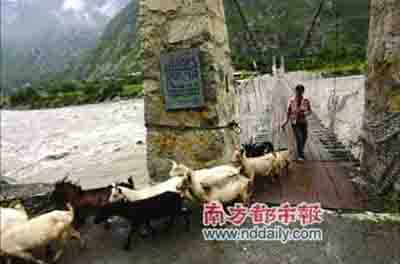
A villager is driving a herd of goats across a bridge over the Dadu River. Hydropower exploitation is greatly changing the river and the life of the people living nearby.
But environment and ecological experts have voiced their concerns. They deem current hydropower exploitation as the second worst ecological disaster in China following the destructive deforestation that took place from the 1950s to the 1990s. The ecological systems of these elevated riverside areas are extremely fragile. And it still remains questionable whether or not a too heavily exploited river can produce the energy as much as predicted.
Miyaluo is a town by the Zagunao River, a tributary of upper Minjiang River. It used to be renowned for its gorgeous maple landscape. Covering an area stretching for about 130 km, it was the largest in China. Now the maples are gone forever: concrete dams have taken their place. Additionally, 58 local households in Miyaluo have been forced to leave their hometown and relocated into a strange place. Although they are now living in new houses and receiving governmental subsidies, people are still worried about their futures because they have been deprived of their old way of life.
Miyaluo will be transformed to a power plant soon and is expected to begin operation by the end of this year. It is just one of the seven power plants along the Zagunao River. Now this river is scattered with busy construction sites where debris flows and landslides are common occurrences during rainy days.
Zhang Qiujin, Director of the Ecology Institute under the Sichuan Provincial Research Academy of Environmental Sciences, says that the construction of hydropower plants will deal a deadly blow not only to aquatic and dry land ecological systems. When a river is heavily exploited, its natural channels gradually dry up. Consequently, not only the aquatic life in the river but also the whole riverside area's natural environment is greatly endangered and very likely to be completely ruined. The relocated population will also exploit their newly found natural resources, thus posing another threat to the fragile balance of the ecological system in their new living places.
The Zagunao River is not the only subsidiary of the upper Minjiang River being exploited. Countless concrete dams and steel tubes will transform most of the upper Minjiang River's tributaries into separate artificial reservoirs. Those natural river landscapes are about to disappear from the earth.
The same fate is awaiting the Dadu River. The river is said to have the most abundant hydropower potential in Sichuan, with its exploitable installed capacities estimated at 50 percent more than the Three Gorges'. Authorities are considering building up to 22 power plants on the Dadu alone. That means more than 100,000 people will have to move from the river valley areas to higher ground. The river will never be the same.
The hydroelectric power plants have altered the way water flows, killing rare aquatic inhabitants, including otters, giant salamanders and the Hucho Bleekeri Kimura. They also have invaded into China's southwestern nature reserves, such as the Fengyongzhai Reserve in Sichuan Province where wild giant pandas are living. "The massive construction will devastate many regional ecological systems," said Yang Yong, an independent explorer.
Yang visited the upper Yangtze River 20 years ago when the ecological systems there were threatened by over-logging. Governments in the region took action in time to prohibit total forest destruction. Yet the roar of roaring generators has again interrupted the protective approach.
Hydropower plants have been built in nature conservation areas regardless of laws and regulations. Take Tianquan Town for example; several generators have been built inside the town's nature reserve. "Districts and towns should make their choices — to be nature conservancies or to be hydropower generator centers," said Chen Guojie, Director of the Sichuan Nature Reserves Review Committee.
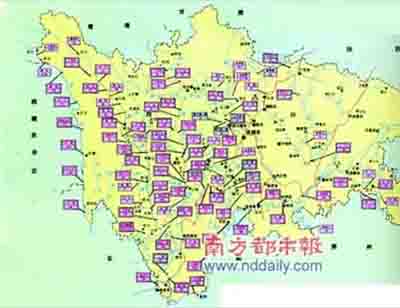
Densely populated hydropower plants are devastating the rivers and their ecological systems. This figure shows all the large- and medium-sized hydropower plants that Sichuan Province plans to build.
But the local government has argued that they had started to build hydropower plants before the place became a protected area. They hoped that the committee could compromise on the standards and allow them to place generators separate from the nature reserve. According to Zhang Qiujin, nature reserves would prohibit scientific explorations, let alone the construction of hydropower plants.
Yet low relocation costs and rich water resources have made these virgin lands irresistible for generator builders. "We have built too many hydropower plants on land that we should not touch," said Ling Lin, Director of the WWF Chengdu Office.
Controversy sparked in 2003 around the construction of a generator near the Renzong River on Gongga Mountain – the 400,000-hectares are designated as a nature conservation area and surrounded by dozens of snow capped mountain peaks. The mountain, covered with approximately 3,000 alpine plants, accommodates about 400 vertebrates.
The power plant on the Renzong Lake was phase one of the project. The second phase was launched in the same year on the Muge, a sacred lake for local people living on Gongga Mountain. The whole project aimed at creating a terraced water conservancy works. Yet the construction has been currently stopped due to strong opposition. According to Fan Xiao, a chief engineer with the Sichuan Geological Prospecting Bureau, earthquakes are occurring more frequently on Gongga Mountain than previously – when there were no hydropower projects.
Generators in China's southwestern regions have been generally built in two ways – tunnel works and terraced works. Both of the methods can do harm to ecological systems, according to environmental protection experts. Rivers have dried up due to changes in water flow caused by man-made tunnels. Such change has caused numerous deaths of plants flanking riverbanks. Although environmental protection experts disapprove of the technique, they have no right to stop it. "The only thing we can do to minimize the negative effects caused by tunnels is to keep a close eye on them," said Zhang.
"If there is no increase in water resources, hydropower plants cannot generate more electricity despite continuous construction," said Ma Huaixin, Deputy Director of the Sichuan Society of Hydropower Engineering.
Statistics show that about 100 fishes in the upper branches of Yangtze River will go extinct if all the planned terraced hydropower stations are put into operation.
Hydropower builders are thronging into China's southwest to struggle for the region's rich water resources. As one of the country's strategic projects, electricity has been sent from China's west, including Guizhou, Yunnan and Sichuan provinces to its energy-deficient east. The project has been part of the country's plan to develop its western regions.
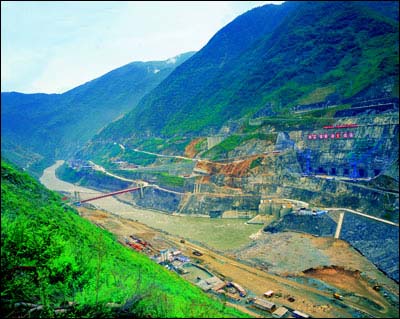
A power plant construction site on the Dadu River
(China.org.cn by Pang Li and Wu Jin, November 3, 2007)