Over the past 14 years there have been 114 deaths from cancer in Huangmengying, a village with a population of more than 2,400 in Shenqiu County, central China's Henan Province. The disease was unheard of to locals until the 1980s. On September 1 this year, three villagers died. Eleven others have been diagnosed with cancer, with an additional seven suspected cases in the village.
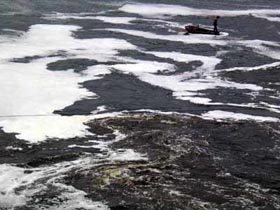
The fishing boat maneuvers in the Yinghe River, a major branch of the Huaihe River, on April 26. After the clean-up campaign was initiated 10 years ago, the pollution situation along the Huaihe River valley is still alarming.
Huangmengying is not alone. According to Huo Daishan, an independent environmentalist based in Shenqiu County, more than 20 villages in the county along the Shaying River have witnessed a dramatic rise in the number of cancer cases over the past two decades, with five of them reporting a high occurrence rate.
The root cause of the deadly disease is believed to be the polluted water of the Shaying River, the source of Huangmengying and other villages' water supply. Responsible for the pollution are numerous factories including a paper mill and gourmet powder factory, which are based just 15 kilometers away from the river and which carelessly discard untreated effluent into the waterway, says village head Wang Linsheng.
The polluted water from Shaying, the largest branch of the Huaihe River, a major river in China that runs through the east of the country between the Yangtze and Yellow rivers, flows into five ditches and 16 ponds in the village, says Wang. He said villagers who live near the ditches or ponds seem to be vulnerable to colonitis, rectum cancer or esophageal cancer.
A public health official in Zhoukou City, which governs Shenqiu County, says an investigation by the local disease prevention center shows that the groundwater at Huangmengying has a high content of manganese and nitrite, two chemical elements believed to be carcinogenic.
Kong Heqin, a rectum cancer patient for four years, says she has been feeling sick ever since she married and moved to Huangmengying 10 years ago. Claiming she "never went to see a doctor" before getting married, the woman says she now owes some 70,000 yuan (US$8,430) following four surgical operations and 12 chemotherapy treatments. But a new lump was found in her belly last March.
Forty-two-year-old village head Wang was diagnosed with colonitis. His health improved during hospital treatment in Zhengzhou, the provincial capital, but he fell ill again after returning home.
As the Shaying River receives most of the sewage from the cities in its upper reaches, Liu Jiaqiang, director of the environmental protection bureau of Shenqiu County, admits the groundwater in all 21 townships of the county is polluted, and the water above the 50-metre level underground along the river is not drinkable.
Polluting nightmare looming
Huo Daishan, 52, who grew up near the river, misses the old riverside life.
"The water was so clear that you could see fish swimming in it, and you could even catch them by hand. Teahouses would not use water from wells because the river water was always so fresh and sweet," says Huo, who gave up his job as a cameraman on a local newspaper and set up a monitoring and research center on the environment of the Huaihe River valley.
At that time, Huo says, local people did not know of the word "pollution" at all. But now, the river that once nurtured people along it has turned into venom.
Local people began to notice that the water was no longer as clear as before in the 1970s, says Huo. Then, with factories mushrooming along it in the 1980s, dead fish were frequently spotted on the surface and the water began to smell. People began to turn to wells for drinking water.
This was the situation for the whole Huaihe River valley. In a report on Huaihe pollution in 1995, Chen Guidi, a writer who grew up in a farmer's family along the river, said Huaihe had become the worst polluted river in China.
The Huaihe River region, Chen said, has witnessed an irrational development of local enterprises, without any pollution treatment, since the mid 1980s.
As early as 1993, a gazette issued by the State Environmental Protection Administration (SEPA) warned that the river was badly polluted, with pollutants in 82 per cent of its reaches above the safe limit during low water seasons.
Cleaning campaign offset
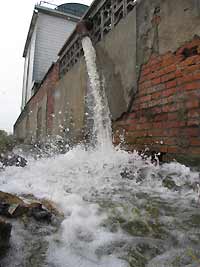
Untreated waste water pours into a branch of Huaihe River from a chemical factory in Huainan, Anhui Province, on May 9.
Waking up to the danger, the State Council launched a cleaning campaign in 1994, ordering all enterprises along the river to take measures to meet the requirements on waste discharge limits by the end of 1997.
Numerous small paper mills and other polluting workshops were closed down, and more than 1,100 enterprises allegedly completed renovations in sewage treatment by the deadline.
But a decade after the clean-up, a sudden flood hit the upper reaches and major tributaries.
Dams were sluiced to get rid of the excess water and foul water poured into the lower reaches. Up to 150 kilometers of the river were polluted.
The incident, says Huo Daishan, revealed serious problems remained in pollution control in the Huaihe River.
The key issue is, he says, that some officials in local governments still prioritize economic growth over the environment, and turn a blind eye to faulty sewage discharge or even act as an umbrella for the wrongdoers.
"Economic development is certainly important, but people's health should never be neglected," Huo says. "What's the use of economic boom if local people are exposed to the threat of death?"
The case of the Huaihe River pollution control, says Qi Ye, a professor of environmental policy with Tsinghua University, exemplifies China's embarrassment in environmental management.
The cleaning campaign of Huaihe took place when the country was dominated by an unprecedented fever of economic development, Qi says. "As economic growth was regarded as the most important yardstick by which to measure government achievements, environmental problems were easily neglected."
A crucial task for the country, if it wants to bring environmental problems into effective control, Qi says, is to strengthen the efficacy of environmental laws and regulations.
"If the laws and regulations are left lying there and not used, the dignity and power of the laws will be impaired and the country's ambition to curb environmental problems will eventually simply be verbal promises," the professor says.
He also calls for the establishment of an effective supervision mechanism over environmental problems, which should involve more extensive participation of common people. "Most members of non-government environmental organizations in the country are the social elite. More common people from the grassroots should be absorbed into such organizations if we want to promote awareness of environmental protection among them," Qi says.
Though the role of non-government green groups is recognized and appreciated by SEPA leaders, Huo Daishan, who heads an environmental group called "Guardians of the Huaihe River," complains that green NGOs' impact on local policy and decision making is rather limited.
"We don't have a smooth access to making our voice heard by government decision makers," he says. "When officials involved in pollution scandals try to hide the truth, voices from the common people or green organizations to higher authorities and the public become crucial."
To Wang Linsheng and his fellow villagers at Huangmengying, however, "there is no other way but to rely on the government" to solve their problem. He says the villagers, most of whom make a living by growing wheat, cannot afford lawyers to fight compensation battles.
The silvery line
While the earthy farmer is uncertain about what might happen to him tomorrow, Professor Qi Ye is optimistic.
"Though many problems remain unsolved after 10 years' work in pollution control in the Huaihe River, I believe the problems can be taken under effective control in the next few years," Qi says.
Unlike the past, Qi observes, economic growth at the expense of the environment is denied in the State policy. China's central leadership last year drew up guidelines for the country's officials to cultivate a "scientific conception of development."
In an era when environmental problems have become a concern for the whole world, Qi says, as a responsible member of the international community who is seeking a sustainable development, China is attaching unprecedented importance to environmental protection.
At Huangmengying, the local government has put in funds to dig a 400-metre deep well, from which water is channeled to villagers' homes. The well is expected to provide clean water for villagers.
But that cannot drive away the shadow of the demon of cancer in Wang's mind. "You can't imagine how dismayed I am when a new cancer case is confirmed in the village. As long as the river remains unclean, I will feel unease in the shadow of the demon," he says.
(China Daily October 19, 2004)