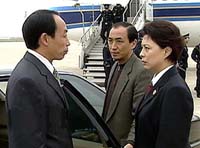
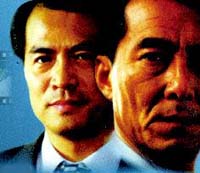
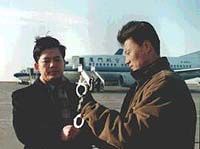
In recent years, literature and broadcasts on a specific theme "campaigns against corruption and mismanagement" have become favorites for Chinese publishing houses and TV stations.
Books on this subject frequently make best-seller lists while their TV adaptations are broadcast in prime time on channels of the national China Central Television (CCTV) network and provincial stations.
Last year alone, Zhou Meisen, a popular rising author and screen writer, saw three of his works on the same theme adapted into television series and broadcast either on local TV stations or CCTV.
The phenomenon invites critics to probe into the stimuli behind it. And, as it turns out, the genre stirs as much controversy as the interest it arouses in the audience.
Contemporary life
An obvious reason for the appeal of such subject matter is its immediate relevance to contemporary social life, critics agree.
On one hand, officials who accept kickbacks or bribes have become one of the most maligned groups of social pests in China. Few things give Chinese people more pleasure than seeing a corrupt official punished.
Political intrigue, trust or betrayal only make these acclaimed novels about fighting corruption more popular with contemporary readers.
On the other hand, the Chinese Government has greatly intensified its drive to oust corrupt officials in recent years. In 2003 alone, 12 senior officials above the provincial and ministerial level lost their positions and were found by the court to be guilty of accepting bribes, embezzlement and other crimes while abusing their political and administrative power.
Many writers do not sit idle. Realism has always been a strong part of China's literary tradition since 1919's May 4th Movement. Many Chinese writers still believe that literature must reflect real social life. A large number of writers committed to writing about fighting corruption have claimed they are motivated by their responsibility to help find solutions to social problems.
"I always believe that literature must actively exert its influence on the society and the people," said Zhang Ping, the author of 1997's To Make a Choice (Jueze), winner of the fifth Mao Dun Literature Award in 2001.
Many writers have undertaken painstaking investigations and managed to unearth first-hand materials from local police, public prosecutors and judicial officials around them before they start to write.
Zhou Meisen has made his exploration in the administrative sector, delving into the realities behind so-called "government achievement" as in Supreme Interest (Zhigao liyi), with the novel published in 2002 and the TV drama series broadcast last year.
He has also gone into the sector of public prosecution as in his 2003 novel State Prosecution, (Guojia gongsu), which also became a TV drama series.
It was said that after To Make a Choice was published, Zhang received threatening mail from enraged local officials, who believed he used them as the models for the corrupt characters in his work. But Zhang also got many more encouraging letters from local people for exactly the same reason. The episode attests how true-to-life the novel is.
The book's movie adaptation, To Make a Choice between Life and Death (Shengsi jueze), produced a box office smash in 2000.
What is the essence?
However, debates have also begun as the genre soon proved to be profitable in the market, which has encouraged more and more writers to pick up the theme and join in the production of films and television series based on the same subject matter.
The discussion mainly focuses on what attitudes the writers should adopt to write about social and official corruption.
Critics say that some works have aroused uncomfortable feelings because some writers have adopted a naturalistic way to describe corruption. Those authors feature corruption in their works but do not give detailed commentary.
Some of the literary works even give the impression that the authors actually take delight in exposing such subject matter. As a result, instead of reinforcing people's disgust toward these depraved lifestyles, they seem to be instilling the idea that it is enjoyable.
"Between writing about the effort to fight against corruption, and writing about corruption, there is a big difference," said Writers' Publishing House President Zhang Shengyou. "The two approaches would influence readers in quite different ways."
Also under the pretense of "fighting corruption," some writers cunningly initiate an adventure to write specifically about political tricks and administrative schemes.
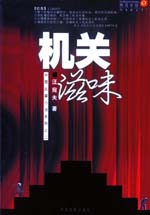
The most representative of this is Wang Yuewen's Chinese Painting (Guohua) (1999), published by the People's Literature Publishing House, and Wang Wanfu's The Taste of being an Official (Jiguan ziwei) (2001), published by the China Movie Publishing House.
Both have hit best-seller lists.
"Human beings have had a natural fascination with power struggles throughout history," said He Hong, a critic working with the Henan Literature Institute. "That's why the TV series centering on Imperial China's royal courts have been so popular in recent years."
Now such an interest also motivates some writers to take to the writing of the so-called "guanchang" novel, or novel about officials.
"These novels seek to satisfy the curiosity of those outside official circles. And to those in it, they may serve as textbooks to teach them the arts of grabbing and wielding power. They are low and vulgar in taste, and immoral as far as a writer's conscience is concerned," said Zhang Shengyou.
As far as the literary accomplishment is concerned, the anti-corruption literature has met with rather cold acknowledgement with literary critics.
Literary merits
Few reviews have ever been dedicated to novels of this theme in literary magazines. When they are mentioned, critics usually relegate those into a category but seldom regard such works as individual examples of creative writing.
The snub irritates many writers who have produced the works. Lu Tianming is the author of several novels featuring the rise and fall of the officials during the period of reforms and opening up.
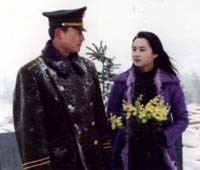
His novel Heavy Snow Leaves No Trace (Daxue wuhen) (2000) was considered a major success in the market.
The TV drama series adapted from Lu's novel of the same title won the Golden Eagle award as the best TV drama series in 2001.
In November of last year, when the former Minister of Land and Resources Tian Fengshan was sacked from his post for corruption, Lu revealed that he had heard about Tian's wrongdoings while collecting first-hand materials in the Northeast for Heavy Snow Leaves No Trace, nearly 10 years ago.
However, few literary critics have touched upon his work.
"I didn't expect they would give me a medal for my writing, but I do wish they could at least appreciate the pains I have taken in writing such novels," Lu Tianming said, in response to the cold response from critics.
"Part of the Chinese literary world seems to have an ingrained notion that the more popular the book, the cheaper it is," he added.
An often-heard observation made by the more "refined" literary world about these anti-corruption novels is that they believe such works cannot endure.
Being the product of a specific era, some critics say, these novels could produce a spell that would last only a matter of several years. Just as Chinese society of the 1970s and the 1980s has for a time been dubbed as producing so-called "scar literature" and "reform literature," which are scarcely read after the society moves on and the historical context changes.
But the writers themselves are optimistic about the long-term appeal of their work.
"As long as there is the phenomenon of corruption, there must be the battles against corruption, and the literature dedicated to them," Lu Tianming said.
Zhou Meisen said he is not happy with the fact that his writings have been relegated to the rank "anti-corruption" works.
A writer who has worked with local government offices in Xuzhou in east China's Jiangsu Province, Zhou said he is concerned with a broad range of social problems, which, arising from reforms and changes, affect the lives and ways of thinking of all Chinese citizens, including those who hold government posts.
"I am trying to examine why those (instances of official corruption) happen," he said.
Critics also question the artistic value of anti-corruption literature. The genre is often generally censured as rough in linguistic craftsmanship, and stereotyped in plot and portrayal of character. Some critics even believe that a large part of the writing should not be called literature at all.
There is no denying that most of the anti-corruption novels are concocted with the same ingredients: criminal investigations, power struggles, suspense and elements found in fictional thrillers, sometimes perhaps spiced with an episode of romance as well.
All of these elements are likely to promote the sales in book market.
The best anti-corruption writers are conscious of the shortcoming of the writing so far as it develops, and are making efforts to instill a new vitality to the genre.
"The most important concern of mine in recent years has been how to establish a more distinctive personal style, while still maintaining appeal in the market," said Lu, who is one of the most influential writers in this field.
Lu tried the subject in 2000 with Heavy Snow Leaves no Trace. The novel removes much of the impulsive mood of The Blue Sky above, (Cangtian zaishang) (1995), and assumes a much more calm and rational tone.
He adeptly dissects the psychology of a promising official who turns from a conscientious young man into a criminal who commits murder to cover his crimes.
"I wanted to draw a comprehensive portrait of a senior Chinese official such as a provincial governor," he said, a job seldom tried before.
(China Daily January 7, 2004)