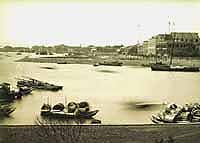
Having spent 30 years researching Shanghai's local history, Zheng Jiao (not his real name) longed to write an article analyzing the significance of kaibu or "openness to international trade" (Shanghai was compelled to open as a treaty port at the end of the First Opium War in 1843).
"I had such an impulse on the 150th anniversary of kaibu," Zheng said, but some worries made him abandon this plan. Now, after the passing of another 10 years, when asked whether he would re-consider writing this article, Zheng said: "Over the past 10 years, nothing has changed. The commemorative activities people hold and the commemorative articles media report are only a kind of emotional reminiscence. They do not commemorate what kaibu really means to Shanghai."
Great potential
In the light of basic historical understanding, Professor Dai Angang from the History Department of Fudan University thought that it was inappropriate to commemorate kaibu, since it was merely a passive "opening' due to China's failure to cope with foreign aggression.
Dai said: "The foreign powers didn't really intend to bring advanced culture or technology to China."
While some people have taken delight in talking about the so-called "rich life" of Shanghai in the early 1900s, Dai held that they should not ignore the negative effects kaibu brought to Shanghai. "Shanghai also has its impoverished side. We should make it clear who benefited most from Shanghai's kaibu," Dai said.
In spite of the historical humiliation, it can at least be conceded that Shanghai's commercial potential was first discovered by foreigners. Actually, in 1832 some foreigners had been sent to China by their governments to undertake investigations, finding suitable overseas markets for their countries' products. The scene of ships coming and going on the Huangpu River caught the attention of the foreigners. Based on their knowledge of China, Shanghai was chosen as one of the five earliest treaty ports after the First Opium War in 1843. "We have to recognize that those foreigners were keen observers," said sociologist Gu Jun from Shanghai University. Because of its position in the delta of the Yangtze River, controlling Shanghai meant seizing the whole Yangtze River system.
Before the arrival of foreigners, the geographical advantage of Shanghai had already existed. Zheng's research showed that earlier in the Qing Dynasty (1644-1911), Shanghai was not a small fishing village as many people thought. "To be exact, it had developed into a middle-scale town," Zheng said. "It can be said that foreigners took over this port."
Cultural collision
According to Zheng, being a treaty port was only a start for Shanghai. From the point of "opening", the main impact of kaibu came from the establishment of foreign concessions, which brought Shanghai into direct contact with the world.
Looking back the history of Shanghai, no particular culture was formed in Shanghai and no particular culture took a dominant position. "The weaker the cultural roots, the easier it is to be influenced by outside forces," Gu pointed out.
In the spheres of foreign powers, each concession had its own extra-territorial privileges and rights, which led to the pluralistic politics of Shanghai. Comparatively, different political powers kept a balanced structure instead of an integrated political power. As a result, corresponding cultural boundaries were also established among the foreign concessions.
Nevertheless, as the carriers of culture, people were free to flow from one place to another. "Culture readily developed in such a free space. The vitality of Shanghai lies in its cross-cultural character," Gu said.
Professor Yu Hai from the Sociology Department of Fudan University said that even without the promotion of outside forces, the inner degeneration taking place during the Qing Dynasty would have hindered social development.
Against the background of modern globalization, when the capitalist system started its expansion to the whole world, "China was a link in the global economic chain," Yu said.
From the point of view of social development, no one expected that the collision of two different political systems would turn Shanghai into becoming China's biggest city in such a short time. "Whether regarding urban construction or cultural construction, Shanghai began to turn its eyes to the world," Professor Ruan Yisan from Tongji University said.
During the process of Shanghai's development, a civil society gradually came into being, in which civil services in the Western sense were introduced, even operating in a way similar to Western countries.
Renewed prosperity
It is because of these kinds of links established during the period of kaibu that Western people often have a special feeling for Shanghai. In 1990, the opening-up of Shanghai's Pudong district once again attracted foreign people to the city.
In contrast to the kaibu160 years ago, the opening-up of Pudong was a step taken by China's government on its own initiative to resume its connections with Western countries. "Shanghai is experiencing its second miraculous entry into the international economic system," Yu said.
Although Shanghai is not an established international metropolis on the same level as New York or Paris, it has rapidly acquired some of the influential power that these international cities have.
"If we say that Western countries tried to turn Shanghai into one of their small overseas satellites many years ago, today Shanghai has become a city that displays China's development," said Davide Quadrio, a foreign resident who came to Shanghai about seven years ago from Italy.
"However, in the sense of culture, its second openness hasn't repeated the cultural riches of the kaibu period." Gu said. "Its cultural development has not kept up with its economy."
His long-term work in Shanghai made Davide Quadrio feel that culture needs to be internationalized and at the same time, absorb other cultures to improve itself. "Open culture doesn't simply mean hosting some cultural activities," he said. "In addition, culture should not have too close a connection to politics."
His thoughts were echoed by Gu who believed that the prerequisite for developing a culture was contrary to that of political development. A social base needed to be set up to provide the possibilities for free combination between different cultures.
(Shanghai Star November 21, 2003)