Few people driving along the paved highway from Ya'an in southwestern Sichuan to Tibet notice a dirt road that forks off near a bridge 4 kilometers from the county seat of Tianquan.
About three hours' drive southwest of the Sichuan capital Chengdu, the dirt road leads to a secluded village called Ganxipo, or Sweet Brook Slope.
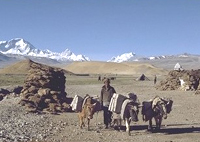
While today's travelers overlook Ganxipo, many in the past used the village as a stopover on the ancient tea-horse trade route.
Heavily ladened porters used to trek through the village of some 100 households to and from Kangding in Tibetan inhabited areas. They climbed over the towering Erlang Mountains, gateway to Garze, now a Tibet autonomous prefecture in western Sichuan.
According to Cheng Minghui, head of Blue Stone Town which has jurisdiction over Ganxipo, the small holes dotting the stone slab path "are left by the T-shaped walking sticks used by the porters."
"As they walked with a heavy load on their shoulders, they would strike the stone slabs regularly with their iron-tipped sticks as a counter balance to the load. And, once in a while, they would have to stop and plant the stick on the ground to have it support the load so they could take a breath," he said.
Cheng said the holes "testify to the ordeal the porters must have gone through."
"Walking sticks could not have bored holes in the hard stone slabs unless countless numbers of porters paused at the same place over hundreds of years."
Survivors' tales
Four of the porters have survived to tell the tale. Although the route has been deserted for 50 years since the Sichuan-Tibet Highway was built, the former porters, who now live in Ganxipo, have kept their walking sticks and other tools they once used for the hard journey.
Li Zhongquan, 81, says he started to carry loads to and from Kangding when he was a teenager. At the time, Kangding was capital of the then Xikang Province, which encompassed today's Garze of Sichuan and Qamdo of the Tibet Autonomous Region.
"It was 180 kilometers one way from Tianquan to Kangding," Li says. "An able-bodied porter would carry 10 to 12 packs of tea, with each weighing 6 to 9 kilograms. Then you'd carry 7 to 8 kilograms of your own grain and five or six pairs of homemade straw sandals to change on the way. The strongest could carry 15 packs of tea, with a total load of 150 kilograms."
The grain lasted no longer than half the journey, says the veteran porter. "And you had to refill your food supply at your own expense. The straw sandals would be worn out easily, as the mountain path was extremely rough."
For Li and other porters, the worst of the journey was the climb over Erlang Mountain, which towers 3,437 meters above sea level about 50 kilometers to the west of the county. The precipitous mountain path was so narrow that it allowed only one person to pass. It was a formidable challenge for any travelers, let alone a man loaded with 100 kilograms or more.
"One misstep, and you were gone," says Li. "We'd have our sandals soled with iron to get over the mountain."
Decades later, Li says he can still clearly remember fellow porters who died on the way over the mountain. "One of us was sick and fell dead on the mountain top in winter. We had to leave him there until the snow thawed in spring, when we carried the body down home," he recalls, choked with emotion.
On their way back, the porters would carry medicinal herbs, musk, wool, horn or other special products from Tibet. For such a trip, Li recalls, a porter was paid one silver dollar or 10 kilograms of rice for every pack of tea carried.
"But from this amount, you had to pay tax at each stop, your food and lodging, and other expenses like the firewood you were supposed to consume," he says. "So there was not much left when you got back home."
Li and other porters could not tell when the route and trade started. But Li is certain "my grandpa's grandpa was a porter as well" and the whole village offered porter service for generations.
Ancient route
Cheng Minghui is sure the path Li used to take was part of the ancient tea-horse trade route, because Tianquan, one of the eight counties of Ya'an Municipality, was a hub of trade between Tibet and inland areas for centuries. According to Li Xu, a research fellow with the Yunnan Provincial Academy of Social Sciences, there was more than one "tea-horse trade route" between areas inhabited by Han people and ethnic groups in bygone eras. And the one extending from Ya'an to Qamdo via Kangding was the main route.
"This was the highest and most perilous known passage of economic and cultural exchanges between different ethnic groups in the world, which played a significant role in the development of Chinese civilization," says Li.
Historians date the introduction of tea to Tibetan inhabited areas back to the 7th century. Tea quickly became indispensable to Tibetan people's daily life as its role in dissolving fat helped them digest their diet of meat and milk. As Tibet's climate and geography precluded tea cultivation, it heavily relied on inland areas for tea supply.
Ya'an held the key to the tea supply to Tibet and other minority areas since it held a monopoly over the trade, authorized by the imperial court. "This is because of Ya'an's proximity to areas inhabited by ethnic groups, including Tibetan, Yi, Qiang and others," says Sun Qian, vice-mayor of the city. "Also, Ya'an has been a major tea producer thanks to its location on the fringe of the Sichuan Basin, that favors tea growth. Much of the tea produced in Ya'an historically went to Tibet."
A temple-like government office set up in 1047 during the Song Dynasty to manage the tea-horse trade still survives in Mingshan, one of the eight counties under Ya'an. At the time, according to Ren Xinjian, a Tibet specialist in Beijing, some 7,500 tons of tea went to Tibetan inhabited areas from Sichuan every year, mostly via Ya'an.
The tea was exchanged for horses during the ancient dynasties. Normally a horse was traded for 50 kilograms of tea but sometimes, as in the Reign of Yuanfeng (1076-85) of the Song Dynasty, for just 20 kilograms of tea. The Office of the Tea-Horse Department in Mingshan could handle 2,000 traders a day.
Although demand for horses declined after the downfall of the Qing Dynasty (1644-1911), the route was still used for transporting tea, which was traded for other commodities. Statistics dating back to 1934 show that 2 tons of musk, 15 tons of Chinese caterpillar fungus (Cordyceps sinensis, a precious ingredient in traditional Chinese medicine), 2,750 tons of wool and 60,000 samples of medicinal herbs, worth more than 4 million taels of silver, were transported from Kangding to Ya'an annually. "It was a considerable trade volume," the academic Ren said.
Many of the goods rode on the backs of porters like Li Zhongquan, although he is not clear about the details of the trade. He only knows there was another route from Ya'an to Kangding for both caravans and foot porters, "but it was often blocked by landslides, so the trade had to rely on porters to a considerable extent."
Renewed interest
Li has no idea that interest in the ancient tea-horse trade and its routes has surged in recent years. Several expeditions have searched for the old routes from Yunnan and Sichuan to Tibet. But Cheng Minghui said disappointedly, "they have focused their attention on the caravan routes and no one seems to know there was a porter passage and there are still survivors of the trade."
There are over 30 stopovers along the porter route throughout Tianquan County, according to Cheng. "I think it's worthwhile to dig up the forgotten history and preserve all the relics that serve as witness to the ancient trade, including the path dotted with holes bored by porters' sticks, tools they used, houses that once served as post stations, and so on."
He hopes those like Li Zhongquan who worked the tea-horse routes live long enough for their stories to be recorded. "Nobody can recall the trade more vividly than they do. I hope a museum documenting the trade will be set up before they fade away," Cheng said.
(China Daily June 13, 2003)