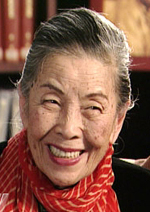
At last year's Lotus Awards, China's biennial National Dance Competition held in southwest China's Yunnan Province, the Chinese Dancers Association had planned to present the Recognition of Lifetime Achievement to Dai Ailian (Tai Ai-Lien) for her pioneering work in Chinese dance.
Because Dai was ill in bed in Beijing, the association decided to hold a ceremony for her in the capital before her 90th birthday in May this year.
But that was not to be.
Dai, the Trinidad-born Chinese ballerina who had devoted all her life to Chinese dance and was dubbed "Mother of Chinese Dance," died of illness last Thursday in Beijing.
Hundreds, if not thousands of people from the dance circle who could not attend the lifetime award ceremony, will pay their last respects to the legendary ballerina tomorrow morning at the Babaoshan Revolutionary Cemetery in western Beijing.
The Chinese Dancers' Association will also hold a memorial forum tomorrow afternoon to remember the unique dancer who got early ballet training in London and moved back to China when the "War of Resistance Against Japanese Aggression" broke out in the late 1930s. She helped start the Ballet Academy in China and spent all her life as the bridge between China and the world dance circle.
Her overseas friends could also honour her contribution to popularizing ballet in China by a visit to the British Royal Dance Academy in London where a bust of her is on display.
Deep impressions
"If, say, Wu Xiaobang is the 'Father of Chinese Contemporary Dance,' Dai fully deserves the title 'Mother of Chinese Ballet and Modern Dance'," comments Feng Shuangbai, vice chairman of the Chinese Dancers' Association.
"She is very innocent, clean in mind and straightforward."
Some 30 years ago when he first saw "The Lotus," one of Dai's signature works choreographed in the 1950s, he could not understand why it was acclaimed, Feng told China Daily.
"The group dance features simple movements and does not boast difficult techniques. I thought it was because Dai had enjoyed a high reputation, so people love her dance blindly," Feng said. "But as I grew older and saw more and more works and gradually knew more about Dai, I realized that the simple but graceful movements of 'lotus' well reflect her pure inner heart."
Some five years ago, when Feng served as the director of the Dance Research Institute of China Arts Academy, the then 85-year-old Dai asked to give lectures at the institute. Feng supposed the elderly woman would talk about Chinese dance history or the history of ballet. However, Dai said she wanted to criticize China's current dance education system.
"She said Chinese dance schools over-stress the techniques training, pay too much attention to the students' body movements, but neglect cultivating the artistic sense how to read the music and how to portray a character. So most dancers could challenge very difficult movements, but their dances have no soul," Feng recalled.
Dai did give a few lectures to the students to explain her view of dance training, but her soft voice to a small group of listeners "failed to wake up the majority who are in the wrong direction." It is a shame, said Feng.
When Dai herself taught students, she not only demonstrated the movements, but emphasized the artistry and character portrayal.
Feng Ying, ballet master and deputy president of the National Ballet of China, is one of the fortunate ones who received training from Dai.
Feng recalled how the class benefited her most when Dai helped her to rehearse Act II of "Swan Lake" in 1988.
Feng started to perform the white swan in 1979 and had danced the ballet for nearly 10 years. She was already a veteran ballerina in 1988 and had her own feelings about the character.
That afternoon, Dai watched her rehearsals, nodding from time to time with great satisfaction. But when the Act II started and the white swan turned into the pretty girl and saw the prince at first sight, Dai stopped Feng and went up to her.
"She told me to hold my breath and use eyes to express the complicated feelings of the white swan at that very moment. When I slowly moved on the tiptoes and had my back to the audience, the audience should sense my feelings from the slight shaking of the back," recalled Feng, who is now in her mid-40s.
"It is really hard to perform, but I admitted Dai's interpretation of those movements are much better than what I did before," said Feng, one of Dai's favourite students in the 1970s and 1980s.
Though Dai could not demonstrate for young dancers often because of her age, she was never far away from Chinese dance. She liked to attend the premiere of new repertoires and after the show, she would go backstage to talk to the dancers and give them her suggestions.
Last May, a few days after her 89th birthday, she also managed to go to the National Ballet of China to help the young dancers rehearse "Giselle." Feng Shuangbai told China Daily that in her later days, Dai often invited him to her house to discuss the situation of Chinese dance.
"When we talked at her home, she liked smoking," he recalled. "Speaking in her not-so-accurate Chinese, narrowing her eyes into a smile behind the spiralling smoke, she looked like a noble, wise and mysterious goddess who was sent to spread dance in China."
Dai's sweet smile with narrowing eyes is always the general impression in people's memory. People could easily figure out her satisfaction and joy from her smile.
A life of vicissitudes
However, her life wasn't always so pleasant. On the contrary, she suffered many losses from her youth. After gambling bankrupted her father, in her teens, she went from a rich merchant's daughter to a poor dance student who had to feed herself by doing temporary jobs. When World War II started, she gave up her career in London and came back to China to devote herself to the nation. Soon after her marriage in 1940, she became infertile after an illness. She also suffered greatly in the "cultural revolution" (1966-76) and divorced twice.
How did Dai survive all these trials and pursue her love for dance all her life?
In My Art and Life Dai Ailian's Autobiography, published in 2003, the following words she repeated a lot in the book best answers the question:
"You must love your country and love your culture.
"Only if you love what you do, you would not care how much you suffer for it or how much you pay for it.
"What I have achieved is attributed to the support and help from my teachers and friends.
"I am very lucky."
In 1916, Dai was born into an overseas Chinese family in Trinidad. As Dai wrote in her autobiography, she was very naughty, liked climbing trees, playing with boys and soccer, but she never liked playing dolls like most girls. In middle school, she loved sports and was good at running, table tennis and swimming.
Growing up on the Trinidad Island, Dai had four dreams. The first was to become a singer. She then wanted to be a navy soldier because there were many ships visiting the island, and she was interested in the life of a sailor and very curious about the world. Another dream was to be a musician because she started to play piano at the age of 7. She even set her sights on becoming a painter.
Although she began ballet lessons at the age of 5 and enjoyed dancing for family members after dinner every day, she did not think seriously about dancing until she was 14, when her mother sent her to London. There she received ballet training by such luminaries of ballet and modern dance as Anton Dolin, Dame Marie Rambert, Rudolf Laban and Mary Wigman.
Her misfortunes came six years later. Her father gambled all the money and could no longer support Dai and her sisters in London. Dai's eldest sister had married in London, and her other sister went back to Trinidad. But out of her love for dance, Dai chose to stay. She did all sorts of jobs just to survive on her own and won two scholarships to study at the Jooss-Leeder Dance School at Dartington Hall.
At Jooss-Leeder Dance School, Dai met her long-time love, an Austrian-British sculptor whom she never married but loved all her life, accompanying him for a year in London.
Never learning to speak Chinese in Trinidad and knowing little about Chinese culture, Dai envied those Chinese students in London and made friends with them to learn Chinese. With a desire to connect with her roots, she borrowed the English versions of Chinese history books from the Great Britain Library.
Fascinated by the story of Yang Guifei, the favourite concubine of Emperor Xuanzong in the Tang Dynasty (AD 618-907), she choreographed a solo performance called "Yang Guifei" in 1936 according to the stories and her own imagination.
After Japan launched its aggressive war against China in 1937, Dai took part in benefit performances organized by the China Campaign Committee in London to raise funds for the Hong Kong-based China Defence League, headed by Soong Ching Ling, wife of Sun Yat-sen.
Then came a turning point in the dancer's life.
By chance, Dai read Edgar Snow's Red Star over China, which made her decide to return to China.
With the help of Soong, Dai arrived in Hong Kong in 1940 and soon fell in love with the noted painter Ye Qianyu,
In the following years, Dai choreographed, performed and taught dance in China. She was named principal when the Beijing Dancing School was first set up in 1954.
Nation's own style
Trained in classical Western ballet, Dai showed great interest in Chinese folk dances, especially the ethnic dances. Soon after she returned to China, she travelled many times to see the minorities in southwest China's Yunnan, Guizhou, Guangxi and Sichuan to learn the folk dances from the ethnic people. In 1993, 77-year-old Dai also visited Yunnan to learn the Pumi ethnic dances.
During an interview with China Daily in 1982, Dai said: "For many of our minority people, dancing has always been part of their life, with men and women, old and young, all taking part."
In her autobiography, she stressed: "A nation's ballet company should have the repertoires of her own characteristics. We learned from Russian school in the 1950s and later drew nutrition from other schools, but the final goal is that China should establish our own style."
Her trade mark works include "Lotus," "Flying Apsaras," "Longing for Home," "The Mute Carries the Cripple," "Tibetan Spring," "Anhui Folk Dance" and "Sale." All of them are fruits of careful studies of Chinese dances. Although classical and some folk dances were restricted in China during the "Cultural Revolution," Dai remained influential in Chinese and international dance circles after China opened up to the world and began its economic reform process in the 1980s.
She has introduced a number of noted dancers such as Rudof Nureyev and Margot Fonteyn to teach in China and tried her best to promote Chinese dancers to the world.
In 1982, she was elected vice-chairman of the International Council for Dance of UNESCO, the United Nations' cultural and educational organ.
Dai led a single life after divorcing her second husband in 1967. When the China Daily reporter asked if she felt lonely sometimes in 1982, her answer was: "Life is interesting with its ups and downs. I am always occupied no time to feel lonely."
In devoting most of her 90 years to her love of dance and her roots, she will be most remembered not only for her soul-stirring performances, but also for paving the way for Chinese ballerinas.
(China Daily February 16, 2006)