The award ceremony for the Sixth Mao Dun Literary Award, the biggest event in Chinese literature, was held yesterday in Wuzhen, east China's Zhejiang Province, without much media clamour.
One reason could have been the fact the prize's winners were announced in April.
But this should not overshadow the significance of the award, which was initiated by the China Writers' Association in 1981 to fulfil the last wish of renowned writer Mao Dun (1896-1981).
The most prestigious and authoritative award in Chinese literature, the prize is given to only five authors every four years.
Despite criticism and questions surrounding the process of selecting winners, it is still the guidepost, the compass and the beacon for China's wordsmiths.
Seventy-seven-year-old Zong Pu was not present due to poor health, but the other four winners of this year's award Zhang Jie, Xiong Zhaozheng, Liu Jianwei and Xu Guixiang all made it to Wuzhen, the birthplace of Mao Dun.
Among the five, Zhang Jie's Without Words (Wu Zi), an epic novel spanning 20th century China, has been unanimously acclaimed by both literary fans and critics.
As deputy chairperson of the Beijing Writers' Association, Zhang is one of the country's more famous writers with a distinguished literary career which stands her head and shoulders above most other writers, male or female.
This was her second Mao Dun award, and she becomes the first person in the prize's history to win two. In 1985, she won her first Mao Dun with Heavy Wings (Chenzhong de Chibang).
The author believes Without Words is the best work she has ever done.
"I am satisfied with few of my previous books, Without Words is the one that I am most satisfied with so far. I am not trying to be modest, I am speaking my mind," she says.
"I was not very good at writing before, but after completing Without Words, I feel I have made a great deal of progress.
"I am not a talented writer, but I have always been very hard-working."
The title of the novel conveys a sense of the East's mysterious philosophy. Taoists believe that "the largest shape is without border, the largest noise is without sound."
And the grandest story, as Zhang explains, is "without words."
The one-million-character semi-autobiographical epic focuses on the fates of four generations of women in one family.
He Shaojun, a member of the review committee and professor of literature at Shenyang Normal University, says: "On the surface, it is about individuals: their love, their family lives. But it is not confined to that.
"Looking through the surface, we can see the twists and turns of the whole society. From the unique perspective of her own life, Zhang makes an introspection into a bigger history the country's historical journey since modernization."
It took Zhang a decade to complete the novel. She says she began her research in 1990, and finished writing in 2002. The finished draft consisted of four volumes, but the published version was condensed to three.
When the first volume was released in 1999, it immediately aroused the attention of critics and book lovers.
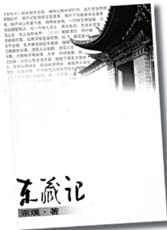
The other female writer in the competition, Zong Pu, won a Mao Dun award for her The Note of Hiding in the East (Dong Cang Ji). In it, she tells the story of highbrow intellectuals in the late 1930s and 1940s, when China was engaged in the War of Resistance Against Japanese Aggression.
The novel, first published in 2001, was based on Zong's own childhood experiences. During the war, she, with her father Feng Youlan (1895-1990), one of the 20th century's most influential philosophers, spent eight years in southwest China. Their life of destitution and homelessness left a deep impression on Zong.
"As an old writer, Zong Pu displays a high degree of writing proficiency in Dong Cang Ji. The style is quietly elegant," says He Shaojun.
While Zhang and Zong focused on events in living memory, Xiong Zhaozheng, a poet-turned-novelist, went further back with his Zhang Juzheng, a historical novel that has won the author critical acclaim.
Its pages are dedicated to Zhang Juzheng, a reformer in early 15th century Ming Dynasty (1368-1644) China. Zhang served as head of the cabinet of the Ming court and undertook a series of reforms involving taxation, land, academia and others. He battled corruption while amassing a great deal of power and angering many.
A regular winner of literary awards, the historical novel genre occupies a special place in the anthology of Chinese literature.
Many historical novels, according to He Shaojun, tend to use the past to comment on the present. As a result, their political implications dilute their aesthetic value.
But Xiong's Zhang Juzheng rose to the top of the dozens of historical novels that come out every year. He stuck to storytelling and did not attempt to offer a panacea for today's problems.
Xiong says he has been interested in history since childhood. After studying the Ming Dynasty, he began to take a special interest in Zhang Juzheng.
Xiong says it took 10 years of "painful effort" to research and write the novel.
"I did not expect to win any awards, and so I am especially happy that my writing has been recognized by the literary circle. It convinces me that hard-working writers are recognized in today's China," Xiong says.
It is his goal, he says, to contribute to society and history with his professional skills, and literature is the best way of doing that.
"Today's society is not short of people good at making money. What it lacks is authors engaged in serious writing."
Of the award-winning authors, Liu Jianwei and Xu Guixiang serve in the People's Liberation Army.
Liu's An Era of Heroes (Yingxiong Shidai) is semi-autobiographical and the third part in his Era Trilogy.
The first part, Cities in North China (Beifang Chengkuo), takes readers to small cities and rural areas. The second part, Breakout (Tuchu Chongwei), is all about life in the army.
The final instalment focuses on large cities such as Beijing and provincial capitals, completing what Liu claims is a "panoramic view of Chinese society at the turn of the century."
Liu's own experiences can also be divided into three such parts. He was born in the countryside and brought up in a county seat until he was 16-years-old. He then joined the army after graduating from a military academy in Henan Province. He is now a senior colonel and screenwriter at the August 1 Film Studio run by the PLA.
"The trilogy is actually another form of my life. I experienced, or at least witnessed, all the things I wrote about," Liu says.
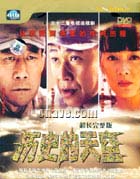
Xu Guixiang, author of The Sky of History (Lishi de Tiankong), also serves in the army, and his novel, spanning nearly half a century from the War of Resistance Against Japanese Aggression to the "cultural revolution" (1966-76), follows two soldiers' struggles against enemies, against fate, and against themselves.
(China Daily July 27, 2005)