When a friend talked about the diaolou (watchtower house) of Kaiping, Guangdong Province, I thought they were just residential buildings in the countryside, or old-style houses like the Qiao's courtyard in north China's Shanxi Province.
However, when I saw the diaolou of Kaiping, I was really taken aback by their history and culture. As a northerner interested in the formation and development of Guangdong's culture, I did not expect to find any answers here.
We drove westwards on the Guangzhou-Zhanjiang highway.
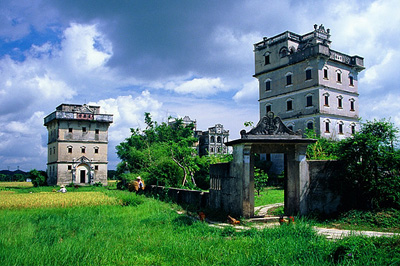
After about an hour, besides paddyfields, there began to appear groups of buildings that looked like castles, different in sizes and styles.
"They are the diaolou of Kaiping and that is where we are going," said Kuang Jikang, an official of Kaiping city government.
"Nowadays, there are probably more people who know about the diaolou than those who know about Kaiping. Actually, we are applying to the United Nations to get the diaolou listed as World Cultural Heritage sites."
Kuang had done much research into the history and culture of the diaolou and was lobbying the UN.
Practical functions
The construction of diaolou started during the late Ming Dynasty (1368-1644) and early Qing Dynasty (1644-1911). The appearance of the diaolou can be ascribed to the geography and security situations of Kaiping at that time.
Kaiping was a low-lying place which often suffered from floods. Located at the joint of the four counties of Xinhui, Taishan, Enping and Xinxing, it was also frequented by bandits. Villagers built the diaolou to prevent both floods and bandits.
Since 1840, the United States and Canada recruited a huge number of Chinese workers to dig gold mines and build railways. Many people from Kaiping left their homes to make a living abroad. Thus today Kaiping is the hometown of some 750,000 overseas Chinese, who live in 67 countries and regions.
Kuang said though overseas Chinese lived hard lives at that time, most of them sent money home to do the three important things in life: buying land, building houses and getting married.
The 1920s and 1930s were the peak of diaolou building, Kuang said. According to historical records, from 1920 to 1930, there were more than 70 serious robberies in Kaiping.
The county annals reported that one night in December 1922, a group of bandits kidnapped the headmaster and 17 students of Kaiping middle school.
Learning the news, local security troops came to the rescue. The troops finally found and rescued them with the help of search lights from a diaolou in Yingcun Village.
This incident caused a sensation in the whole county. The overseas Chinese from Kaiping not only were happy about the result, but realized the significance of the diaolous in fighting the bandits. To protect their families and properties, some of them began to send back money to build more.
When the overseas Chinese returned home, they designed their diaolous according to their own purposes and aesthetic values, which resulted in a variety of styles. They also equipped them with weapons.
Cultural influence
A saying of that time goes that there is no village without a diaolou in Kaiping. The maximum number used to be over 3,000. Now there are 1,833 left.
Looking up at the gray buildings and their rusty old-style doors and windows, we felt we were facing an old man who was telling us about everything that happened around and inside the buildings.
Kuang said that after World War II, as overseas remittance decreased and finally stopped, the construction of diaolous also came to an end, and the last one in Kaiping was built in 1948.
However, the cultural influence of the diaolous carries on today.
"Up to now, the diaolou of Kaiping still maintain and affect the local social structure, clanship and lifestyle," said Zhang Guoxiong, a professor of Jiangmen Wuyi University. "Moreover, the diaolou also maintain the overseas Chinese tradition and affection for their homeland."
A few years ago, Zhang came from Beijing to work in Jiangmen, mainly for the purpose of studying them. Now he has become an expert.
"A perfect combination of Chinese and Western cultures in architecture, the diaolou of Kaiping illustrate Chinese people's active borrowing of Western culture as well as the preserving of traditional culture," said Zhang. "The diaolou not only showed off the owners' wealth and social status, but also reflected different personalities."
The local people adopted and combined various architectural styles, including Greek, Roman, Gothic, Islamic, Baroque and Rococo.
Elements of different styles co-exist in the diaolou of Kaiping, which manifest unique artistic charm as well as great inclusiveness.
We came to a place called Xia Village, which is better known as the Canada Village nowadays. It is because the diaolou here were all built in Canadian style, and all the villagers had emigrated to Canada, except a "village head."
As we drove into the village, we saw a Canada Village sign on a telegraph pole. Kuang pointed to an old man who was sifting in the paddyfield and told us that he was the "village head."
The 68-year-old "village head" Guan Xinsen stayed in the village to accompany his mother, who did not want to emigrate to Canada. Now he lives a self-sufficient life, raising some 500 chickens and planting rice.
Besides Guan's house, the whole village was left with about 10 diaolou, closed and hollow. Walking among these gray structures, one not only has the illusion of another time and space, but also feels an isolated somberness.
We asked the old man whether he felt lonely. Perhaps because of long-time isolation, he only waved his hands, not knowing what to say.
Zili Village
Kuang said that there were still some villages like this in Kaiping. To prevent the diaolou from human destruction, the government of Kaiping recently employed some locals to guard them, and carried out regular inspections. Guan is a volunteer guard.
Our last stop was Zili Village, which has the most diaolous. Our guide Wu Jiuliang used to be the chief editor of the county annals, and is now working for the Kaiping government for applying to the UN to list the diaolou of Kaiping as a site of the World Cultural Heritage.
According to Wu, there are now 63 households and 175 villagers living in Zili, 248 villagers living overseas, in the United States, the United Kingdom, Malaysia, the Philippines, Fiji, as well as the Hong Kong and Macao special administrative regions.
Most of the overseas villagers are engaged in service trades such as the food and clothing industries. Overseas remittance is a major source of income of the villagers.
When the village was founded, there were only two houses surrounded by wasteland. As more and more came to reclaim the wasteland, groups of houses were established.
During the early years of the 20th century, many villagers went abroad to seek a livelihood, and many of them came back to buy land after they earned some money.
In the 1920s, villagers began to build diaolou to ward off the bandits. The diaolou were named either after the owners' names or their wishes, like Leisurable Life Villa (Yangxian Bieshu) and Safe Dwelling Building (Ju An Lou). Wu led us into the well-preserved Stone Building (Mingshi Lou).
Built in 1925, Stone Building is a five-storey diaolou of reinforced concrete. Every storey consists of one sitting room and four bedrooms. The rooms were not only well-furnished, but luxurious by the standards of the time.
The owner's suitcase, thermos bottles, gramophone, and box for whiskey all looked as if they had just been used the day before. On the walls hang black-and-white photos of the owner and his family. Walking upstairs, we noticed that the handrail was steady and exquisite.
On the top of the diaolou, four towers known as swallow nests occupied the four corners, each with embrasures, and cobblestones and an alkali water sprayer which were used against the bandits.
According to Wu, the owner Fang Runwen did business in the Unites States. He had three wives, and all his offspring lived abroad. When Fang got rich from his business, he spent huge amount of money building his home, which became the most spectacular and beautiful diaolou in Zili Village.
After Fang died in the United States in 1948, his concubine Yang and his children used medicine to guard his body against infection, and shipped the body back to Zili. After burying him in a small hill outside the village, his family members left quietly, taking away jewellery and valuables.
After half a century, Fang's offspring came back to Zili from abroad. When they saw their well-preserved house, they felt grateful and relieved to let the government administer the diaolou and open it to the public.
Wu said that most building materials used for diaolous, like iron and concrete were bought abroad and imported via Macao. Only blue bricks and wood were local. Therefore, the cost was very high.
In terms of design, some diaolou were constructed according to the blueprints that the builder brought from abroad, and some just to the owner's ideas. It is interesting that one can roughly tell which country the owner lived in from the architectural styles of the diaolou, or at least whether they were the American-European style or Nanyang (Southeast Asia including the Malay Archipelago, Malay Peninsula and Indonesia) style.
When the foundation of a diaolou was dug, a big awning was usually established on the whole construction site to prevent weather damage. Workers were mostly locals.
Now there are 15 diaolou in Zili Village, all under national protection. All the diaolou owners in Zili have emigrated abroad, and entrusted management of their property with the local government.
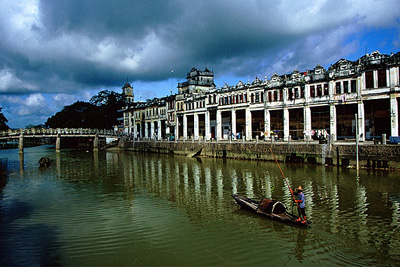
Driving from Kaiping to Taishan, and to Xinhui, one will see diaolou of various styles all along the 100-kilometre road. With regard to the defence function and scale of their architecture, I do not think it is exaggerating to call the area the Great Wall of Diaolous.
(China Daily December 27, 2004 )