Every three years since 1995, fans of Peking Opera have celebrated a big festival of their own -- the China Peking Opera Art Festival.
This year's, which started on December 1 and closed yesterday, was the fourth one. Shanghai became the fourth host of the event after Tianjin, Beijing and Nanjing.
Over the 15 days of the festival, 21 plays and five performances of selected excerpts were staged.
As well as major troupes like the China, Beijing, Tianjin and Shanghai Peking Opera theaters, troupes from western China such as Gansu Province, Ningxia Hui Autonomous Region and Xinjiang Uygur Autonomous Region also put on acts.
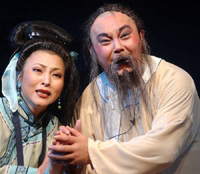
The Scholar of Ba-Shan (Bashan Xiucai) by Taipei Li-Yuan Peking Opera Theatre was the first work from Taiwan Province to take part.
Themed "succession and innovation, concern and development," the festival's programme featured mostly original works.
Of 21 plays, 13 were original, mostly written in the past three years
Many of them were based on historical stories, such as Shanghai Peking Opera Theater's The Disinterested Governor Yu Chenglong (Lian Li Yu Chenglong), China Peking Opera Theater's Lu River Yi Mountain (Lu Shui Yi Shan) and Shanxi Peking Opera Theater's Departure for the West (Zou Xi Kou).
Tianjin Peking Opera Theater's Mazu adapted a legendary tale, while Guangxi Peking Opera Troupe's Farewell My Concubine (Bawang Bie Ji) was a play of contemporary life. Unlike the traditional play of the same name, the new play describes how Peking Opera troupes live in our time and the struggle of the actors.
Absorbing other genres
Peking Opera has borrowed many elements from other art genres. Some works this year incorporated new characteristics.
Jinzhou Peking Opera Troupe's Soul of Wine (Jiu Hun), for example, included Song of Making Wine, which was sung in the Manchu language and melody; in Qinghai Drama Arts Theatre's Song of a Heavenly Horse (Tian Ma Ge), the set tunes were mixed with folk songs of the Tu ethnic group and Qinghai local opera; and Beijing Peking Opera Theatre's Mei Lanfang used a symphonic orchestra.
One of the most welcomed plays at the festival, Sorrow in Chu Palace (Chu Gong Hen), by the Tianjin Youth Peking Opera Troupe, was a play rearranged using the traditional costumes, set, music and acting style of Peking Opera.
"We should develop Peking Opera, but we should never forsake its characteristics," said Ye Shaolan, director of Sorrow in Chu Palace. Rearranging old plays is a good way to enrich today's stage and keep us learning from the past."
On the basis of the traditional script, the new version omitted some of the plots, putting more emphasis on the supporting role of Wu Zixu. Wu had two new arias, and an acrobatic scene was added.
The stylized singing and acting may be difficult for outsiders to appreciate, but acrobatics are easy for everyone to understand. They were some of the most popular acts.
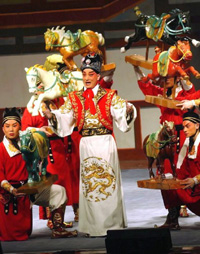
From December 10 to 12, about 800 actors and crew from 17 troupes all over the country competed in acrobatics at the Tianchan Theater in Shanghai.
In five divisions, the participants performed 26 excerpts, such as Eighteen Arhats Fighting Monkey King (Shiba Luohan Dou Wukong), Yue Fei and Yang Zaixing and Where the Three Roads Meet (San Chakou).
Acrobatics is one of the four basic techniques of Peking Opera (singing, recitation, acting and acrobatics), although it seems to have been on the decline in recent years, possibly because it is considered dangerous.
"We have to practise numerous times to master one movement,"said 22-year-old acrobat Feng Yun, who played the leading role in Baicao Spring (Baicao Quan). "We must be very careful at training, for one mistake may end in life-long physical injury."
The festival provided insurance for all the acrobats. Orthopaedic doctors from the Renji Hospital of Shanghai were ready backstage, to provide treatment in time.
"This competition has provided a rare opportunity for acrobats to display their art, and they have given their best," said Jin Yuxian, deputy-director of the Fujian troupe.
Seeking prodigies
The festival also had a showcase of children's operas, which included four plays: Big Dipper Star (Beidou Xing), Sparkling Red Star (Shanshan de Hong Xing), The New Monkey King(Xin Nao Longgong) and Young Soldiers of the Yues (Yuejia Xiao Jiang).
The showcase aimed at providing live experiences to Shanghai's youth, who are already receiving education about the art form in their music classes.
Other events of the festival included an exhibition on the culture of Peking Opera, a photography competition and a seminar on the transmission and innovation of the art.
Shanghai, a place to make fame
Peking Opera is based on northern Chinese dialect, but the festival was warmly accepted in Shanghai, which is to the south of the Yangtze River. In fact, Shanghai has always been an important place in its development. Even its Chinese name "jingju" came from Shanghai.
In the first 50 years or so after the art form was born, it was called pihuang in the north. On March 2, 1876, the Shen Bao newspaper in Shanghai published an article which referred to it as "jingju." This was the earliest use of the term. Since then, the term has been gradually accepted all over China.
Because of its advanced economy and comparative peace in the late Qing Dynasty (1616-1911), Shanghai soon became the biggest market. Many famous artists, like Mei Lanfang (1894-1961), Cheng Yanqiu (1904-1958), and Xun Huisheng (1900-1968) all made their fame first in Shanghai.
"Peking Opera is characterized by both the vigour of northern Chinese music and the melody of southern Chinese music, appealing to a wide range of people," said Gao Chunming, director of the Shanghai Art Research Institute. "Such a temperament is interlinked with the multi-culture of Shanghai, which is why Shanghai people are so fond of it."
Shanghai soon developed its own "Hai" school of Peking Opera, which featured earthly themes and comprehensive stage elements. In the new era, Shanghai is still active. In 1988, the Shanghai Peking Opera Theatre put on Cao Cao and Yang Xiu, an original work of theirs considered to be a milestone in the contemporary development of the art.
At this year's festival, the Shanghai troupe's The Disinterested Governor Yu Chenglong was also a hit.
"Nowadays the difference between the styles of Peking Opera in Shanghai and Beijing is not as obvious as before," said Mao Shi'an, art critic and director of the Shanghai Artistic Creation Centre. "Shanghai should carry on its efforts to create new works, and continue to contribute to its treasured heritage."
(China Daily December 16, 2004 )