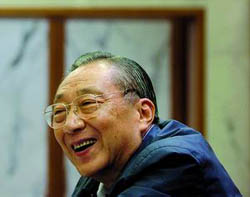
When Li Lanqing took over the administration of China's educational affairs in 1993, among other tasks as vice-premier, he set a goal for himself that his first and foremost role should be to serve as a quartermaster.
He meant to accommodate its reform and development with every convenience.
"I should try my best to serve the cause in practical ways and to bring real and substantial improvements to it," said Li.
In the following years, he worked to fulfill his promise. During his two tenures, the country witnessed changes in the entire educational sphere and every part of the machine was redesigned to be more efficient.
But nowhere was the transformation so evident and substantial as in the improvement of teachers' social status and pay.
Social esteem
The popularity of teaching as a career was at a very low point when Li was inaugurated.
While incomes for most other professions forged ahead with China's economic take-off, teachers' salaries remained pitiful by comparison.
At the year of 1993, annual salaries averaged only 3,098 yuan (US$374) for primary school teachers, 3,293 (US$398) for secondary school teachers and 3,880 (US$469) for college teachers.
In the countryside, millions of so-called "minban jiaoshi," or community school teachers, made an average of less than 100 yuan (US$12) a month.
Reports about teachers' poor living conditions, including one that claimed some professors had to sell snacks to earn a living, shocked the public.
What made the situation worse was the general low public opinion of their jobs.
In 1993, when Li was on a fact-finding tour in a remote area of southwest China's Yunnan Province, he was struck by what one primary teacher told him. "One of our local leaders told me to work hard, so that one day he will promote me to be a shop assistant."
That was when Li set his target to "make teaching an enviable profession" and it became one of his primary concerns in the following years, he said.
There seemed a long way to go, but there was determination to change, and as Li later wrote in his book -- before they knew it, it had happened.
Teaching has now become one of the top job choices for many university students. Enrolment in teachers' colleges has increased steadily.
Since 1993, teachers' salaries have risen every year. The Ministry of Education statistics of 2002 say that the annual basic salary (not including allowances and bonuses) for teachers in universities, secondary schools and primary schools averaged 21,046 yuan (US$2,542), 12,763 yuan (US$1,541), and 10,898 yuan (US$1,316) respectively, each representing an increase of 5.42, 3.88 and 3.52 times the 1993 figure.
The income structure in universities has changed significantly, and with allowances now accounting for a big part of their payment, incomes have actually risen by a much wider margin.
A Beijing Morning News survey conducted in 2003 showed that almost all teachers interviewed were satisfied with "the extent to which they were respected," and more than 90 per cent of them had no intention of switching to other careers.
'Imperial swords'
As the leader in China's educational reform, Li has said on various occasions that to push for the change one should know how to make good use of the "shangfang baojian," or the "imperial sword."
The swords were presented by ancient Chinese emperors to their vassals as a symbol of the supreme power entrusted on them, but to Li, the real swords were the legislature, policies and mandates that would guarantee the success of the campaign.
In 1995 former Chinese President Jiang Zemin announced the national strategy of rejuvenating the nation through science and education.
In 1998, in forming his administration, former premier Zhu Rongji declared to the nation and to the world: "Rejuvenating our nation through science and education is this government's most important mission."
A series of mandates was decreed by the central government requiring regional governments at all levels to attach top priority to work in education, and to guarantee enough financial support to fuel its momentum.
In 1994, the enactment of the Teachers' Law provided the most-needed "imperial sword" for Li. The first of its kind in China, the law secured a legal basis for teachers' social status and financial reward.
In his book, Li recalls the debate over how the law about the major players in China's education should be written.
"There had been a lot of controversy over whether teachers' pay should be regulated in law. Some argued that since many countries did not specify pay levels in their laws, China should not have to either. But I was among those who disagreed.
"Teachers were already paid well in those countries. Laws there focused on job requirements, making it clear that not everyone could work as a teacher. But in China it was a different story. We first needed to make sure that teachers were paid commensurate with their labor, then we could ask them to serve well."
Just how to specify this provision needed debate and deliberate consideration.
The provision finally read:
"Teachers' average salaries should not be lower -- and should even be higher -- than that of civil servants, and should be gradually raised."
"As employees of governments of all levels, civil servants in China receive remuneration based on a uniform and stable standard," Li explained. "It had already been decreed that civil servants' average salaries should be about the same as those of employees in large and medium-sized State-owned enterprises.
"But why should the provision include the redundant phrase 'even be higher,' since 'not lower' means equivalent or higher? This wording actually reflected a strong desire throughout society to raise teachers' salaries."
Touching memories
In the book Li recalled many emotional moments he experienced as he visited teachers and schools.
He visited rural schools all over China and met rural teachers everywhere.
The name "minban jiaoshi" was a special tag for a group of rural teachers.
Their rather strange identity was the specific result of the "cultural revolution" (1966-76), when rural schools had to use people without training to make up for the deficiency of teachers in the countryside.
Statistics for 1977 showed an all-time high of 4.91 million such teachers nationwide. These teachers were not considered State employees and not on any regular payroll. The salaries they received were much lower than those of formally employed teachers.
Li remembered a teacher about 50 years old, who he met in a small, run-down shack in a village school in Jiangxi Province of East China.
"How many years have you worked here, teacher?" Li asked him, as he stood correcting students' papers in the dim light.
"Seventeen," the teacher answered.
"How much are you paid each month?"
"Fifty-six yuan (US$6.76)."
"Why so little?" Li was shocked.
"Because I am a minban school teacher," the man said.
"I had to leave the room quickly after I heard the answer," said Li, "because I felt tearful."
Things would certainly have changed for old teachers like him now. By the end of 1999, most of the minban school teachers in China were being treated exactly the same as State-employed teachers.
Now many of these dedicated and humble rural teachers who are approaching or in their 50s or 60s, are enjoying or expect to enjoy a retirement with pensions that will look after their needs in rural areas.
The minban schoolteacher is not the only term that has fallen into disuse.
Tongzi lou, or dormitory-style buildings, are also out of use.
"The occasions when I visited these buildings were among my sorries and most upsetting moments," Li admitted.
This kind of building was once being one of the things that Beijing's young university teachers were famous for. The buildings had long central corridors, with single bedrooms, each accommodating one family, opening off on either side.
"What met my eyes was even worse than I had expected." Li described dormitory-style apartments in Peking and Tsinghua universities on the eve of the 1996 Spring Festival.
"The corridors were stacked with a chaotic assortment of household things and filled with greasy cooking fumes. The walls were black with soot and drying laundry hung about in the middle of the corridors like curtains.
"We were deeply disturbed by the wretched living conditions and felt that something had to be done immediately."
The solution turned out to be practical, effective, and economical. At very low cost, most of these buildings were transformed into tidy, bright, and much more commodious small apartments with private bathrooms and kitchens.
More than 80,000 junior university faculties around China had moved into new apartments by the end of 1999, according to statistics from the Ministry of Education. "These apartments are small, but are comfortable transitional shelters for young families before they are able to buy new homes," said Li. "When we visited these buildings again, the sight of the smiling faces of the young teachers came as a huge relief."
In fact, the renovation is just one move in a huge project to improve Chinese teachers' housing conditions in recent years.
It is estimated that between 1994 and 2000, 114.4 billion yuan (US$13.8 billion) was invested nationwide to build 150 million square meters of housing for teachers, nearly double the investment of the 44 years between 1949 and 1993.
In 1993, urban teachers averaged only 6.9 square meters of housing space as against the average 7.5 for each urban dweller. But by the end of 2002, the figure had expanded to 11.9 square metres, higher than the 11.4 for the average urban resident.
(China Daily November 26, 2004)