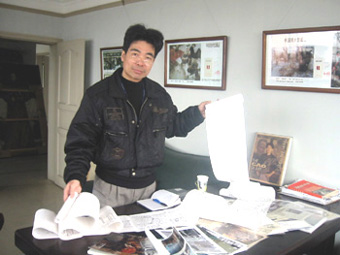
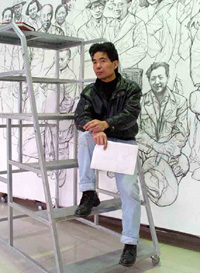
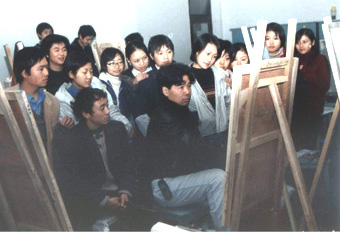
In 1982, the then student artist Gao Xiaohua embarked on a train journey that was eventually to take him to fame, money and admiration among his peers.
His luggage consisted mainly of paintbrushes, oils, an easel and a large canvas. The idea was simple in its conception but would be hard to realize. Gao wanted to capture the atmosphere of his country as it shifted and shrugged off one chapter of its history and prepared to turn a new page. But how does one capture everyday life of the Chinese in a single scene? The country is huge and diverse, its people rich in many cultures, dialects and thoughts. The answer, decided Gao, was you catch a train -- or as it transpired, many. He stopped countless times to set up his canvas on a station platform and add some brush strokes.
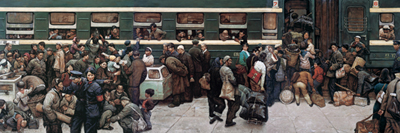
The result was the Rush to the Train (Gan Huoche), a painting which last year sold for 3.76 million yuan (US$455,000) at a Guardian Auction in China -- the highest price ever paid for a contemporary Chinese oil painting in the 21st century.
Painted on a canvas measuring 155cm x 450cm, Gao depicted a vivid scene featuring 80 characters. To many, the young artist successfully captured the ambience of the time, a period described as one of disorder and ambiguity.
"It is a sensational scene," says Gao. "People from different ethnic groups and from across the social strata are there on the canvas, travelling north or south, seeing friends off or welcoming people home, happiness and sadness alike, departure and reunion."
"Everything you can have in life arrives at that very moment. It is an epitome of contemporary Chinese society," the 49-year-old reflects.
Gao was in his final year of study at the Sichuan Fine Arts Institute. He traveled on trains painting his masterpiece whenever he had time.
The work won the 20th Century Arts Contribution Award of the Asian and Pacific Art Research Institute of America. And it is acclaimed by many to be the contemporary version of the Riverside Scenery on Pure Brightness Festival (Qingming Shanghe Tu) -- one of the great Chinese classical paintings of the Northern Song Dynasty (AD 960-1127), which features a panorama of daily life, business activities and social interactions in China's capital of that time.
Gao was one of the founders of the "Wounded Art" movement in China's post "cultural revolution" (1966-76) period. He was also a chief initiator of the "Sichuan School of Painting" and is a representative of China's "Critical Realism Painting." And of course, he is the winner of many international gold medals during the 16 years spent living in the United States. He returned to his homeland in 2000.
Today, he is a professor and graduate student tutor at Chongqing University in Southwest China. Gao is also one of the judges for the humanity and social sciences awards, given by the Chinese Ministry of Education.
Yet his journey to fame has been a protracted experience.
The road to success
Born in 1955 in Nanjing, the capital of east China's Jiangsu Province, Gao moved to the countryside when he was 14 with his parents, who were then both labeled as "capitalist sympathizers" during the "culture revolution."
At 15, he joined the army and was posted to Luoyang, a major city in central China's Henan Province, where he began painting a year later.
At 17, he became a photographer and arts editor on the Wuhan Military Area newspaper.
During this period, he often traveled while on duty, and it was on such trips that he observed the social realities around him. It was this curiosity that was to propel him to his greatest work.
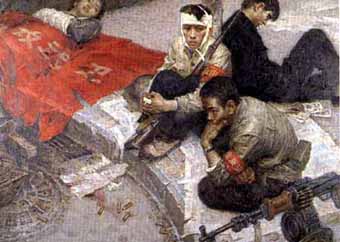
As his skills improved, he was admitted to the Sichuan Fine Arts Institute. His fame began to grow when he produced two famous works, called Why (Wei Shenme, 1978) which started the "Wounded Art" movement in China, and I Love Oilfield (Wo'ai Youtian, 1978). Both won silver medals at the 1979 National Arts Exhibition, and became part of the permanent collection at the National Art Museum of China in Beijing.
However, his biggest success came with Rush to the Train which was immediately exhibited at the National Art Museum of China.
Diversified styles
In order to produce his masterpiece, Gao traveled on trains from Chongqing, where his college is based, to Wuhan, Beijing and Henan Province, making observations, sketching and photographing in a bid to observe and learn from real life and gather materials.
Once home, he would start to produce his masterpiece in a style known in art circles as "Critical Realism Painting."
By portraying the simple human nature of common people, the style -- some critics say -- shared some similarities with the contemporary literature style of "Stream of Life" from the West.
A breakthrough from his early "Wounded Art," this piece pushed him to the frontiers of "Critical Realism Painting."
From 1983, Gao began to paint the Yi ethnic group in Sichuan's Liangshan area.
Paintings such as the Butuo Yi People Series (Butuo Yiren Xilie, 1983) and Old Forest in Early Spring (Laolin Zaochun, 1985), which recorded the life and customs of that area, entered the 1985 International Young Artists Exhibition and were collected by the National Art Museum of China.
To diversify his own style, Gao also touched on picture-story books between 1980 and 1985.
Pondering the functions of society became his major theme, and he was viewed as a philosopher on canvas. He persisted with experimental styles until his emigration to the United States in 1985.
Critics' view
"Gao Xiaohua is a young artist with outstanding contributions to the Chinese oil painting scene in the later part of the 20th century," the Chinese Fine Arts magazine says in a recent editorial.
Gao did not rest on his laurels and take his success for granted. He painted more and achieved more by diversifying and evolving his styles.
"If you do not want to copy others, you start with not copying yourself. If you want a breakthrough in arts, you should make the breakthrough on yourself," art critic Sun Meilan says.
"Gao's 'Rush to the Train' is such a tribute to his efforts to break through his awards-winning 'Why' and 'I Love Oilfield.' The busy scene of more than 80 people depicts the life and customs of the contemporary Chinese," Sun says, adding that "dramatic conflict, event, emotion and its relation to psychological logic evident in early 'Wounded Art' has vanished."
"The change from 'Wounded Art' to 'Critical Realism' shows the diversion of Gao's concern and focus," Sun notes.
"'Rush to the Train' neither offers sharp conflict and dramatic plot, nor focuses on the creation of heroes. Instead, the artist's focus is on the everyday life of the general public," Sun adds. "I cannot but be shocked by its realness and truth."
US sojourn
During his 16 years in the United States, Gao constantly travelled. He visited California, New York, Washington D.C., Connecticut, Kansas, among other states, cities, towns and countryside. He spent some time as a visiting professor at the University of Kansas.
He has been invited to hold over 40 individual and other exhibitions in world-renowned institutions such as the Asian and Pacific Museum of America and the Hammer Gallery in New York.
During this period, Gao spent five years in New York. He finished an interesting series of New Yorkers oil-painting works on canvas, including Students, Telephone Booth and Roadside Shop.
A viewer can sense the bustling streets of the metropolitan city without having to travel there.
"I did paintings everyday," Gao recalls. "Only hard work, improved quality and increased quantity can demonstrate my existence."
Back to China
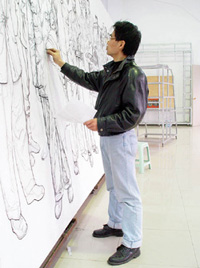
In 2002, Chongqing University invited Gao to become a professor, graduate student tutor and dean, and also to act as the director of the university's Historical Themes Oil Paintings Studio.
"This is a new stride for me," Gao says, referring to his new career of arts education and historical theme paintings. "It provides a rare opportunity for me."
Chongqing is known for its Red Crag. On November 27, 1949, the then Kuomintang launched a massacre of 300-odd revolutionaries, who fought for a New China which came into being with the founding of the People's Republic of China on October 1, 1949.
The famous Chinese novel Red Crag (Hongyan) was based on the revolutionaries' heroic deeds prior to and during the "November 27 Massacre."
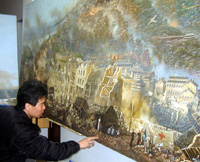
Gao himself was familiar with the story. He was one of the chief designers and the head of the Oil Paintings of "Enlightenment of Red Crag," a large-scale fine arts site.
After six months' hard work, Gao finished the mammoth design, which was praised by the Chongqing Municipal Government as "a bold way with complete new ideas and pioneering work, and an efficient combination of revolutionary cultural relics and artistic forms."
Gao is still busily working on the colossal project, which includes 35 oil paintings and five groups of sculptures on a span of three exhibition areas.
"The work is hard but I am happy, because I enjoy painting everyday," he says.
"Society is moving forward with China's reform and opening-up, and I have to reflect on the new changes."
(China Daily August 26, 2004)