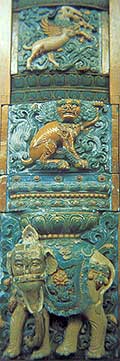
During the reign of Emperor Yongle of the Ming Dynasty a most grand and extraordinary building was created in Nanjing -- the Glazed Pagoda of Grand Bao'en Temple, once the most illustrious building in China's architectural history. It was considered one of the greatest wonders from the middle ancient times in the world.
Grand Bao'en Temple was one of the three most famous temples in Nanjing in the early years of the Ming Dynasty (the other two being Tianjie Temple and Linggu Temple). It was located at Changganli out of Nanjing's Jubao Gate (today's Zhonghua Gate). The ruins of the temple are now in the southeast of Changgan Bridge east of Yuhua Road. The Glazed Pagoda, an important part of the temple, was constructed under the direct instruction of Emperor Chengzu, whose name was Zhu Li, of the Ming Dynasty. Why did he want to build the pagoda? There is a complicated story behind it.
Zhu Li, fourth son of Emperor Taizu, Zhu Yuanzhang, was not the legitimate successor to the throne. Because he was born prematurely, the empress, jealous of his mother, one of the emperor's concubines, falsely accused his mother of adultery. Suspecting the child was not his, Zhu Yuanzhang ordered the child's mother to be punished by wearing an iron skirt. The poor concubine was imprisoned and soon tortured to death. The child, however, was allowed to live. When he grew up, the emperor found that he bore him a strong resemblance, so he consulted imperial physicians and forensic doctors and learned that it was not rare for a child to be born prematurely. It was too late to regret and also too embarrassing for the emperor to announce the real reason for his concubine's death. However, he began to grant special favors to this son of his and appointed him King of Yan to command the garrison in the north. When Zhu Yuanzhang died, his eldest grandson, Zhu Yunwen, declared himself emperor. Zhu Li led a punitive expedition to Nanjing and Zhu Yunwen was forced to burn himself to death. Zhu Li succeeded to the throne and moved his capital to Beijing. In order to release his mother's soul from purgatory, he decided to build a temple and a pagoda for her. The temple was named Grand Bao'en (Paying a Debt of Gratitude) Temple. In order to show his gratitude to his mother, he spared neither labour nor money on the construction of the temple and pagoda, which were designed in the same style as imperial palaces and constructed of materials normally used only for construction of imperial palaces. He also sent two of his most trusted eunuchs to oversee the project. One of them was Zheng He, who became famous for his voyage to the "Western Ocean" (mainly Southeast Asian Islands). More than one hundred thousand soldiers and laborers took part in the project. Construction lasted ten years, from 1412 to 1422. When construction was completed, the halls and chambers of the temple looked like the imperial palace. Sacrificial-offering ceremonies were conducted in Gongfei Hall (Tribute to the Imperial Concubine) by the Ministry of Protocol every year. At other times the hall was closed and nobody was allowed to enter it.
Since the pagoda was the most important place for worshipping Buddha and releasing the soul of the dead from purgatory, it received special care. It was built right behind Gongfei Hall. It was such a big and complicated project that it took more than twenty years to complete construction in 1431. According to historical accounts, the pagoda was about a hundred meters tall, octagonal, with nine storeys. The outside walls were covered with white porcelain bricks, each with a small statue of Buddha in the middle. Every storey had the same number of bricks, but as the storeys grew progressively smaller, the bricks also became smaller. The pent roofs on each storey and the arched doors were all covered by colored glazed tiles. The arched doors were decorated with patterns such as golden-winged rocs, dragons, lions, elephants, and human figures, all depicted vividly and elegantly. On the first storey statues of the four heavenly kings carved on marble were inlaid in the walls between the arched doors. The steeple, made of cast iron, was composed of nine discs, the biggest in the middle and the others becoming progressively smaller towards each end. The discs had a pedestal composed of two layers of lotus petals. The pedestal was made of gilded iron, so it was called the gold ball by the local people. The bead on top of the steeple was made of gold, weighing "two thousand taels." The steeple was linked to the roof ridges of the pagoda by eight iron chains. Nine small bells hung from each chain. In addition, eighty bells hung under the eaves of the pagoda. It was truly a magnificent building, bright, colorful, even dazzling. Legend has it that the underground palaces and the top of the pagoda contained priceless treasures, such as pearls that were luminous at night or could protect their owners from water, fire, wind and dust, a diamond, "a hundred jin" (fifty kilogrammes) of tea, "four thousand taels" of gold, "a thousand taels" of silver, a thousand strings of coins issued during the reign of Emperor Yongle, two bolts of yellow satin and a volume of Guardian of the Earth Buddhist scripture. On the pagoda 146 oil lamps were attended by more than a hundred virgin boys day and night. The "everlasting lamps" were so large, it was said, that the diametre of a lampwick was "an inch," and they consumed "64 jin" (32 kilogrammes) of oil a day. Emperor Yongle, to show his respect for the pagoda, wrote "Pagoda Number One" for the building.
The method of construction was also different from other buildings. It is said that instead of scaffolds dirt piles were used for building the high structure. The piles became higher and higher as each storey was added. When the whole project was finished, the dirt was removed, revealing the pagoda. Also, each construction component, including the glazed tiles, white porcelain bricks and all the other ornamental objects, had three copies, so if any part was damaged during construction, it could be replaced. When the pagoda was completed, the spare components were numbered and buried underground, so that if anything broke, it could be replaced according to the number. Sure enough, in 1958 the department of cultural relics of Nanjing found a large number of spare components of the pagoda, most with handwritten numbers in ink on them.
The "Porcelain Pagoda of Nanjing"--the wonder of the Middle Ages recorded in the civilized history of mankind--as it was called by foreign admirers, stood for more than four hundred years before it was destroyed in the middle of the nineteenth century. Even today, when people see the colorful glazed tiles and ornaments of the pagoda preserved in the Nanjing Museum, they can imagine the lofty mid magnificent appearance of the pagoda in olden times.