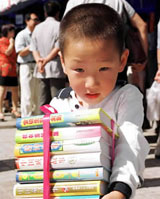
 Nowadays, the competition for college admission has extended to primary schools or even kindergardens. Children begin to shoulder the heavy hopes of their parents at an early age. For some time, a schoolyard rhyme spread widely among children in primary and middle schools. This rhyme, which truly reflects the excessive schoolwork of students, goes: “It is me who has the heaviest schoolbag; it is me who is the first to go out in the morning and the last to come home; and it is me who works the hardest, sleeps the latest and is the most pitiful.”
In China, the schoolbag of a primary school student weighs at least 2 kg. Students at junior middle schools usually get up around six o'clock in the morning, and school ends after five o’clock in the afternoon. Many schools also require students to review their lessons at night. It is a luxury for children to take a rest during weekends. Many students don't agree that study is pleasant. Even adults say: “Today’s children no longer have a childhood!” Experts warn that excessive schoolwork and increasing resentment of study are likely to cause psychological or social problems.
Yao Jiye, deputy director of the Guangzhou Commission of Education, pointed out that China is an Asian country in which students have the heaviest schoolwork load. This may result in an imbalance in a child’s moral, intellectual and physical development.
On January 7, 2000, the Ministry of Education convened a teleconference on how to reduce the burden of primary and middle school students. Minister Chen Zhili pointed out that the large number of books, courses, exams and contests, as well as the large amount of homework, contribute to the heavy burden of primary and middle school students in China.
Shortly afterwards, the Ministry of Education issued an Emergent Notice on Reducing the Heavy Burden of Students in Primary Schools. Related regulations were also made concerning middle school education. Special supervisory and reporting mechanisms have been established, responsible for seriously dealing with matters that violate these regulations.
How Do Adults View Burden-Reducing Attempts?
Since last year, except for the end-of-term exams, the Yuying Middle School in Jinan, Shandong Province has replaced the “100-score system” with a “grading system” in all tests and exams, said Wang Zexian, assistant to the principal at Yuying. All courses are required to design one or two sets of test questions. If there is only one set of questions, some are compulsory while others are optional.
This aims to reduce the psychological pressure caused by scores on students. At the end of each term there is a quality-education report, for which the student give a score first, then the teachers give their grades, then the parents give scores to their child, and finally a comprehensive assessment is conducted to give a grade to the student. This aims to accurately reflect a student’s performance both in and outside the school, while avoiding a biased evaluation by the class advisor.
Prof. Lin Chongde, from the Development Psychology Institute of the Beijing Normal University, said educational administrative departments and schools need to rationally arrange students’ time, following the attempt to reduce excessive schoolwork. He pointed out that students must be made to understand that learning is an obligation, and that while excessive schoolwork is a barrier to their growth, a proper burden can be an impetus for their physical and mental development.
Liu Wenjun, vice-principal of Beijing No.166 Middle School, noted that as most children in cities are the only child in their family, few can endure hardships, and the reduction of schoolwork can easily become an excuse for such children to evade study. “There would be no motivation without pressure, and a certain amount of pressure is necessary to help children form good learning habits.”
The reduction of excessive schoolwork has given children more freedom. Some experts noted that, as many children lack a cheerful disposition, the scarcity of homework might result in some negative effects. “Obedient” kids will become more introverted, while “disobedient” ones will go out and make trouble. Some, who are not good at allocating their leisure time, will idle it away in electronic game arcades or book markets stocked with books that can be harmful to children. Some students, especially those still in primary school, will indulge themselves in watching TV when they have more free time, as they know little about alternating work with rest and recreation.
According to these experts, homework can be very flexible, rather than the traditional review of lessons. Therefore, they advocate the “second classroom,” which should combine activities of students in and outside of the campus and classroom, so that students can grow happily and healthily while gaining knowledge. In particular, efforts should be made to develop students’ practice ability and expand their thinking. Schools, families and society should work together to ensure the comprehensive growth of students, including their moral, intelligence, physique, aesthetics and labor skills.
Experts advise that more amusement facilities should be constructed in communities, and that museums, science and technology exhibition halls and gymnasiums should be open more to primary and middle school students.
They explained that an improvement in students’quality of life in their spare time is a good way to relax from the pressure of study. Children are given more freedom so they can give better play to their creativity. Parents, schools and society should try to create conditions for this purpose, which is the true goal of burden reduction.
Experts also reminded parents that family education is as important as school education, and it is not right to shift all responsibilities to schools.
Do Students Feel More Relaxed?
Surveys show that, for some time following the issue of the Emergent Notice on Reducing the Heavy Burden of Students, most primary school students felt relaxed. However, sixth graders were not. They anticipated that they could enjoy their winter and summer vacations, but had to return to their classrooms two weeks earlier. Meanwhile, many middle school students still keenly feel the pressure of study.
Although relevant departments reiterate a ban on any disguised courses and classes targeting students during winter and summer vacations, it is common for sixth graders to return to their schools ahead of time. Schools start early at the request of parents and students.
But shortly after school commenced last year and this year, many children found their teachers returning to the “old path,” assigning endless homework, giving exams and contests one after another, and ranking students according to their scores.
Many surveys show that primary and middle school students still encounter the problem of schoolwork overload. Some schools, report their achievements in reducing students’burdens, yet everything goes the same as before. A survey reveals that more than 60 percent of primary and middle school students spend more time in schools and on homework than national standards.
There are constant reports about the punishment of schools that “make up missed lessons” by violating government regulations. However, similar events keep occurring.
Prof. Lin and his students conducted a special survey on the effects of burden reduction. They found that while schools are reducing the burden, families are increasing it, which is demonstrated by the fact that more and more parents are hiring private teachers for their children. Investigations at book markets also reveal that at the “recommendation” of teachers, parents are still enthusiastically buying all kinds of auxiliary teaching materials.
According to Prof. Lin, the high hopes of parents for their children are worse than schools’ undue emphasis on the proportion of graduates admitted to schools of a higher level. He also found that though children now have less schoolwork to do, they bear more psychological pressures. Some students, who have a less favorable foundation but are eager to make progress through doing large amounts of exercises, are worried about their future after their schoolwork is lessened.
Some experts noted that many teachers only pay attention to the student’s scores, and most parents only care about their children’s life and study in purely material terms. Both teachers and parents neglect communication with the children and usually ignore their psychological needs. As a result, the alleviation of study pressure only results in the aggravation of another kind of pressure.
What Is Behind the Overload?
It is agreed that among the various reasons for persistent excessive schoolwork, the most direct is competition for admission to college, as well as the subsequent competition for employment. Prior to the “cultural revolution” (1966-76), only 3 percent of college-age people could receive a college education. Over the 20-plus years since China adopted reform and opening-up policies, although institutions of higher learning have been expanding their recruitment of students, only 9 percent of college-age youth can be admitted to colleges and universities.
The huge pressure for college admission has forced schools, teachers and parents to work out various countermeasures. One way that has been universally accepted as effective is to increase the amount of exercises to be done, which is known as the “mountain of homework” tactic. The increasing homework nearly crushes students. To deal with the numerous tests, students have to read all kinds of extra books at the cost of giving up play and other extracurricular activities.
Some parents said that although burden reduction is now advocated, the criterion for college admission remains a score. While the system of “judging a hero by the test scores” remains unchanged, how can they relax their children’s schoolwork?
The deep-seated traditional model of education through taking examinations has seriously restricted implementation of burden-reducing attempts. Many educational specialists admit that, so long as the current examination system remains unchanged, the burden on students won't be alleviated in a true sense.
In addition, traditional concepts, such as "Only the learned rank high, all other trades are low" and "He who excels in learning can be an official," still have a profound influence upon the values of contemporary Chinese. Many people hold the view that only those who excel in learning and receive a college education can have a bright future. The overdue emphasis of employers on educational background has also intensified competition for college admission, which has extended to primary schools or even kindergartens. From the day children first enter school, they begin to shoulder the heavy hopes of their parents.
Many schools report that currently, there are too many courses in primary and middle schools. Moreover, the textbooks are usually dull and hard to digest. The teaching programs set excessively high requirements and teaching methods are boring, mainly relying on repeated exercises. All these are reasons for the heavy burden on primary and middle school students.
A teacher revealed that with eight or nine courses in the middle school curriculum, students are left with little spare time. However, they have to deal with a dozen special education programs assigned by authorities. No wonder the students have such a heavy burden.
Some teachers pointed out that the current education evaluation system is irrational. Good schools and teachers are those who have trained more graduates who have been admitted to schools of a higher level, and the bonus and professional rank of teachers is also closely linked with the proportion of graduates who are admitted to schools of a higher level. Obviously, all this encourages schools to place undue emphasis on the proportion of graduates admitted to schools of a higher level.
The Key Lies in Educational Reform
A scholar pointed out that with the alleviation of students’ schoolwork, teachers need to raise their class efficiency and improve their teaching methods, so that as many questions as possible can be solved within classrooms and students can learn as much as before in a limited time. However, teachers can do very little to improve classroom efficiency, and the fundamental solution to the problem is to change the system of education.
An expert said that the criterion of success is the key to reducing the burden of students. The phenomena of “diploma counts” and “all students try to be successful via one single-plank bridge (college education)” over the years have formed a society that worships higher-level diplomas and college entrance examinations. Many children are exposed to their parents idea of “studying hard, going to college and finding a good job” at an early age. And teachers only enhance such an idea. Consequently, the vast majority of children think mostly of how to get into a college, while giving little serious thought to fundamental issues such as their responsibility to society and the meaning of life.
Indeed, the key to burden reduction is reform of the educational system, especially reform of the examination system. Now, although children in many areas can be admitted to middle schools without taking examinations, senior middle school students still have to face the choice between going to college and finding an ordinary job. This choice will decide, in most cases, their role in society as well as their road in life. So the pressure of examinations always exists among primary and middle school students.
Some headmasters and principals noted that the reduction of schoolwork is by no means an isolated topic. It needs a series of supporting reforms, and is an ongoing process. The top priority is to reform textbooks and teaching programs.
Many people from the educational community pointed out that nowadays, some test questions seem not to test students’ proficiency but lead them to tackle insignificant and insoluble questions, some even surpass the thinking ability of the students of their age. Examination is the baton of teaching, creating traps in classroom education. Zou Jingzhi, a well-known Chinese poet and playwright, said that she could do little to help with the Chinese course of her daughter, a primary school student.
The top priority at the moment is to change the curriculum and the way of examination, said many experts. Children should not be expected to remember so many things at such a young age.
According to experts, the key of educational reform is to make society realize that the goal of primary and middle school education is not only for the students to master necessary knowledge but, more importantly, to raise the overall quality of students. Students should be taught to think more about the meaning of life, social responsibilities and other fundamental issues. Schools need to conduct in-depth research in this regard and select appropriate content and methods to help student form correct ways of thinking. If schools only emphasize knowledge learning and neglect guidance related to life itself, school education can only produce a batch of word or number machines, rather than useful personnel who are going to play important parts in society.
(Beijing Review November 8, 2001)