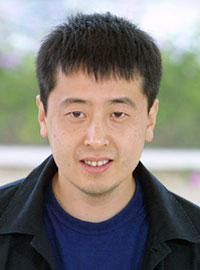
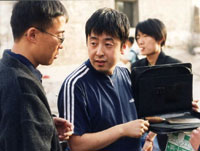
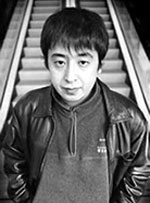
Jia Zhangke: Born in 1970 in Fenyang, a small town of Shanxi Province, China. Graduated from the Beijing Film Academy.
Filmography
Feature films
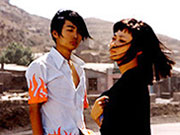
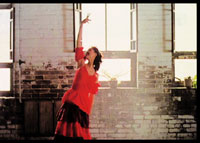
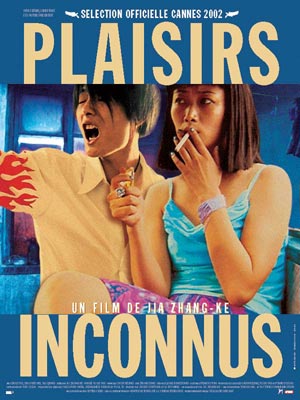
Unknown Pleasures (Ren Xiao Yao) (2002) Distributed by e-pictures (France), Bitters End and Office Kitano (Japan) and New Yorker Films (USA).
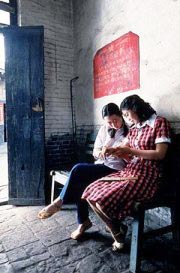
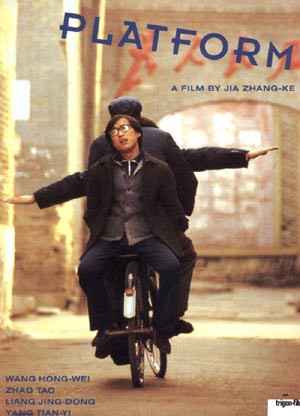
Platform (Zhantai) (2000) Distributed by Ad vitam (France) and Primer Plano (Argentina).
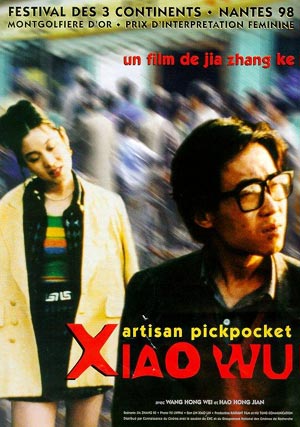
Xiao Wu (1997).
Short films
In Public (2001)
Xiao Shan Goes Home (1995)
Du Du (1995)
Independent filmmaker Jia Zhangke keeps going back to his hometown for inspiration. The result is a series of gritty, realistic films about life in a small Chinese town.
Director Jia Zhangke never smiles. Underneath his calm, cool exterior lies a burning intensity. Maybe it's his personality or maybe it's because the director is essentially unknown in China even though international critics heap praise on his films.
All three films directed by Jia -- "Xiaowu,'' "Platform'' and "Unknown Pleasures'' -- focus on the lives of young people in his hometown, Fengyang County, Shanxi Province. His films are noted for their honest portrayal of life, both good and bad, in rural China. While local reviewers and cinemagoers have said Jia's films are repetitive and visually coarse, the director remains undeterred.
"The town is where I am from,'' says the 33-year-old, who visited Shanghai late last month. "I lived there for 21 years and understand it so much. Perhaps that is my limit, but I don't want to go beyond it. As for the quality, I just shoot my hometown in a realistic way and show exactly what they are like -- the people, the street, the noise and the environment. They are the same on screen and in reality. Perhaps they don't look nice, but I can't make a portrait of the town in a comfortable way. I believe that's my way of being honest.''
Jia talks with a small gathering and answers the questions of local movie fans at DDM Warehouse, near the Bund, where all his creations have been screened. The crowd of about 50 people filled the room as the projector rolled. The audience is watching "Platform.'' On one scene, a peasant gets a contract to work at a coal mine.
Illiterate, he asks his cousin to read the contract. The paper doesn't guarantee the safety of miners, but the man still takes the job. This scene is Jia's favorite from not just "Platform,'' but all his films.
"It unveils some big differences within a small space,'' says the graduate of the Beijing Film Academy. "Some young people like the cousin are seeking their own lifestyle. However, just across the mountain, others like the miner have to make a decision of life and death. It's an impressive contrast.'' Jia's films are seen by few people in China. Those that see the independent filmmaker's movies are through film fan clubs, at minor film festivals or pirated DVDs. Jia's strength and signature is the documentary style of filmmaking. He uses non-stop long shots, amateur actors with strong accents and lots of background noise. These elements successfully create that realistic look and feel he seeks.
"The documentary function of films is nearly forgotten by most Chinese,'' says Jia. "The mainstream in the country is all about drama and entertaining programs. But the documentary format can teach a director how to observe and what to observe in real life.'' Though the documentary style looks simple and uninteresting, Jia's works are highly acknowledged by overseas critics and filmmakers. Maria Barbieri, an independent TV producer from Italy, loves Jia's movies. "His films are great,'' she says.
"With very simple technical means, he managed to portray a lot of depth. You just feel the atmosphere, those young people living in the rural environment in China.'' Barbieri mentions actor Wang Hongwei, who plays leading roles in several of Jia's films. She thinks he is ideal as the small guy who never looks people in the eyes. Moreover, she speaks highly on Jia's plots. "The story of 'Platform' is great,'' she continues.
"Any foreigner who knows little of China can see the passage of time in the 20 years that the film is talking about. 'Xiaowu' is so much like early Italian films where somebody is on the verge of accomplishing something different, but encounter many difficulties and remain the same.'' Jia entered Beijing Film Academy in 1993 and started shooting two years later. With the help of friends, he raised just under 200,000 yuan (US$24,096) for his first film "Xiaowu.'' Highly acclaimed abroad, it has won the Dragons and Tigers
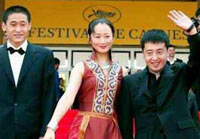
Award at the Vancouver International Film Festival, the Wolfgang Staudt Prize at the Berlin International Film Festival and the Sky Prize at the San Francisco International Film Festival. "Platform'' almost repeated the success, and "Unknown Pleasures'' has been selected as the only Chinese film to compete in this year's Cannes International Film Festival -- it knocked out big-name Chinese directors Zhang Yimou and Sun Zhou.
Sylvie Levey, a French freelance writer, feels emotional when watching Jia's productions. "These films are the best I've ever seen,'' she says. "They are so Chinese, so realistic and so powerful, with no fake stuff at all. Though those characters or scenes look quite 'tu' (unsophisticated), they make audiences understand something underneath the surface. And that's part of Chinese culture.'' Currently Jia is preparing the script for his next film, which he says will be something different.
"Unknown Pleasures' was the ending of my previous phase,'' he says. "I'll restart from scratch to make my next movie, with new methods and production modes. But I shall stick to the same theme and same people. I am excited about it and will try my best to make it accessible to domestic audiences.''
People can only hope that the talented director delivers on his promise.
Despite some critics belief that he focuses on rural themes too frequently, independent director Jia Zhangke doesn't apologize.
Unseen lives
Like all movie directors, Jia Zhangke wants his movies to be seen. But instead of luring audiences into cinemas, he is trying to get his movies into Chinese cinemas.
Although his three feature movies and his documentaries have won awards in many international movie festivals, they have never been shown in public cinemas in China.
Jia directed his first feature work in 1998. The movie entitled, "Xiao Wu", tells of the experience of a pickpocket in Jia's hometown Fenyang of North China's Shanxi Province.
"Cahiers du Cinema", the leading French movie magazine, said "Xiao Wu" showed the revival and vigour of Chinese films. It won two awards at the 48th Berlin International Movie Festival and other awards in France, Canada, Italy and South Korea.
The movie was released in 25 countries and made a large profit but it failed to achieve a showing in China and the Chinese movie-going public has not been able to see it.
His two other works, "The Platform" (2000) and "Unknown Pleasures" (2002), met with a similar fate. They won international awards but were not released at home.
Ambivalence
The only channel for ordinary Chinese audiences to access his work is through the "pirate market". Jia believes that this has cut box office receipts by one third. However, he has divided feelings about pirate DVDs. "I won't refuse any audience even if that infringes upon my rights," he said.
"I have sent the script for my next movie to the SARFT (State Administration of Radio, Film and Television) for assessment," Jia said. He was speaking in the DDM warehouse, a non-commercial art centre where he was discussing "Unknown Pleasures" with the art house audience.
Jia looked pale in front of the small audience of around 100. Later he explained that he had only had one-hour's sleep the previous night. It was a rare opportunity for him to face an audience in China and he considered every question carefully and answered them with sincerity.
"It is not a problem with movie censorship, but rather with bureaucracy," he said. "I have felt the changes in the system, with movies like "Purple Butterfly" and other experimental works shown in public. Chinese movie-making is being industrialized now and that is why I want to make movies for the public."
True to life
Jia's reputation was built largely on his documentary style, with large amount of TV news, pop music, natural sound effects and local dialects. And most of all, he used untrained amateur actors. "As long as you make the plot reasonable to actors, they can accept the story and the character, and act it out," Jia said.
But he has also often been criticized for his "coarse" style.
An artist has limitations, he admitted. And he doesn't intend to surpass this limitation. "The more powerful try to break through but were deserted by the audience just because of the attempt."
Although traditionally Chinese movie audiences paid little attention to documentaries, Jia believed that the documentary remains avant-garde.
Since the 1990s, young Chinese have started to observe and record real life through the camera lens, thanks to the arrival of digital video. Their work, shown in private salons and galleries, is gradually changing Chinese people's expectations of movies.
Jia was one of the young movie makers shooting their first documentary pieces while still students majoring in Movie Theory at the Film Academy of Beijing. His early work gained some attention and helped him to get investment from Hong Kong to make "Xiao Wu".
Unlike his previous works, depicting marginal characters - social drop-outs and petty criminals in his under-developed hometown of Fenyang - Jia decided to shift his lens to the urban scene.
Also, he gave more consideration to the rules of the market, providing a good story and refined production.
But he will still stick to the realistic style and go on portraying the experiences of country folk in the city.
"You can't make up for the missed lessons of life," Jia said. He lived in Fenyang until he was 21. "By 21, one already knows about oneself." It was in his adolescent years that the desire to express himself first sprouted.
Childhood pains
"I composed poems, tried painting, and finally found movie-making," said the director, now 33. "All my desire to tell stories came from my hometown." Jia believes that the vital element in his movies is the depiction of "truthful inner experience."
The greatest pain he ever felt was the hardship of his early years. The poverty pervasive in the Chinese countryside left a strong mark on his memory. "For a whole winter, the main food we had to eat was only sweet potato. I hated that."
Although he was born into a teacher's family - his father was a school teacher and mother a shop assistant - his family helped with farming in busy seasons.
In summer for the wheat harvest, everybody was given a reaping hook to work in the fields. "There was nothing lyrical about the work. It was all sweat. The back hurt very much at night," Jia recalled.
After he went to Beijing, Jia felt a pervasive prejudice against peasants. "My classmates often said, 'That is just like a peasant', which made me uncomfortable."
"The country scene is the background of China and of the Chinese people," Jia said. "I am ready to admit my origins. I am proud of where I am from but I don't want to glorify it with lyricism. I just don't want to break my link with the earth."
Like Zhang Yimou whose early works depicted backward rural life, Jia was also accused
of catering to Western interest in a poorly developed and uncivilized China.
"China has many realities. I picture the reality I know. It may not represent the general situation of Chinese culture," Jia said.
Jia's home province of Shanxi used to be an important coal supplier for the whole country but that resource is drying up now. "My hometown has been sacrificed, left far behind by the great changes in society and I happened to live here," he said. "I don't know any other reality."
"I can't depict my hometown in a way people feel comfortable about." The dust, the low houses, the cold factories are fully revealed in his realistic film-making and story-telling.
But instead of viewing his characters through a "cold lens", he shows deep sympathy for them. "I identify with them. The life I pictured was my untaken road. I used to be one of them."
Like his characters, he used to wander on the main street in town, with nothing to do. Every shop played pop music, which was a novel entertainment in his experience. He goes back home often, not as a celebrity and avant-garde movie director, but just as: "the guy is back again". Many of his actors he actually found among his fellow townsfolk.
"You know how relaxed it is to live among a crowd when everybody around knew what you were like at three years old," he said.
Posters:
Xiao Wu
Platform
Unknown Pleasures
(eastday.com December 5, 2003)