The Fourth Session of the Ninth National People's Congress (NPC), China's top law-making body, opened at the Great Hall of the People on March 5. At 9:00, Li Peng, executive chairman of the session and an executive member of the session presidium, announced the opening of the session, and invited Premier Zhu Rongji delivered a report of the draft outline of the country's 10th Five-Year Plan for economic and social development.
Achievements in 9th-Five Year Plan
The people of all nationalities united and worked hard and made great achievements during the Ninth Five-Year Plan Period (1996-2000), despite the complicated situation at home and abroad, said Premier Zhu Rongji.
Premier Zhu Rongji said that the national economy experienced a sustainable, rapid and healthy development and the overall national strength continued to grow.
Over the five years, China's GDP increased by an average annual rate of 8.3 percent to reach 8.9404 trillion yuan by 2000. The target of quadrupling the 1980 per capita GNP was met ahead of time. Thanks to the sustained economic growth and improved efficiency, the state revenue reached 1.338 trillion yuan by 2000, averaging an annual growth of 16.5 percent.
He announced that China's output of major industrial and agricultural products now stands in the front ranks of the world's economies, and commodity shortages were by and large eliminated in the country.
The quantities of grain and other major agricultural products we are capable of producing increased noticeably, marking a historic change from a long-term shortage to a basic balance in total supply and demand, with even a surplus during good years.
Zhu went on to say that progress was made in industrial restructuring. Good results were achieved in eliminating outmoded industrial production capacity, reducing excess production capacity and upgrading technology in key enterprises.
Significant advances were made in the establishment of a modern corporate structure in large and medium-sized state-owned enterprises. Most key state enterprises became corporations, and a considerable number of them were listed on stock markets in or outside China.
There was a marked reduction of losses and increase of profits in enterprises, and total profits from state-owned industrial enterprises and from the industrial enterprises with a controlling share held by the state reached 239.2 billion yuan in 2000, 2.9 times the 1997 figure. The objectives of reforming large and medium-sized state-owned enterprises and turning around loss- generating operations within three years were basically attained.
The market system continued to improve; the state macro- regulation system was further strengthened; information technology and other new- and high-tech industries grew rapidly; and marked success was achieved in infrastructure development.
During the period, China opened wider to the outside world, and the pattern of all-round opening took shape, the premier said, noting that reform of the foreign trade system steadily progressed, and the internationally-oriented economy grew rapidly.
The total volume of China's imports and exports reached 474.3 billion US dollars in 2000, with exports accounting for 249.2 billion US dollars, a rise of 69 percent and 67 percent respectively over the 1995 figures.
In the meantime, foreign investment was increased and better utilized in China. More than 289.4 billion US dollars in foreign funds were put to use during the past five years, an increase of 79.6 percent over the period of the Eighth Five-Year Plan. China's foreign exchange reserves totaled 165.6 billion US dollars at the end of 2000, 92 billion US dollars more than at the end of 1995.
In the period, Chinese people's living standards continued to improve, and generally people began to lead a relatively comfortable life, Zhu said.
In 2000, the per capita net income of rural dwellers and the per capita disposable income of urban residents reached 2,253 yuan and 6,280 yuan, respectively, increasing by 4.7 percent and 5.7 percent annually in real terms.
There was abundant supply of commodities in China, with the level of consumption rising steadily and the total volume of retail sales of consumer goods increasing by an average annual rate of 10.6 percent. Housing, telecommunications, electricity and other aspects of living conditions for both urban and rural residents improved considerably. Personal savings deposits of residents increased by more than 100 percent over the past five years and their financial assets, including stocks and bonds, increased rapidly.
The number of people below the poverty line in the rural areas decreased drastically. The objectives set in the seven-year plan (1994-2000) to help 80 million people get out of poverty were basically attained.
On the issue of the development of science, technology and education, Zhu said that "Program 863", a high technology development program, was implemented successfully. A number of major results were achieved in the fields of aeronautics and astronautics, information technology, materials science, bioengineering and other high technologies. New advances were made in basic and applied research.
The transformation of applied research institutes under government departments into enterprises has basically been accomplished, and restructuring of other research institutes has been carried out in a comprehensive way. The process of marketization and industrialization of scientific and technological achievements was accelerated.
He said that progress was made in strengthening various types of education at all levels. Initial success was achieved in fulfilling the objectives of making nine-year compulsory education basically universal in the country and eliminating illiteracy among young and middle-aged people. Major progress was made in the reform of the management system of higher education. The increase of university and college enrollment was widely appreciated by the general public.
New advances were made with regard to population growth and family planning. Great efforts were made in ecological conservation and environmental protection. Culture, public health, sports and other social undertakings continued to develop. Successive results were achieved in building a clean and honest government and in the struggle against corruption. The administration of all facets of public security was improved.
New progress was made in promoting socialist cultural and ethical progress, democracy and the legal system. Continuing progress was made in modernizing national defense and the armed forces.
During the Ninth Five-Year Plan period, the premier said, the Chinese government resumed its exercise of sovereignty over Hong Kong and Macao, and historic progress was made in the great cause of peaceful reunification of the motherland.
Since the return of Hong Kong and Macao to the embrace of the motherland, the principle of "one country, two systems" and the basic laws of the two regions have been implemented in a comprehensive way. Outstanding achievements were made in the work of the governments of the special administrative regions. Social stability and economic development were secured in Hong Kong and Macao.
He pointed out that these tremendous achievements in economic and social development during the Ninth Five-Year Plan period were hard-won victories over numerous difficulties.
China successfully coped with the challenges posed by unexpected international events and protected itself from the impacts of the Asian financial crisis. The country controlled inflation during the initial stage of the Ninth Five-Year Plan and curbed deflation in the middle and late stages.
China also conquered severe floods and droughts. "We attained these achievements thanks to the timely and correct policy decisions made by the CPC Central Committee with Comrade Jiang Zemin at its core in the face of numerous problems and difficulties and to the concerted efforts of the people throughout the country," he noted.
Macro-Economic Control
China has accumulated a wealth of experience in macro-economic control and regulation in the process of executing the Ninth Five-Year Plan for National Economic and Social Development (1996-2000), said Premier Zhu Rongji.
In the report, the premier summed up the following experience:
-- Revolving problems on the road of advance by way of development.
Development is the hard and fast principle. Persistence in making economic development the central task and in adopting effective measures to stimulate a sustainable, rapid and healthy development of the national economy provides the foundation for handling properly all contradictions.
Persisting in doing a good job of both material and spiritual civilization and in promoting democracy and the legal system provides the comfortable social environment and strong motivation to economic development.
-- Timely adjustment of the thrust and strength of macroeconomic control policies in the light of changes in economic situation.
In controlling inflation, persistence in maintaining economic growth paves the way to "soft landing"; while coping with deflation, persistence in the policy of expanding domestic demand and introduction of the proactive fiscal policy by issuing both additional state treasury bonds and expanding investment to encourage consumption gives a big pull to economic growth.
-- closely combining expansion of domestic demand with restructuring.
The government increased investment in agriculture and science, technology and education and supported the technical transformation of enterprises. It accomplished something big that had not been accomplished for years by taking advantage of surplus production capacity of capital goods.
-- Properly handling the relations among reform, development and stability.
Instead of stopping, reform continued, actively and orderly, amidst complicated and difficult situations, giving a powerful impetus to economic development. At the same time, the government paid high attention to protecting the basic interests of the people by introducing the re-employment projects and ensuring the issue of basic living allowances for laid-off workers and pensions for retired workers. The government also introduced the open-end purchasing of grain from farmers at the protective prices. All these helped maintain good social stability and sustainable economic growth.
Social, Economic Problems
The Premier said numerous problems exist in China's economic and social life.
According to the premier, China suffers from an inappropriate industrial structure and non-coordinated development of local economies, a low overall quality of the national economy, low competitiveness on the international market, imperfections in the socialist market economy and conspicuous systematic factors hampering the development of productive forces.
He also acknowledged a comparatively backward state of science, technology and education and relatively weak innovative ability in science and technology in the country.
Moreover, he said, China suffers from a shortage of important resources such as water and petroleum and the deterioration of the ecological environment in some regions, growing employment pressure, slow income increase of farmers and some urban residents, an increasing income gap and considerable disorder in some areas of the market economy.
The country has also witnessed frequent occurrences of grave accidents, serious corruption, extravagance and waste, formalism and bureaucratism; and poor public order in some localities, the premier noted.
Zhu explained that causes for these problems are rather complicated, but that they are not unrelated to shortcomings and errors in government work. He pledged to pay greater attention to these problems and take further steps to solve them.
Principles for New 5-Year Plan
Making development the central theme; concentrating on economic restructuring; making reform and opening up and technological progress the driving force for economic growth; making improvement of the people's living standards the prime goal; and coordinating economic development with social development.
These are five guiding principles for the Tenth Five-Year Plan for National Economic and Social Development (2001-2005) listed by Premier Zhu Rongji Monday in his report.
The premier briefed NPC deputies on the rationale of the five guiding principles for the new five-year plan.
Referring to the principle of "making development the central theme", the premier stressed a balance between a high growth rate and good economic returns and the need to attain fairly rapid growth by improving economic returns.
Sound economic growth must be based on strong market demand and good economic returns. This is a fundamental principle, he said. Based on an overall analysis of conditions in all sectors of the economy, "we have set the target for the average annual economic growth rate in the Tenth Five-Year Plan period at around seven percent," he said.
Though slightly lower than the actual growth rate of the Ninth Five-Year Plan period, which is 8.3 percent, it is still fairly high, according to the premier.
Arduous efforts have to be made to attain this target through better economic performance, he stressed.
On the principle of "concentrating on economic restructuring", he said that China has already reached a point where it cannot further develop its economy without making structural adjustments.
Under the old economic structure and its crude manner of growth, products would not be marketable, and it would be impossible to sustain resources availability and preserve the environment, he noted. "We must adjust the economic structure in the process of developing the economy and maintain a relatively rapid growth in structural adjustments," he said.
In the next five years, efforts should be intensified to adjust the industrial structure, regional economic structures and economic structures in urban and rural areas, with emphasis on the industrial structure, according to the premier.
On the principle of "making reform and opening up and technological progress the driving force" for economic growth, Zhu said that the success of both economic development and structural adjustment depends on institutional, scientific and technological innovation.
In the next five years, "we must unswervingly pursue reform, open China wider to the outside world, and break down institutional obstacles to the development of productive forces," he said. This will provide a strong impetus for economic and social development, he added.
"We should give priority to the development of science, technology and education and further implement the strategy of developing China through science and education," the premier stressed.
Explaining the principle of "making improvement of the people's living standards the prime goal," he said that raising the people's living standards in both urban and rural areas is the basic goal of economic development and a crucial factor for expanding domestic demand and stimulating sustained economic growth.
"We must give priority to raising the people's living standards. To accomplish this we must create more jobs, increase personal income, distribute income more equitably, improve the social security system, and ensure a more comfortable life for the people, " he said.
On the principle of "coordinating economic development with social development," the premier called for great efforts to promote socialist cultural and ethical progress, democracy and the legal system; balance reform, development and stability; accelerate development of various social undertakings; and ensure social stability.
Agriculture, Farmers' Income
Zhu Rongji said that the government must put it on top agenda to strengthen agriculture as the country's economic foundation and increase the income of farmers in the next five years.
Accelerating restructuring of agricultural production and the development of the rural economy is the fundamental way to improve economic returns in agriculture and increase farmers' income, the premier said.
While effectively protecting cultivated land and stabilizing grain production capacities, China needs to restructure the patterns of farming, focusing on improving strains, quality and economic returns.
Great efforts need to be exerted to promote the industrial management of agricultural production, to support leading enterprises, and to spread the practice of farmers working with companies or producing crops on a contract basis, Zhu said.
"We need to develop industries for processing, storing and transporting agricultural products and keeping them fresh in order to gain better returns from intensive processing of agricultural products," he said.
Small towns and cities need to be expanded, and steady progress needs to be made in urbanization in order to increase job opportunities and sources of income for farmers, he noted. "In restructuring agriculture, we need to proceed in the light of local conditions and follow the principles governing the development of the market, and we need to protect farmers' right to independence in production and operation and refrain from pressure and coercion," he said.
The premier called for actively promoting reforms in rural areas. While keeping the system of stable, long-term land contracts as a foundation, localities where conditions permit should be encouraged to explore a land operation rights transfer system, he said.
Zhu went on to say that the system of administrative fees and taxes in rural areas needs to be reformed by raising the current rates of agricultural tax and special agricultural product tax where it is appropriate, and at the same time abolishing all administrative fees imposed exclusively on farmers, such as contributions to township and village public accumulation funds.
This is a sound policy for safeguarding the legitimate rights and interests of farmers and reducing their burden, he stressed. As a result of the reform of taxes and administrative fees, it will be necessary to decrease the number of administrative bodies and employees in towns and townships, and reduce the number of village and group functionaries receiving government subsidies, he said.
China needs to continue to deepen financial reform in rural areas and actively seek a financial system that helps stimulate rural economic development, according to the premier. The Agricultural Bank of China and other financial institutions should also give more support to agriculture and the rural economy, he said.
Zhu urged all localities to step up the construction of agricultural and rural infrastructure. More investments need to be made to accelerate the harnessing of big rivers and lakes, he said, stressing that no time should be lost in constructing pivotal projects on major rivers and reinforcing decaying reservoirs to improve their flood-control, flow-management and storage capabilities.
China needs to increase the construction of power grids, telecommunications, radio and television installations, roads and water supply facilities in rural areas to improve production, living and marketing conditions there.
On continuing to fight poverty in rural areas, the premier said that although the seven-year national program (1994-2000) to help 80 million people out of poverty has been basically fulfilled, it will be an arduous task for a long time to bring about a fundamental change for the better in poverty-stricken areas.
"Priority needs to be given in our anti-poverty endeavor to ethnic minority areas in central and western China, the old revolutionary base areas, border areas and destitute areas," Zhu said. Assistance to the poor needs to continue to be development- oriented, he added.
He said that more funds need to be put into anti-poverty efforts in every possible way. "We need to expand the scale of programs that provide jobs as a form of relief and support efforts in poverty-stricken areas to improve the infrastructure there," he noted.
Optimizing Industrial Structure
The Premier has called for energetically optimizing and improving the industrial structure, stressing that readjusting and improving the industrial structure is the key to a strategic restructuring of China's economy.
China should enhance its traditional industries with high, new and advanced technologies, Zhu said, urging to pay close attention to the restructuring and reform of traditional industries.
He noted that in these industries enterprises are the main entities, and they should be directed by the market and supported by technological advances. He proposed taking the following measures:
First, China needs to increase product variety, improve product quality, save energy, reduce waste, prevent and control pollution, and increase productivity. These measures are most important in energy, metallurgical, chemical, machinery, automobile, building materials, construction, textile and light industries. Support should be given to a number of key enterprises for technological renovation to improve their technology and equipment.
Second, China needs to speed up the development of universal, key and accessory technology that can stimulate structural advancement by depending on both domestic innovation and imported technology. It needs to stimulate equipment manufacturing and design and build complete plants of large, advanced and highly- efficient equipment urgently needed in China.
Third, in major industries, China needs to encourage the establishment of a number of large companies and enterprise groups through stock listing, merging, association and reorganization. Such companies and groups need to have their own intellectual property rights, core products and a strong central leadership, and they should become key players and pillars in industrial readjustment and advancement.
Fourth, China needs to support and promote renovation of old industrial bases, fully utilizing their strong foundation and concentration of talent to raise their production levels. At the same time, the country needs to take economic, legal and necessary administrative measures to continue closing down plants and mines that produce shoddy goods, waste resources, cause serious pollution, or operate under unsafe conditions.
Outmoded and surplus production capacity needs to be abandoned or reduced. Relocation and reconstruction of these outmoded facilities will be prohibited. Enterprises that have been in the red for long with little hope of recovery and whose debts exceed assets should be allowed to go bankrupt, and mines with exhausted resources should be closed.
The premier called for developing new and high-tech industries, and using information technology to stimulate industrialization.
"In accordance with actual situations, we need to selectively stimulate development of new and high-tech industries such as information technology, bioengineering and materials science. We need to lend support to important high-tech projects, such as high- speed, wide-band information networks, key integrated circuits and new-type carrier rockets in order to strengthen China's new and high-tech industries on an overall as well as individual basis," he said.
He urged intensifying construction of water conservation, transportation, energy and other infrastructural facilities and attaching great importance to strategic issues concerning resources. China needs to put water conservation high on its work agenda, establish a rational pricing mechanism, comprehensively adopt water conservation technologies and measures, develop water- efficient industries, and raise the entire society's awareness of water conservation. he noted.
Prevention and control of water pollution should be strengthened, he stressed. "We need to expedite the planning and building of projects to divert water from the south to the north," he said.
The premier said that energy, oil in particular, is of strategic importance. Domestic development and production of oil can no longer keep pace with the needs of the country's economic and social development, resulting in an increasing imbalance between oil supply and demand, Zhu said.
"Therefore, we need to take all possible measures to conserve oil, accelerate exploration and exploitation of oil and natural gas resources, and make effective use of overseas resources," he said. China needs to institute a system for preserving strategic resources such as oil as soon as possible, he added.
China needs to vigorously carry forward the renovation of large coal mines, construct highly productive and efficient mines, and place special emphasis on the exploitation of clean coal, according to Zhu. While making full use of existing power- generating capacity, China needs to develop hydroelectric power and build large-scale thermal power plants near coal mines, reduce small thermal power stations, and moderately develop nuclear power, he said.
Emphasis should be placed on the development of all types of new energy, Zhu said, noting, "We should further reform the power management system, gradually allow power plants and grids to operate separately, and institute bidding for power supply."
Zhu urged accelerating the development of China's service industry. This is an important avenue for stimulating economic restructuring and increasing employment, he said
He also called for actively developing modern service industries, such as information services, banking, accounting, consulting and law.
Up-to-date management and technology should be applied to renovate traditional service sectors, such as internal and foreign trade, transportation and municipal services, to improve their quality and efficiency, according the premier.
More Big Projects in Next 5 Years
In the coming five years, China will invest heavily in a number of projects of strategic significance, including transmission of natural gas and electricity from western to eastern regions, the planned Qinghai- Tibet Railway, the Beijing-Shanghai High-Speed Railway, and a project to diver river water from south to north.
This was revealed in a draft of the Outline of the Tenth Five- Year Plan for National Economic and Social Development (2001-2005), which was presented to deputies attending the Fourth Session of the Ninth National People's Congress (NPC), which opened Monday.
In a report on the outline, the premier called for paying great attention to building infrastructure and improving the ecological environment during the next five years.
According to official reports, the project to transmit natural gas from western to eastern regions centers on a 4,200 km-long pipeline. It transports natural gas, both for household and industrial use, from the Tarim Basin in the Xinjiang Uygur Autonomous Region, to Shanghai Municipality, east China, via Gansu Province, the Ningxia Hui Autonomous Region and Shaanxi, Shanxi, Henan, Anhui and Jiangsu provinces. The first phase of the gas project is scheduled to begin this year and finish by 2003, with a cost of 120 billion yuan.
The project to transmit electricity from western to eastern regions aims to provide the developed eastern and coastal areas, which suffer from severe shortages of power supply, with electricity from the energy-abundant western areas. The project is expected to cost over 100 billion yuan.
The planned Qinghai-Tibet Railway, linking Golmud, Qinghai Province, with Lhasa, the capital of Tibet Autonomous Region, is 1, 118 km in length, which is to bring an end to Tibet's history of not having a single inch of railway.
China has completed a feasibility study on the construction of the Beijing-Shanghai High-Speed Railway and plans to raise funds from different channels to cover a total cost of around 100 billion yuan.
After decades of research, the project to diver river water from south to north has entered the stage of planning. Diversion routes are to be located in eastern, central and western parts of the country.
to be continued












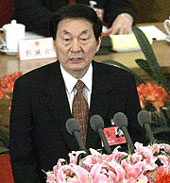 The Fourth Session of the Ninth National People's Congress (NPC), China's top law-making body, opened at the Great Hall of the People on March 5. At 9:00, Li Peng, executive chairman of the session and an executive member of the session presidium, announced the opening of the session, and invited Premier Zhu Rongji delivered a report of the draft outline of the country's 10th Five-Year Plan for economic and social development.