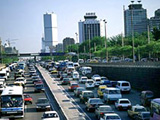
"Beijing's traffic situation is a complete nightmare!" "Beijing is one giant parking lot at rush hour!" "Walking is often faster than driving!"
Complaints like these continue to mount as the number of automobiles in the Chinese capital surpasses two million, a figure previously targeted for 2010 by the city's development plan.
Yu Xiao, a 28-year-old office worker who commutes daily by bus from the southwestern suburban district of Fengtai into downtown Xidan, described a typical journey.
"Traffic seldom flows smoothly, and although the main thoroughfare in my neighbourhood is a two-lane road, it's used more as a three- or four-lane highway," said the young woman.
At 7:35 am, bicycles and pedestrians can be seen weaving their way between buses and taxis moving, slowly, in all directions. Yu boarded her bus 20 minutes earlier, but it has gone just two kilometres in that time.
"It's always at a standstill," said Yu. "You may not think it's such a big deal, seeing it for the first time, but how would you feel if you had to sit in this same traffic on your way to work every single morning?" Yu complained.
Jiang Hua, a middle-aged university teacher who works in the Haidian District but lives in Shunyi 40 kilometres across town, purposely gets up earlier and leaves his office later to avoid the traffic jams.
"I won't attempt to describe the gridlock on Beijing's streets at rush hour, because I do everything imaginable to stay off the roads during those times," said Jiang.
Every day, Jiang gets to his office around 7 am, before the main morning rush begins, and although he can leave around 5 pm, the beginning of the evening rush hour, Jiang usually has dinner and a few drinks until things calm down around 8 pm before heading home.
But the complaints do not tell the whole story. Beijing has experienced a rapid increase in road construction, expressways in particular, over the past few years.
Ten years ago, it often took nearly half a day to travel from central Beijing to the suburban Tongzhou District by public transport. Today, however, the same distance can be covered in less than an hour. The number of roads Beijing has built since 1998 alone exceeds all those constructed in the previous 20 years. These roads radiate in all directions, connecting Beijing and its suburban areas, as well as neighbouring provinces and municipalities, into an integral transportation network. Thanks to convenient transport facilities, the ancient capital city seems to be getting smaller and smaller as it becomes more modern.
But how did the traffic problem start?
One survey has been quoted as saying that overly cautious women drivers were to blame. But transport department officials in Beijing stress that only one in four drivers is female.
And they added that women were more inclined to observe the rules of the road than their male counterparts. They urged men to follow their example.
With a history stretching back more than 3,000 years, Beijing has been the nation's capital for 800. In a display of imperial power, old Beijing was constructed like a chessboard, with the most important structures protected at the centre. All roads stopped outside the walls of the royal palace; none ran through the city.
But after 1949, the incomplete roads were linked one by one, laying a foundation for Beijing's development. However, limited by historical factors in general, and national resources in particular, a complete road network was never built. Touring Beijing then via public transit was time consuming. Visitors often marvelled at the "vastness of Beijing".
But as times changed, so did transportation in the city. The number of registered motor vehicles in use has increased from 600,000 in 1990 to two million at the beginning of August.
Road construction, in contrast, lags far behind.
Rarely does a day go by without a traffic jam, local residents complain, especially drivers. Traffic tie-ups have become a major daily headache for Beijingers.
"There is a traffic jam at..." and "Drivers, please take another road" are phrases routinely broadcast by the city's Traffic Control Centre over the radio.
Historical Factors
Because Beijing enjoys such a large influx of visitors every year, the number of passengers carried by public transit amounts to several billion annually, many times the entire population of China.
The constrained traffic conditions are the result of historical factors, as well as the city's physical make-up and infrastructure. For instance, incorporating a multitude of functions, the central area of Beijing includes the seats of both the central and municipal governments, commercial districts and residential quarters. Hence, a centripetal traffic structure is formed, with the bulk of vehicular and passenger flows moving towards the central area.
Moreover, the road network in the central area is far from rational, with bicycles and cars travelling side by side on many roads. The situation is further aggravated by the fact that about 80 per cent of all vehicles registered in Beijing are on the road every day, a rate four times that of Tokyo and other large international cities.
In early 1998, after repeated deliberations and verifications by experts, the Beijing municipal government decided to shift its focus for municipal construction from urban districts to suburban areas, and from expansion of the city proper to adjusting and transforming the urban structure.
It also decided that along with accelerating construction of a rapid mass transit system between the urban districts and the suburbs, efforts would be concentrated on building a modern urban communication system based on public and fast transport facilities.
Experts note that Beijing lacks communication lines from the central area and that distances between ring roads are unreasonably long.
Zhang Zhuting, a professor at the Beijing School of Transportation Management, said the lack of sub-routes and feeder roads has handicapped the functions of the newly built expressways and urban arteries. Many cars travelling just a short distance squeeze onto the expressways, reducing the speed of the entire traffic flow. Zhang said Beijing is coming up with plans to solve this problem in the near future.
Fast-track Solution
The urban road network currently under construction will consist of expressway, main and feeder road systems. Of these, the expressway system will be of the highest standard with the largest transportation capacity possible. All expressways will be built as three-dimensional, fully enclosed through lines without a single traffic light. Thus, the system will ensure high-speed, continuous traffic flow, and smooth communication between urban districts and suburban areas.
Beijing will build a fast road system without intersections, encompassing the second, third, fourth, fifth and sixth ring roads and 15 feeder lines. Another 15 arteries will stretch out from the central area to link the fast roads. Experts emphasize that, in order to complete this road system, construction on four major systems must be accelerated. These are the road, priority public transportation line, transit stop and public traffic control systems.
Experts believe that developing a fast urban public transit system is the best way to ease transportation pressures in the central area.
Gao Yang, a senior engineer with the Transportation Planning Institute under the Beijing Municipal City Planning and Design Institute, said that at a total length of 300 kilometres, the quasi-high-speed public transportation network would cover almost all urban districts in Beijing area.
Specialists also note that Beijing has limited land resources to accommodate road construction, and future modern urban road networks must conform to requirements implemented to preserve those unique qualities that make Beijing what it is, an ancient capital city grounded in history. Therefore, municipal construction planning departments must put the focus on developing a three-dimensional road network, including metro lines, flyovers and underground and overhead pedestrian crossings.
The south-north communication situation, which has plagued Beijing for many years, will be greatly improved after construction of two new metro lines. Accessing the busy commercial districts of Dongdan and Xidan, the two lines will encourage more people to travel underground, thus reducing surface traffic. A U-shaped urban light rail links the newly developed residential quarters in northern Beijing to metro facilities.
By 2006, Beijing's metro lines will extend from the current 53 kilometres to cover 138 kilometres. In order to build a more scientific and advanced metro system, Beijing is inviting experts from around the world to suggest revisions and improvements to its current metro construction plans. The overall planned metro length will be increased from 408 kilometres to more than 600.
(China Daily HK Edition September 5, 2003)
|