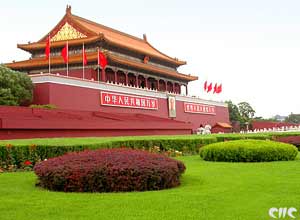
Tian'anmen Gate was the principal entry to the Imperial Palace during the Ming and Qing dynasties.
It is one of the finest monumental gates in the world, extraordinary for its imposing size. Ornamental Columns (huabiao), stone lions and white marble bridges decorate the front.
Early in the Ming Dynasty, a wooden memorial gate covered in yellow glazed tiles was built on the present site. Known as the Gate of Receiving Grace from Heaven (Chengtianmen), it burned down, and was later rebuilt in 1465 during the reign of the Ming Emperor Xianzong.
At the end of the dynasty, when the peasant leader Li Zicheng, who had defeated Ming forces, was driven out by Qing troops, many buildings were destroyed. The Gate of receiving Grace from Heaven burned again, leaving only the foundation of its walls.
In 1651, under the Qing Emperor Shunzhi, the gate tower was rebuilt in the original style and renamed Tian'anmen -- the Gate of Heavenly Peace. Today it retains the basic character of the early Qing gate.
The base of Tian'anmen, pierced with five arched gateways and set on a foundation of white marble, stands 10 meters high. It is built of huge bricks, each weighing approximately 24 kilograms. On top of this massive structure stands a palace like gate tower with its roof top 33.7 meters above the ground. A low wall surrounding the gate tower encircles a white marble balustrade which frame the gate tower on four sides. The roof is covered with the same imperial yellow glazed tiles found on every building in the Imperial Palace.
On the roof ridges is a menagerie of animals purported to protect the palace and its inhabitants from danger. Prominent among these are 10 carved dragon heads at the ends of the main roof and at each corner of the double roof.
Just before the southern entrance to Tian'anmen, seven arched bridges, shaped like curving jade belts, cross the Golden River (Jinshuihe). The central bridge is slightly wider than the rest and forms part of the Imperial Way -- the path over which only the emperor could pass.
One of the more unusual features of Tian'anmen is a pair of 10 meter high white marble columns (huabiao) topped by a "dish for collecting dew." A carved stone animal known as a "heaven gazing hou"(a small, lion like legendary creature) squats inside each dish. These dishes were used to catch the "jade dew" imbibed by the emperor to ensure long life. According to the legend. The "heaven gazing hou" watched over the emperor's activities when he was away from the palace, hoping he would not overindulge in his pleasures. If the emperor did not return in good time, the creatures would warn him, "Your Majesty, you mustn't spend so much time enjoying yourself. Hurry back and attend to state affairs! We've nearly worn our eyes out waiting for your return!" The "heaven gazing hou" are also called "Watching for the Monarch's Return," and the stone columns, the "Watching Columns."
Below is a pair of carved stone lions, one with his paw on an embroidered ball, the other playing with a cub. That the king of beasts should be reduced to an obedient watchdog in the presence of the emperor is a clear sign of the Son of Heaven's supreme authority.
Tian'anmen was off limits to commoners as the main entrance to the Imperial Palace during the last two dynasties. Several hundred meters in from stood the "Great Ming Gate." Between the two ran the Imperial Way.
The Great Ming Gate was opened only on the following ceremonial occasions:
--At the winter solstice, when the emperor offered sacrifices to heaven at the Temple of Heaven.
--At the summer solstice, when he sacrificed to the earth at the Altar of Earth.
--In the second month of the lunar calendar, when he proceeded to the Altar of the God of Agriculture (Xianongtan) to plow furrows in the sacred field.
--In early spring, when he sacrificed to the God of Grain.
The emperor's procession was a major undertaking. From Tian'anmen, the roads along his route were sprinkled with water to settle the dust and yellow earth spread to ensure a proper appearance and avert traffic accident. Thousands of officials and soldiers lined the road, and at the appointed time, the five gateways of Tian'anmen were thrown open. The emperor, clad in his dragon robes, passed through the central gateway seated in his grand sedan chair. Civil and military officials marched fore and aft. The imperial banners fluttering, ceremonial guard armed with a forest of flags and weapons presented a truly awe-inspiring sight.
In old China, the most exciting celebration at Tian'anmen was that after the triennial imperial examinations. An "imperial dragon canopy" was erected to the east, and the top three candidates lined up to be summoned to an imperial audience. The entire body of new officials presented themselves behind the top candidates before the official written list of successful scholars. There beneath the canopy, the prefect of Beijing presented the top scholar with a golden emblem for his hat and red silk to drape over his shoulders. The successful candidates were then received at the city yamen (government office in feudal China) for a celebratory feast.
There were also the imperial trials. The accused, who had already been subjected to severe torture, were led to kneel before the magistrate's bench on the western side of the gate. The magistrate would ask the accused questions at random and then mark the man's name in red to indicate death sentence. Execution was carried out immediately. If a man were lucky, he would receive a year's reprieve, and his relatives, who had been waiting to one side, would rush forward to hang a string of hawthorns around his neck, congratulating him on his good fortune.
Tian'anmen also served as the site for proclamations of state celebrations such as the enthronement of an emperor imperial marriages. A proclamation platform was set up above the central gateway. Imperial edicts, attached to the mouth of a Golden Phoenix (in Ming times. They were tied with colored rope to a dragon head on the end of a pole), were lowered onto a "cloud plate" held by officials from the Ministry of Ceremonies who stood before the gate tower. The edicts were later sent to the Ministry of Ceremonies where they were copied onto imperial yellow paper by special scribes and dispatched throughput the empire.
Ironically, the imperial edict announcing the abdication of the last Qing emperor, Puyi, on December 25, 1911, was issued by Empress Dowager Longyu in the traditional fashion. No finer mockery of the "Divinely Appointed Son of Heaven" can be imagined.
In 1900, the columns before the gate were damaged by the cannon fire of the Eight-Power Allied Forces. Then, in July 1937, when the Japanese occupied Beijing, they nailed a sign calling for the establishment of a "New East Asian Order" to the walls of Tian'anmen. Tian'anmen fell into disrepair, the red paint peeling from its walls, window lattices left broken and gaping, the once colorful decorations streaked and dulled. Weeds sprouted in the cracks and along the roof line.
Changing times brought a new face to Tian'anmen. On the afternoon of May 4, 1919, several thousand students from Peking University and 13 other institutions raised their voices here. They came to protest the signing of the Treaty of Versailles by Chinese representatives and the Northern Warlord government's traitorous policies against the country. Their demonstration marked the start of the May 4th Movement and set the sage for the founding of the Communist Party of China.
On December 9, 1935, Beijing students marched again to Tian'anmen, this time in opposition to the Japanese invasion of northern China and the Kuomintang's policy of non-resistance. Over 10,000 people participated, calling for an end to the civil war and the formation of a united front against the foreign invaders. From 1945 to 1949, Tian'anmen was frequently the meeting place for members of progressive student movements, an undying legacy to this day.
In 1949, Tian'anmen regained its former grandeur through a complete renovation. The square has been widened to 40 hectares and is now one of the largest public squares in the world.
Address: On the Chang’an Boulevard, west of Wangfujing;
Entry ticket for the rostrum: 15 yuan;
Traffic: Subway Line 1, Bus No.s 1, 2, 4, 5, 10, 20, 22, 52, 57, or walk over from Qianmen or Wangfujing.
(China.org.cn)
|